On this page
- 01Key takeaways
- 02Does your budget change which platform to choose?
- 03Which channels still give organic reach?
- 04What is a minimum viable paid budget?
- 05What should paid spend actually do?
- 06When is organic genuinely enough?
- 07What does this look like in practice?
- 08How long should a paid test run?
- 09Next step
- 10Sources and further reading
- 11Frequently asked questions
Key takeaways
Choose channels that match your budget position. With no budget, pick channels where distribution is earned. With budget, page-based feeds become viable. Spending £100 a month across three platforms achieves nothing on any of them.
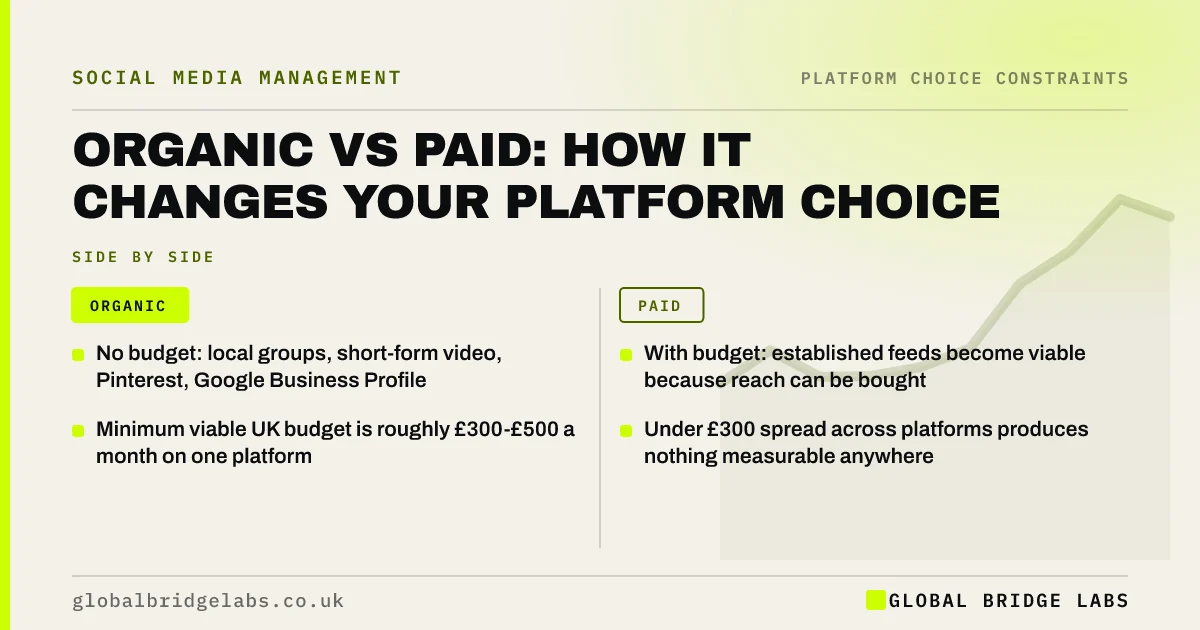
- No budget: local groups, short-form video, Pinterest, Google Business Profile.
- With budget: established feeds become viable because reach can be bought.
- Minimum viable UK budget is roughly £300-£500 a month on one platform.
- Under £300 spread across platforms produces nothing measurable anywhere.
- Paid amplifies what works organically. It does not fix content that does not.
Unsure whether you need budget for your channel? Ask us on WhatsApp.
Chat on WhatsApp →Does your budget change which platform to choose?
Substantially, and this is usually left out of channel comparisons. On some platforms organic distribution still exists for good content; on others, page-based reach has been squeezed to the point where the channel is effectively a paid one.
Choosing a pay-to-play channel with no budget is the most reliable way to conclude that social media does not work. The channel was never going to work under that constraint, and no amount of content quality changes it.
Which channels still give organic reach?
Broadly, the ones where the feed is interest-based rather than follower-based, plus anything that behaves like search.
- Short-form video: still shows good content to strangers without spend.
- Community groups: entirely organic. Nobody can buy their way into a recommendation.
- Pinterest: search-driven, so pins keep working without amplification.
- Google Business Profile: free visibility at the moment of intent.
- Page-based feeds: organic reach to your own followers is now a fraction.
What is a minimum viable paid budget?
Roughly £300 to £500 a month on one platform for a UK small business, sustained for at least three months. Below that, the system does not gather enough data to optimise and you are paying for learning that never completes.
The critical rule is concentration. £300 on one platform will teach you something; £100 each on three teaches you nothing about any of them and produces three disappointing reports. If your budget is under £300, run it on one platform or save it until it is not.
We will tell you whether your budget is enough to be worth spending. Ask on WhatsApp.
Chat on WhatsApp →What should paid spend actually do?
Amplify what already works, or reach people who could never have found you organically. Those are the two legitimate jobs, and neither of them is fixing content that does not perform.
A post that produced enquiries organically is proven; putting budget behind it is low risk. A post that produced nothing organically will produce nothing more expensively. Paid social is a multiplier, and multiplying zero is still zero.
When is organic genuinely enough?
When you serve a small geographic area, when your sector has active communities, or when your buyers search rather than browse. In those situations budget adds speed rather than capability.
It is not enough when you need scale quickly, when your category is dominated by advertisers, or when your product needs to be explained to people who are not looking for it. Recognising which situation you are in saves a year of frustration either way.
What does this look like in practice?
A UK specialist pet food retailer spent £120 a month split across three platforms for a year, and could not tell whether any of it worked because none of them had enough data to report on.
Consolidating the same £120 into one platform, behind a single product post that had already sold well organically, produced a measurable return within two months. The budget did not change. The concentration did, and concentration is what made the spend legible.
How long should a paid test run?
Three months minimum on one platform, because the first four to six weeks are mostly the system learning who to show your advertising to.
Stopping at four weeks because the numbers look poor is the most common way a UK small business concludes that paid social does not work for them. It frequently means the campaign was switched off during the period where it was still calibrating.
Set the budget at a level you can sustain for that full period before you start. A three-month commitment at £300 a month teaches you something usable; a single £900 month teaches you almost nothing and spends the same money.
Change as little as possible during those three months. Every edit to targeting or creative restarts part of the learning, which is the second most common reason a small budget produces nothing.
Next step
Decide your budget position before you pick a channel. If it is zero, choose from the organic list and commit. If you have £300 or more, put it all on one platform behind something that has already worked.
Message us on WhatsApp and we will match your channel choice to your budget.
Chat on WhatsApp →Sources and further reading
- Meta Business Help Centre · Meta
- Tips to improve your local ranking on Google · Google Business Profile Help
Frequently asked questions
Do you have to pay for social media to get results?
Not on every platform. Short-form video, local community groups, Pinterest and a Google Business Profile all still offer distribution you earn rather than buy. Page-based organic reach on the large established feeds is now effectively pay-to-play for most business accounts, whatever the content quality.
What is a minimum social media advertising budget in the UK?
Roughly £300 to £500 a month on a single platform, sustained for at least three months. Below that the system cannot gather enough data to optimise properly, and splitting a small budget across several platforms produces nothing measurable on any of them.
Should you boost posts that did not work organically?
No. Paid social amplifies something that already works, or reaches people who could never have found you organically. A post that produced nothing without spend will produce nothing more expensively with it, because multiplying zero still gives you zero.
When is organic social media enough on its own?
When you serve a small geographic area, when your sector has genuinely active communities, or when your buyers search rather than browse. It is not enough when you need scale quickly, or when your category is dominated by competitors who advertise heavily.
Written by
Global Bridge Labs (GBL) is a UK–Sri Lanka partner for social media, websites and BPO. Everything here comes from client delivery, not theory.