On this page
- 01Short answer
- 02What makes business photos look amateur?
- 03Which five shots should you take of everything?
- 04How should you handle light?
- 05What about editing?
- 06When is stock photography acceptable?
- 07How do you get permission on site?
- 08How do you photograph work that is not attractive?
- 09Next step
- 10Sources and further reading
- 11Frequently asked questions
Short answer
Good social media photography for a small business needs daylight, a clean background, and five repeatable shot types. Equipment is almost irrelevant above a modern phone. What makes photos look amateur is clutter, mixed lighting and inconsistent editing, all of which are free to fix.
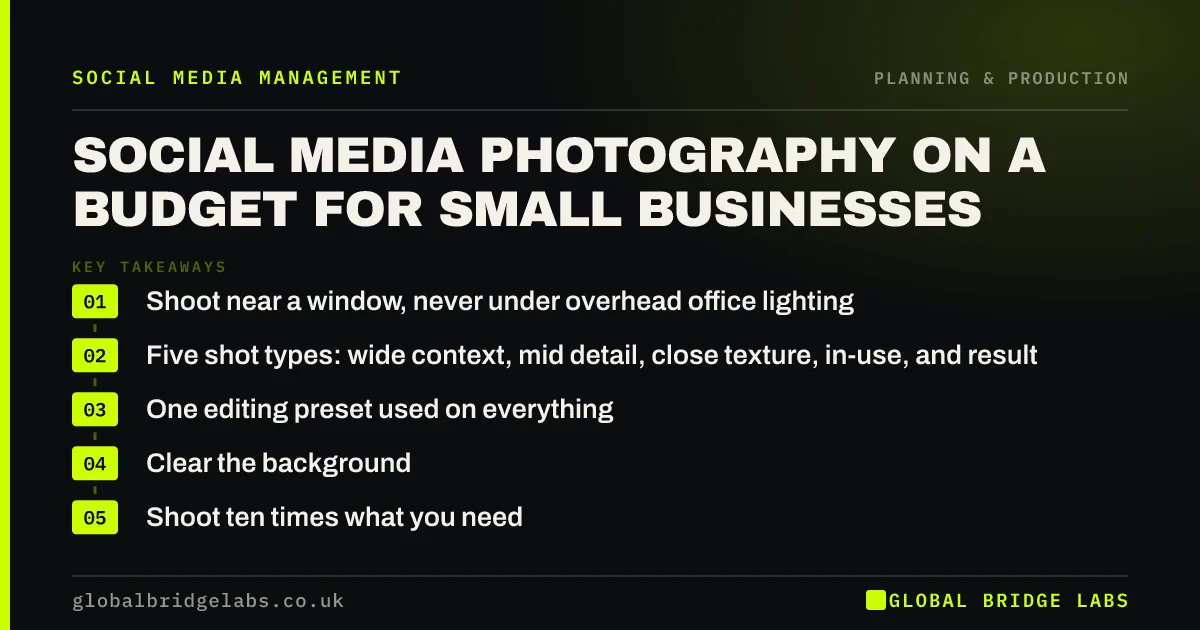
- Shoot near a window, never under overhead office lighting.
- Five shot types: wide context, mid detail, close texture, in-use, and result.
- One editing preset used on everything. Consistency reads as professional.
- Clear the background. Most amateur photos are ruined by what is behind the subject.
- Shoot ten times what you need. Storage is free; a second trip is not.
Want a shot list for your next job or product batch? Message us on WhatsApp.
Chat on WhatsApp →What makes business photos look amateur?
Four things, in order of frequency: a cluttered background, mixed light sources, a subject photographed from standing height, and inconsistent colour across a feed.
None of them are camera problems. A phone in daylight against a tidy background, shot from the subject's own level, produces images that hold up next to work from a paid shoot for social purposes.
Which five shots should you take of everything?
Use the same sequence for a finished job, a product, a dish or a workspace. It takes four minutes and produces a week of content from one subject.
- Wide: the whole thing in its context, so people understand what they are looking at.
- Mid: the part that matters, framed cleanly.
- Close: texture and quality detail, the bit a buyer would run their hand over.
- In use: a person interacting with it, even partially in frame.
- Result: the outcome, ideally with something for scale or comparison.
How should you handle light?
Face the light, do not stand in front of it. Position the subject so a window is in front of them and you are between the window and the subject. That single adjustment fixes most underexposed business photos.
Avoid mixing daylight with fluorescent or warm interior lighting, which produces colour casts that no amount of editing corrects convincingly. On site, outside on an overcast day is close to ideal, because cloud cover is a very large softbox.
What about editing?
Pick three adjustments and apply them identically to everything: exposure, contrast and warmth. Save it as a preset. Consistency across a grid is what makes a feed read as considered rather than collected.
Avoid heavy filters, and never use different filters on different posts. The most common self-inflicted damage to a small business feed is six months of photos that each look like they came from a different company.
Send us six recent photos on WhatsApp and we will tell you the two adjustments that would lift all of them.
Chat on WhatsApp →When is stock photography acceptable?
Rarely, and never for your own work. Stock images of generic offices and handshakes actively harm a small business, because buyers recognise them and the implication is that you had nothing real to show.
The defensible uses are abstract backgrounds behind text, illustrative concepts in educational posts, and locations you genuinely cannot photograph. Even then, your worst real photo usually outperforms the best stock image for trust.
How do you get permission on site?
Ask at the point of quoting, not on the day. A line in your quote or booking confirmation saying you photograph completed work for marketing unless the customer opts out removes almost all friction and gives you a record.
For commercial sites, check whether the client has restrictions before you arrive, and never photograph anything showing security arrangements, personal data on screens, or identifiable people without consent. Under UK GDPR, identifiable individuals in marketing photography require a lawful basis, and consent is the cleanest one for a small business.
How do you photograph work that is not attractive?
Most business work is not photogenic, and that is a framing problem rather than a subject problem. A loft full of insulation, a server rack, a spreadsheet on a screen: none of them look good, and all of them can carry a post.
Three techniques do most of the work. Shoot the contrast, so the old and the new sit in one frame. Shoot the hands, because human activity reads as skill in a way an object does not. And include something familiar for scale, so the viewer understands the size of what they are looking at.
Where the subject genuinely cannot be photographed, use an annotated screenshot or a simple diagram. An image that carries information beats an attractive image that carries none, and anything the image says should also appear in the text.
- Shoot the contrast: old and new in one frame.
- Shoot the hands, not only the object.
- Include something for scale.
- Use annotated screenshots or diagrams when the work is invisible.
Next step
Photography is the cheapest quality improvement available to most small business feeds, and it is almost entirely process rather than equipment.
Message us on WhatsApp for a shot list and editing preset built for your business.
Chat on WhatsApp →Sources and further reading
- Lawful basis for processing personal data · Information Commissioner's Office
- Meta Business Help Centre · Meta
Frequently asked questions
Do I need a professional camera for social media?
No. A phone from the last four years exceeds what social platforms display, since images are compressed on upload anyway. Spend the budget on lighting and background instead, which affect the result far more than sensor quality does.
How do I make phone photos look professional?
Shoot in daylight with the light in front of the subject, clear the background, get down to the subject's level, and apply the same three edits to every photo. Consistency across a feed reads as professional more than any single image does.
Is stock photography bad for small businesses?
For showing your own work, yes. Buyers recognise stock images and read them as a sign you had nothing real to show. It is acceptable as an abstract background behind text or for illustrating a concept you genuinely cannot photograph.
Do I need permission to photograph a customer's property?
Yes, and the easiest way is a line in your quote or booking confirmation stating that completed work is photographed for marketing unless the customer opts out. Never photograph identifiable people, security arrangements or personal data without explicit consent.
Written by

Global Bridge Labs (GBL) is a UK–Sri Lanka partner for social media, websites and BPO. Everything here comes from client delivery, not theory.