On this page
- 01Key takeaways
- 02What does an in-house web developer cost?
- 03What does an agency cost?
- 04When does an in-house web developer make sense?
- 05What are the risks of a single in-house developer?
- 06Is there a middle option?
- 07What should you check in an agency?
- 08What should stay with you whichever route you choose?
- 09What does this look like in practice?
- 10Developer or agency checklist
- 11Next step
- 12Sources and further reading
- 13Frequently asked questions
Key takeaways
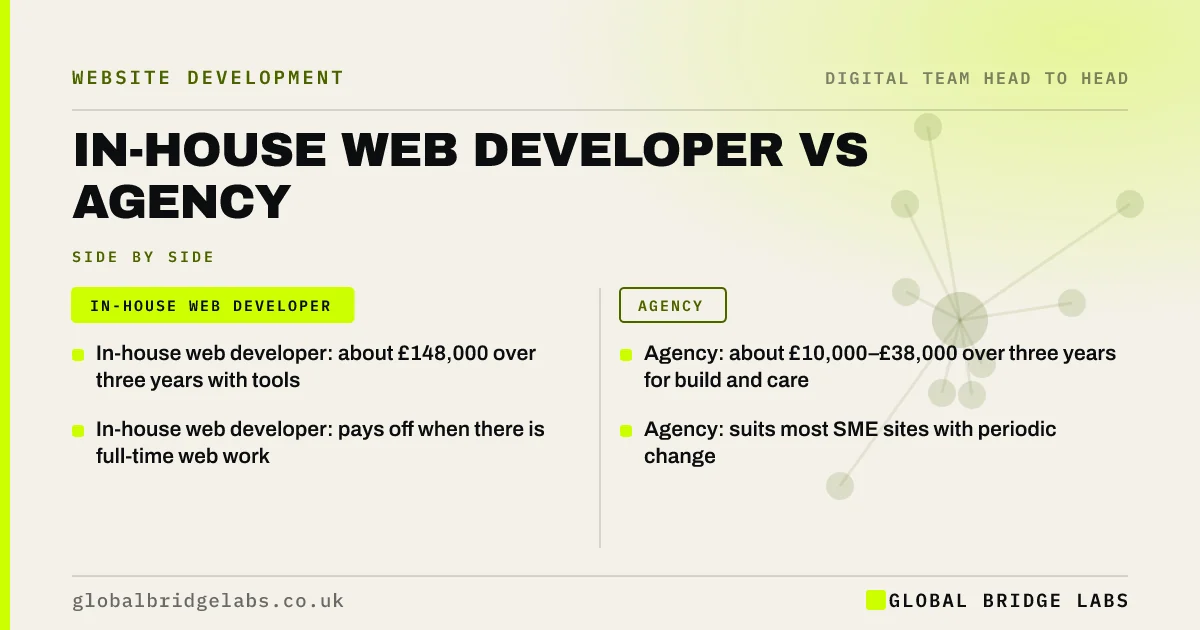
In-house web developer vs agency is decided by how much web work you have. A £40,000 developer costs about £49,300 a year with tools, or about £148,000 over three years. An agency build of £5,000–£20,000 plus care at £150–£500 a month costs roughly £10,000–£38,000 over the same period. A hire pays only when web work is constant.
- In-house web developer: about £148,000 over three years with tools.
- Agency: about £10,000–£38,000 over three years for build and care.
- In-house web developer: pays off when there is full-time web work.
- Agency: suits most SME sites with periodic change.
Want your web costs compared over three years? Message us on WhatsApp.
Chat on WhatsApp →What does an in-house web developer cost?
A web developer on £40,000 costs about £46,263 a year in employment costs using 2026/27 rates. Add equipment, software and hosting tools, about £3,000, for about £49,300 a year, before recruitment. Over three years that is about £148,000. Check salaries for your area and skill level; ONS earnings data gives a reference.
What does an agency cost?
As typical UK ranges, an agency-built lead generation site costs about £5,000–£20,000, and care with regular changes about £150–£500 a month. Over three years, build plus care comes to roughly £10,000–£38,000. Ad hoc work is often charged at £50–£100 an hour.
Want an agency plan priced against a hire? Send us your site and change volume on WhatsApp.
Chat on WhatsApp →When does an in-house web developer make sense?
When there is enough web work to keep a developer busy all year: an e-commerce business shipping weekly changes, a product with a customer portal, or many sites and landing pages. At that point, internal speed and context are worth the fixed cost.
What are the risks of a single in-house developer?
One developer is one point of failure. If they leave, knowledge of the code, hosting and passwords can leave with them. They also cannot cover every skill, from design to SEO to security. Document the set-up and make sure the business owns every account.
Is there a middle option?
Yes. A marketing or operations person makes content changes in the CMS, and an agency handles builds, technical changes, security and performance on a care plan. This covers most SMEs at a fraction of a developer salary.
What should you check in an agency?
That you will own the domain, hosting account, code and content; that response times are written into the care plan; and that the agency measures what the site produces, such as enquiries, not just uptime. Ask for examples of sites they maintain and how they handle urgent fixes.
What should stay with you whichever route you choose?
Ownership and access. Keep the domain registration, hosting account, analytics, Search Console and code repository in the business's name, with at least two people in the business holding admin access. Keep a short document of how the site is built and deployed. These make any change of developer or agency straightforward.
What does this look like in practice?
A pattern we see in UK trades businesses: a relative or junior hire built and runs the site, but changes take weeks and nobody measures enquiries. An agency rebuild focused on conversion, followed by a care plan, costs far less than a developer. Across GBL website clients we have seen a 2.4x enquiry rate from this kind of work.
Developer or agency checklist
Use these steps to decide.
- Estimate web work hours per month for the next year.
- Cost a developer fully loaded over three years.
- Get agency quotes for build and care.
- Check who owns every account and the code.
- Decide who makes day-to-day content changes.
Next step
Tell us how much your website changes and what it needs to produce. We will cost a developer and an agency over three years in a 30-minute call.
Message us on WhatsApp for a developer vs agency comparison, or book a 30-minute consultation.
Chat on WhatsApp →Sources and further reading
- Rates and thresholds for employers 2026 to 2027 · HM Revenue & Customs
- Earnings and hours worked, occupation by four-digit SOC: ASHE Table 14 · Office for National Statistics
- Updating WordPress · WordPress.org
Frequently asked questions
Is it cheaper to hire a web developer or use an agency?
For most SMEs, an agency. A £40,000 developer costs about £148,000 over three years with tools, while an agency build plus care typically costs about £10,000–£38,000 over the same period. A hire pays off only when there is enough web work to keep a developer busy all year.
Does a small business need an in-house web developer?
Rarely. Most small business sites change periodically, which suits an agency care plan plus someone in-house making content updates in the CMS. Businesses shipping web changes weekly, running customer portals or managing many sites may justify a dedicated developer. Review the decision once a year as the site grows.
What happens if my in-house developer leaves?
Knowledge of the code, hosting and accounts can leave with them. Keep every account in the business's name, document the set-up and deployment process, and consider an agency relationship as back-up so someone can step in quickly if the developer is unavailable.
Can an agency work alongside an in-house developer?
Yes. A common split is an in-house developer for day-to-day changes and product work, with an agency for design, larger builds, security reviews or extra capacity at busy times. Agree who owns deployment and code review so work does not clash.
Written by

Global Bridge Labs (GBL) is a UK–Sri Lanka partner for social media, websites and BPO. Everything here comes from client delivery, not theory.