On this page
- 01Key takeaways
- 02How long will people actually wait?
- 03What does the research say about patience?
- 04Why does patience vary by visitor and task?
- 05Does showing progress buy more time?
- 06When will visitors wait longer?
- 07What does this look like in practice?
- 08Visitor patience checklist
- 09Next step
- 10Sources and further reading
- 11Frequently asked questions
Key takeaways
Most visitors will wait a few seconds for a website to load, and fewer with every second after that. There is no single cut-off. Patience depends on how much they need what is on the page, what else is one tap away and whether anything visible is happening. Plan for two to three seconds on mobile and treat anything longer as lost visits.
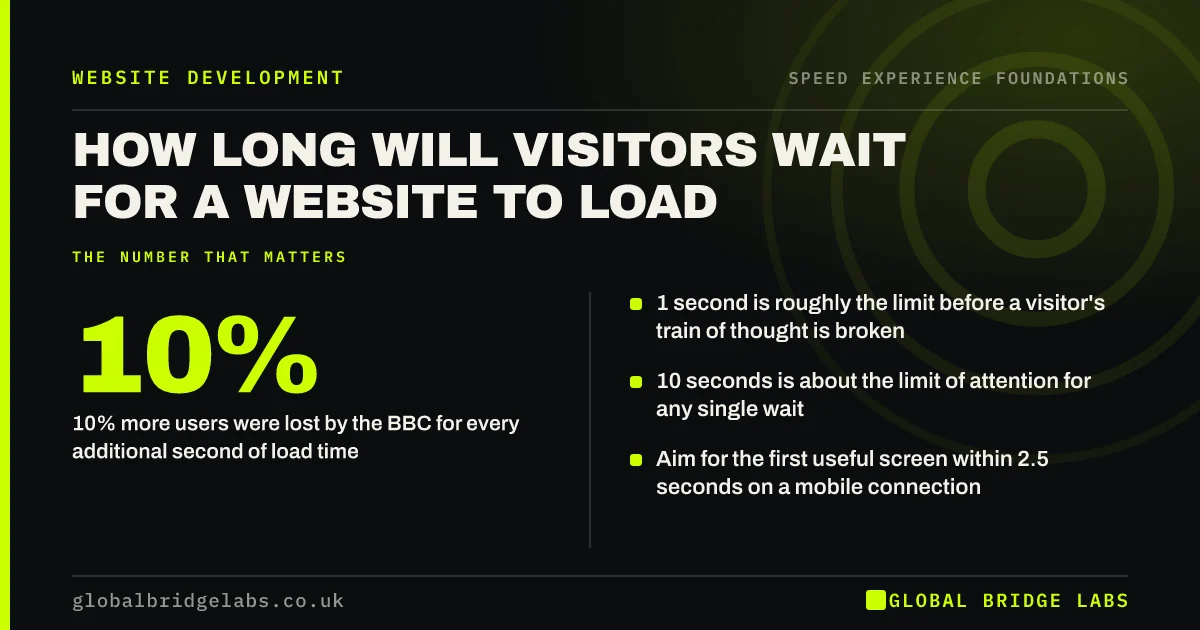
- 10% more users were lost by the BBC for every additional second of load time.
- 1 second is roughly the limit before a visitor's train of thought is broken.
- 10 seconds is about the limit of attention for any single wait.
- Aim for the first useful screen within 2.5 seconds on a mobile connection.
Not sure how long your customers are waiting? Send us the URL on WhatsApp.
Chat on WhatsApp →How long will people actually wait?
People wait as long as the page seems worth it, which for an unfamiliar business from a search result is very little. The clearest published figure comes from the BBC, which found it lost an additional 10% of users for every extra second its pages took to load. That is a steady drain, not a cliff.
You will often see a claim that 53% of mobile visits are abandoned after three seconds. It comes from Google research published in 2016, on networks and phones of that period. The direction still holds. Quote the exact figure with care, because Google no longer hosts the original page.
What does the research say about patience?
The Nielsen Norman Group describes three response time limits that have held for decades. Up to 0.1 seconds, a response feels instant. Up to 1 second, the visitor notices a delay but stays focused on the task. At around 10 seconds, attention wanders and people start doing something else.
For a website, that means delays under a second are forgiven, delays of a few seconds are tolerated when the visitor is motivated, and anything approaching ten seconds needs a progress indicator or it will be abandoned. Google's own target of 2.5 seconds for the main content sits deliberately in the tolerated range.
Why does patience vary by visitor and task?
Patience follows need and alternatives. A customer checking a delivery they have already paid for will wait. A stranger comparing three plumbers from a search page will not, because the next result is one tap away.
- Existing customers tolerate more than first-time visitors.
- Paid and social clicks are the least patient, because the visit was an interruption.
- Urgent needs cut patience on arrival but raise it once the answer is visible.
- Mobile visitors on weak signal expect some delay, but blame the site if nothing shows.
- Returning to a page that was slow last time lowers patience further.
Does showing progress buy more time?
Yes. A wait with visible progress feels shorter than a blank one, and visitors stay longer when something is clearly happening. Showing the headline and a button while images load, or a simple 'sending your enquiry' message after a form is submitted, buys seconds that a blank screen would not.
It only works when the progress is real. A spinner that runs for eight seconds teaches people that the site is slow. Use feedback to cover delays you cannot remove, and remove the ones you can.
Want to know where your visitors give up? Ask us on WhatsApp for a walk-through on a real phone.
Chat on WhatsApp →When will visitors wait longer?
Visitors wait longer when the task is important and they have already invested effort. Someone at the final step of a booking, or logging in to an account, will tolerate a pause that would have ended a first visit. That is not a reason to relax. It means the cost of slowness on those steps is frustration and support calls instead of a silent exit.
There is also a limit to how far speed work pays. Below about two seconds for the first screen, most visitors stop noticing, and further gains change little.
What does this look like in practice?
A pattern we see with local services: analytics shows a large share of mobile sessions lasting only a second or two, and the owner assumes those visitors were not interested. Many of them never saw the page. They tapped a search result, watched a blank screen and went back to pick the next business.
Getting the headline, phone number and one button on screen quickly, before the gallery and the map, turns some of those lost seconds into visits. Across client work at Global Bridge Labs (GBL), we have seen a 2.4x enquiry rate from conversion changes like these.
Visitor patience checklist
- Time the first useful screen on a phone over mobile data.
- Check the share of very short mobile sessions in analytics.
- Compare landing pages from ads with pages from search.
- Add visible feedback to every form and button.
- Fix any wait that approaches ten seconds first.
- Stop optimising pages once the wait is no longer noticed.
Next step
The question is not how long visitors will wait. It is how many you are prepared to lose each second. We will measure your key pages and show you where the waiting happens.
Message us on WhatsApp for a load-time review of your top landing pages.
Chat on WhatsApp →Sources and further reading
- Why does speed matter? · web.dev
- Response times: the 3 important limits · Nielsen Norman Group
- Website response times · Nielsen Norman Group
- Understanding Core Web Vitals and Google search results · Google Search Central
Frequently asked questions
How long will a visitor wait for a website to load?
A few seconds at most for an unfamiliar site, with more people leaving each second. The BBC found it lost an additional 10% of users for every extra second of load time. Aim to show the main content within 2.5 seconds on mobile, which is Google's threshold for a good experience.
Is the three-second rule for websites true?
As a rule of thumb, yes. As a precise statistic, treat it carefully. The widely quoted figure that 53% of mobile visits are abandoned after three seconds comes from Google research published in 2016. Networks and phones have changed since, but visitors still leave slow pages in large numbers.
Do visitors wait longer on mobile?
Not usefully. Mobile visitors expect some delay on a weak signal, but they are often in a hurry and one tap from a competitor. Because most UK web traffic is now on phones, a page that is acceptable on office broadband and slow on mobile data is slow for most of your audience.
What happens after ten seconds?
Attention moves elsewhere. The Nielsen Norman Group puts ten seconds as roughly the limit for keeping a person focused on a single wait. Any step that can take that long, such as a file upload or a payment, needs a clear progress indicator, or visitors will assume it has failed.
Written by

Global Bridge Labs (GBL) is a UK–Sri Lanka partner for social media, websites and BPO. Everything here comes from client delivery, not theory.