On this page
- 01Short answer
- 02What are the stages of a website project?
- 03Why do website projects run late?
- 04How do you keep a website project on time?
- 05Can a website be built faster?
- 06When should you not set a hard launch date?
- 07What does this look like in practice?
- 08Project timeline checklist
- 09Next step
- 10Sources and further reading
- 11Frequently asked questions
Short answer
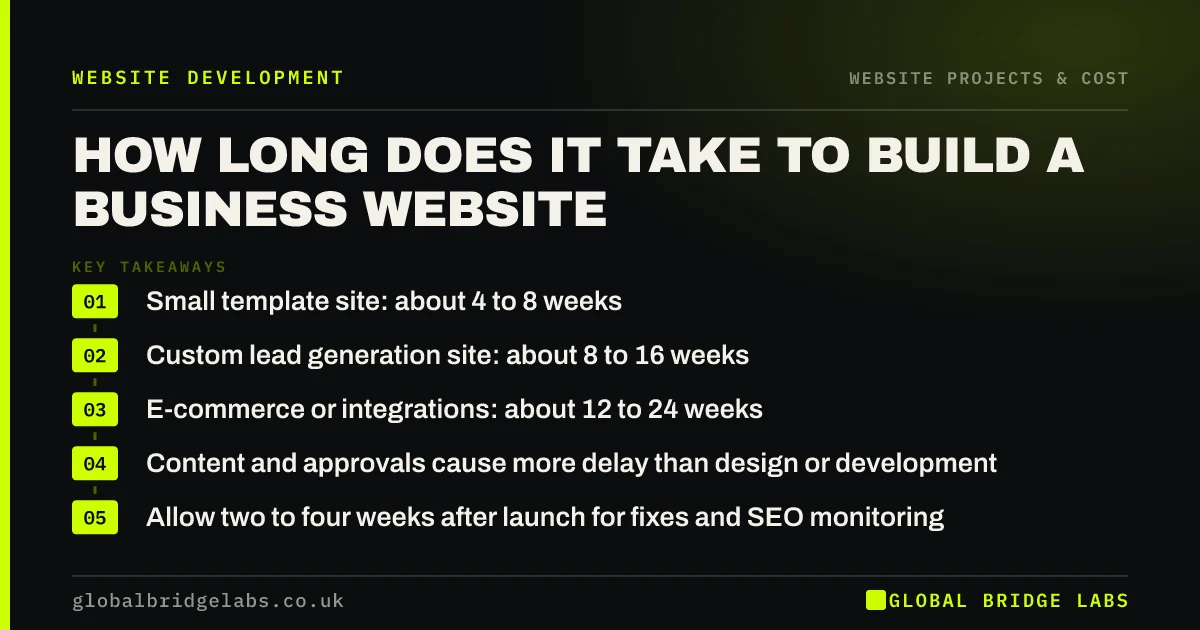
Building a business website typically takes 4 to 8 weeks for a small template-based site, 8 to 16 weeks for a custom lead generation site, and 12 to 24 weeks for e-commerce or sites with integrations. The biggest cause of delay is rarely the build. It is content: copy, photographs and decisions arriving late.
- Small template site: about 4 to 8 weeks.
- Custom lead generation site: about 8 to 16 weeks.
- E-commerce or integrations: about 12 to 24 weeks.
- Content and approvals cause more delay than design or development.
- Allow two to four weeks after launch for fixes and SEO monitoring.
Planning a launch date? Message us on WhatsApp and we will tell you whether it is realistic.
Chat on WhatsApp →What are the stages of a website project?
A website project is the sequence of work that takes a site from brief to launch and beyond: discovery, content and structure, design, build, testing, launch and post-launch improvement.
Each stage depends on decisions from the previous one, so time lost early compounds later. A week's delay agreeing the sitemap can become three weeks by launch.
- 1. Discovery: goals, audiences, sitemap and requirements (1 to 3 weeks).
- 2. Content: copy, photography, proof and pricing (2 to 6 weeks, often in parallel).
- 3. Design: key page templates and approval (2 to 4 weeks).
- 4. Build: development, integrations and content entry (2 to 8 weeks).
- 5. Testing: speed, mobile, accessibility, forms and tracking (1 to 2 weeks).
- 6. Launch and post-launch monitoring (2 to 4 weeks).
Why do website projects run late?
Most delays come from the client side, not because clients are slow, but because website content competes with running the business. Copy, photographs, testimonials and pricing decisions all need input from people who are busy with customers.
Other common causes are scope changes mid-project, too many people approving designs, and integrations with third-party systems that turn out to be harder than expected.
Supplier capacity matters too. An agency or freelancer juggling several launches may slip when another client's deadline takes priority. Ask at the start who is working on your project, what else they have scheduled, and how progress will be reported each week.
- Copy and photographs not ready when the build needs them.
- Several people giving conflicting feedback.
- New pages or features added mid-project.
- Third-party integrations with poor documentation.
- Domain or hosting access held by a previous supplier.
How do you keep a website project on time?
Start content first. Write service pages, gather reviews and book photography during discovery, not after design. Appoint one decision-maker with authority to approve. Freeze scope once design is approved, and keep a list of phase-two ideas instead of adding them.
Sort access early. Confirm who controls the domain, hosting, analytics and Search Console in the first week, because recovering access can take longer than building pages.
Want a realistic project plan with content deadlines built in? Message us on WhatsApp.
Chat on WhatsApp →Can a website be built faster?
Yes, with trade-offs. A focused launch with the homepage, core service pages, contact and legal pages can go live in two to four weeks, with further pages added in phases. That gets a better site working sooner and lets real data shape what comes next.
What should not be rushed: SEO migration for an existing site, testing of forms and tracking, and accessibility checks. Cutting those saves days and can cost months.
When should you not set a hard launch date?
Avoid a fixed date when content does not yet exist, when integrations are untested, or when the date is arbitrary. A launch driven by a date rather than readiness often means broken forms, missing redirects and a weaker site than the one it replaced.
If a date is genuinely fixed, such as a trade show or a rebrand, reduce scope to hit it and phase the rest.
What does this look like in practice?
A pattern we see often: design approved in week four, development ready in week eight, and launch delayed to week sixteen while the business writes service page copy between client jobs.
Moving copy to the start of the project, with a writer interviewing the owner for an hour per service, removes the bottleneck. The project then runs at the speed of the build rather than the speed of spare evenings.
Project timeline checklist
Agree these at the start of any project.
- Name one decision-maker.
- Confirm access to domain, hosting and analytics.
- Start copy and photography in discovery.
- Freeze scope after design approval.
- Keep a phase-two list for new ideas.
- Protect testing and SEO migration time.
- Plan two to four weeks of post-launch monitoring.
Next step
If you have a launch date in mind, we will map a realistic timeline with you in 30 minutes, including the content deadlines that usually decide whether it is met.
Message us on WhatsApp for a website project timeline, or book a 30-minute consultation.
Chat on WhatsApp →Sources and further reading
- User research · GOV.UK Service Manual
- Site moves with URL changes · Google Search Central
- Google Search Console · Google
Frequently asked questions
How long does it take to build a small business website?
Typically 4 to 8 weeks for a small template-based site and 8 to 16 weeks for a custom lead generation site, if content is ready on time. E-commerce and sites with integrations usually take 12 to 24 weeks. A phased launch can get core pages live in two to four weeks.
What slows down a website project?
Late content is the most common cause: copy, photographs, reviews and pricing decisions arriving after the build is ready. Other causes include several people giving conflicting feedback, scope added mid-project, difficult integrations, and delays getting access to the domain or hosting.
Can I launch my website in stages?
Yes, and it is often the best approach. Launch the homepage, core service pages, contact and legal pages first, then add further pages in phases. You get a better site working sooner and can use real visitor data to decide what to build next.
What happens after a website launches?
Plan two to four weeks of monitoring: check forms and tracking, watch Search Console for indexing and redirect errors, test speed on real devices and fix any issues. After that, move into a monthly rhythm of reviewing enquiries and making one improvement at a time.
Written by

Global Bridge Labs (GBL) is a UK–Sri Lanka partner for social media, websites and BPO. Everything here comes from client delivery, not theory.