On this page
- 01Key takeaways
- 02What makes a hero image convert?
- 03What should the image show?
- 04How do you keep text readable over an image?
- 05How big should a hero image be?
- 06When should you not use a hero image at all?
- 07What does this look like in practice?
- 08Hero image checklist
- 09Next step
- 10Sources and further reading
- 11Frequently asked questions
Key takeaways
A homepage hero image sells when it shows the result or the people buyers will deal with, leaves clear space for the headline, loads fast and makes sense at a glance on a phone. Stock photos of handshakes and city skylines tell visitors nothing. A real photo of your work, compressed and correctly sized, usually beats an expensive generic one.
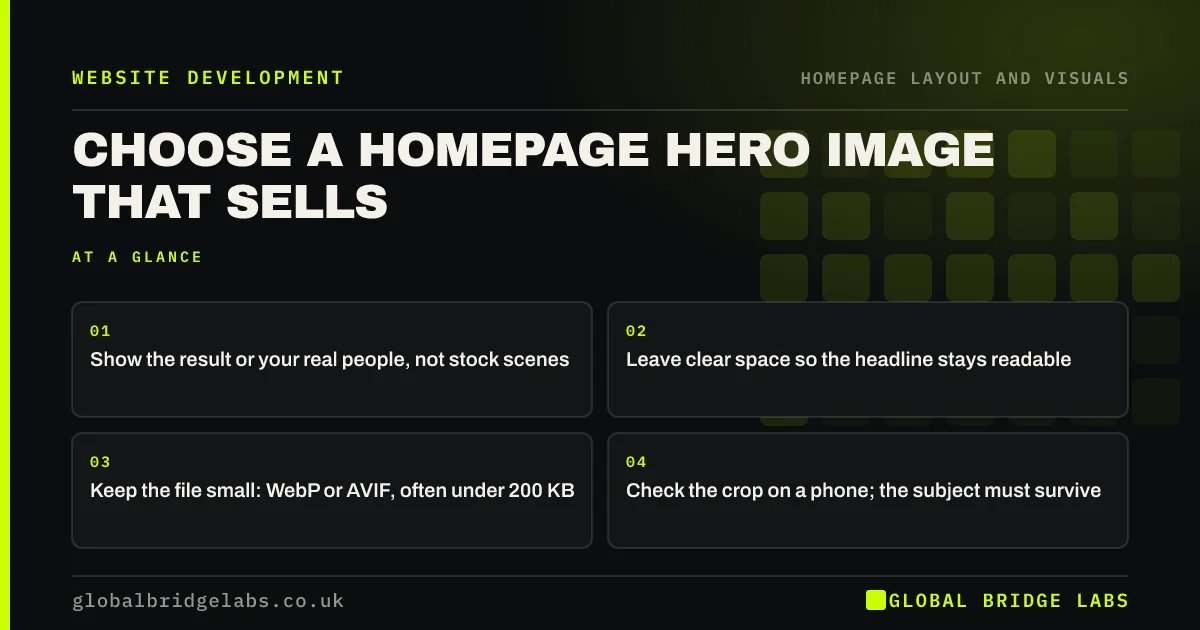
- Show the result or your real people, not stock scenes.
- Leave clear space so the headline stays readable.
- Keep the file small: WebP or AVIF, often under 200 KB.
- Check the crop on a phone; the subject must survive.
Want your hero image checked for clarity and speed? Message us on WhatsApp.
Chat on WhatsApp →What makes a hero image convert?
A hero image converts when it helps the headline answer 'what do you do and is it for me?'. A finished loft conversion, a calm treatment room or a chef plating a dish carries meaning; a stock handshake does not. Nielsen Norman Group's research found people pay attention to photos that carry information and ignore decorative stock images.
What should the image show?
Show what buyers are paying for or who they will meet. For trades, a finished job; for clinics, the room and clinician; for restaurants, the food and the room; for B2B services, your team at work. Avoid images that need a caption to make sense, and avoid people looking away from the headline.
How do you keep text readable over an image?
Choose images with a calm area where the text sits, or place text beside the image rather than on it. If text must sit on a photo, add a solid or semi-solid panel behind it so contrast meets WCAG's 4.5:1 for normal text. Never put key words inside the image itself, where search engines and screen readers cannot read them.
How big should a hero image be?
Big enough to look sharp and no bigger. Serve responsive sizes so phones get a smaller file, use WebP or AVIF, and keep the main file small; as a GBL working rule of thumb, often under 200 KB. The hero image is frequently the Largest Contentful Paint element, so give it priority loading and do not lazy-load it.
When should you not use a hero image at all?
Skip it when you have no good photo and a stock image would mislead, or when the message is strong enough on its own. A clean hero with a headline, proof line and button on a plain background often performs well and loads instantly. A bad image is worse than none.
What does this look like in practice?
A pattern we see: a 3 MB stock image of a smiling call-centre worker on a logistics firm's homepage. Replacing it with a compressed photo of the firm's own vehicles at a depot makes the page faster and tells visitors in one look what the business does.
Hero image checklist
- Show the result or your real people.
- Leave a calm area for the headline.
- Keep text out of the image file.
- Check contrast of any text over the image.
- Compress it and serve responsive sizes.
- Do not lazy-load the hero image.
- Check the crop on a phone.
Next step
Look at your hero on a phone and ask: if the headline were hidden, would the picture alone hint at what you do? If not, plan a photo of your real work.
Message us on WhatsApp for an image review, or book a 30-minute consultation.
Chat on WhatsApp →Sources and further reading
- Photos as web content · Nielsen Norman Group
- Optimise Largest Contentful Paint · web.dev (Google)
- Understanding SC 1.4.3: Contrast (Minimum) · W3C
- Responsive images · web.dev (Google)
Frequently asked questions
What makes a good homepage hero image?
One that shows the result buyers pay for or the people they will deal with, leaves space for readable text, loads quickly and still makes sense when cropped on a phone. Real photos of your work usually beat generic stock images.
What size should a hero image be?
Large enough to look sharp on the screens your visitors use, with smaller versions served to phones. Use modern formats like WebP or AVIF and compress carefully. As a rule of thumb, aim for a main file under about 200 KB.
Should I use stock photos for my hero image?
Avoid them if they show generic scenes like handshakes or skylines, because visitors recognise and ignore them. If you must use stock, choose an image specific to your service and replace it with real photos as soon as you can.
Written by

Global Bridge Labs (GBL) is a UK–Sri Lanka partner for social media, websites and BPO. Everything here comes from client delivery, not theory.