On this page
- 01Key takeaways
- 02Can a small business A/B test its homepage?
- 03When is an A/B test worth running?
- 04What should you do instead?
- 05How do you run a test without harming SEO?
- 06When should you not test at all?
- 07What does this look like in practice?
- 08Homepage testing checklist
- 09Next step
- 10Sources and further reading
- 11Frequently asked questions
Key takeaways
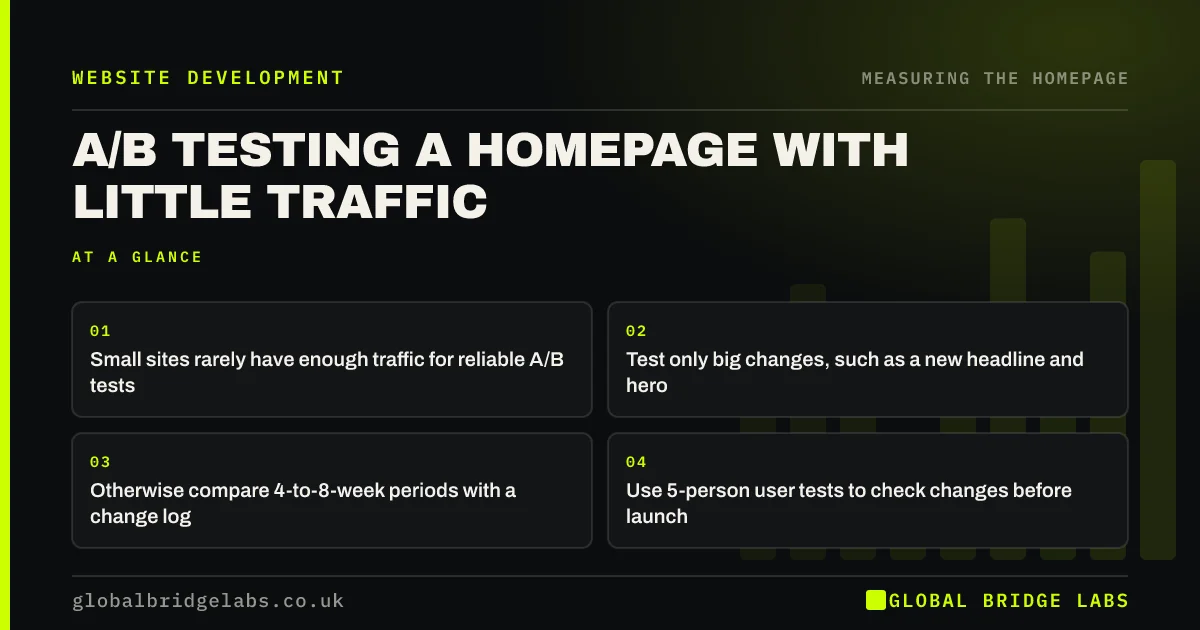
A homepage A/B test needs far more traffic than most small business sites have to detect a realistic improvement with confidence. With a few thousand homepage visits a month, test only big, bold changes, or use before-and-after comparisons over four-to-eight-week periods with a change log, user tests and a careful look at seasonality.
- Small sites rarely have enough traffic for reliable A/B tests.
- Test only big changes, such as a new headline and hero.
- Otherwise compare 4-to-8-week periods with a change log.
- Use 5-person user tests to check changes before launch.
Want to know if your homepage has enough traffic to test? Message us on WhatsApp.
Chat on WhatsApp →Can a small business A/B test its homepage?
Sometimes, but rarely in the way large sites do. An A/B test splits visitors between two versions and compares results. Detecting a modest improvement in enquiry rate with confidence needs thousands of visitors per version, and many small business homepages get a few hundred enquiry-ready visits a month.
When is an A/B test worth running?
Run one when the homepage gets enough traffic, the change is big enough to make a large difference and you can wait several weeks. A completely different headline and hero is testable; a button colour change is not, at small-business traffic levels.
What should you do instead?
Combine three lighter methods.
- Before and after: compare four-to-eight-week periods, with the change logged.
- User tests: show the new version to five target buyers before launch.
- Leading signals: watch next-step clicks, which move faster than enquiries.
How do you run a test without harming SEO?
Google's guidance on testing is to avoid cloaking, use rel=canonical on variant URLs pointing to the original, use 302 redirects for redirect tests and end the test promptly. Most testing tools handle this, but check before running a test on your most important page.
When should you not test at all?
Do not test when the current homepage has an obvious flaw, such as no clear headline or a broken form. Fix it. Testing is for choosing between two reasonable options, not for proving that a broken page is broken.
What does this look like in practice?
A pattern we see: a firm runs a button-colour test for three months and gets no clear answer, because each version received a handful of enquiries. Rewriting the headline, logging the change and comparing the next six weeks with the previous six usually gives a clearer, quicker read.
Homepage testing checklist
- Check monthly homepage sessions and key events.
- Run A/B tests only for big changes with enough traffic.
- Otherwise log changes and compare 4-to-8-week periods.
- Run a 5-person user test before launch.
- Follow Google's guidance to protect SEO during tests.
Next step
Note your monthly homepage sessions and enquiries. If enquiries are under a few dozen a month, plan before-and-after comparisons rather than A/B tests.
Message us on WhatsApp to plan your approach, or book a 30-minute consultation.
Chat on WhatsApp →Sources and further reading
- Minimise A/B testing impact in Google Search · Google Search Central
- Why you only need to test with 5 users · Nielsen Norman Group
Frequently asked questions
How much traffic do I need to A/B test my homepage?
Usually thousands of visitors per version, and enough enquiries in each, to detect a realistic improvement with confidence. The exact figure depends on your current conversion rate and the size of change you expect. Use a sample size calculator before starting.
How can I test homepage changes with low traffic?
Test big changes rather than small tweaks, compare four-to-eight-week periods before and after a logged change, watch leading signals like clicks to the next step and run quick user tests with five target buyers before launch.
Does A/B testing hurt SEO?
Not if done properly. Google advises against cloaking, recommends rel=canonical on variant pages, 302 redirects for redirect tests and ending tests promptly. Most reputable testing tools follow this guidance, but check before testing your homepage.
Written by

Global Bridge Labs (GBL) is a UK–Sri Lanka partner for social media, websites and BPO. Everything here comes from client delivery, not theory.