On this page
- 01Key takeaways
- 02What does the patient journey look like for a private clinic?
- 03What reassures patients on a clinic website?
- 04How should booking work for patients?
- 05Which rules affect clinic websites?
- 06How should the website support patients after treatment?
- 07When should a clinic keep the journey offline?
- 08What does this look like in practice?
- 09Patient journey checklist
- 10Next step
- 11Sources and further reading
- 12Frequently asked questions
Key takeaways
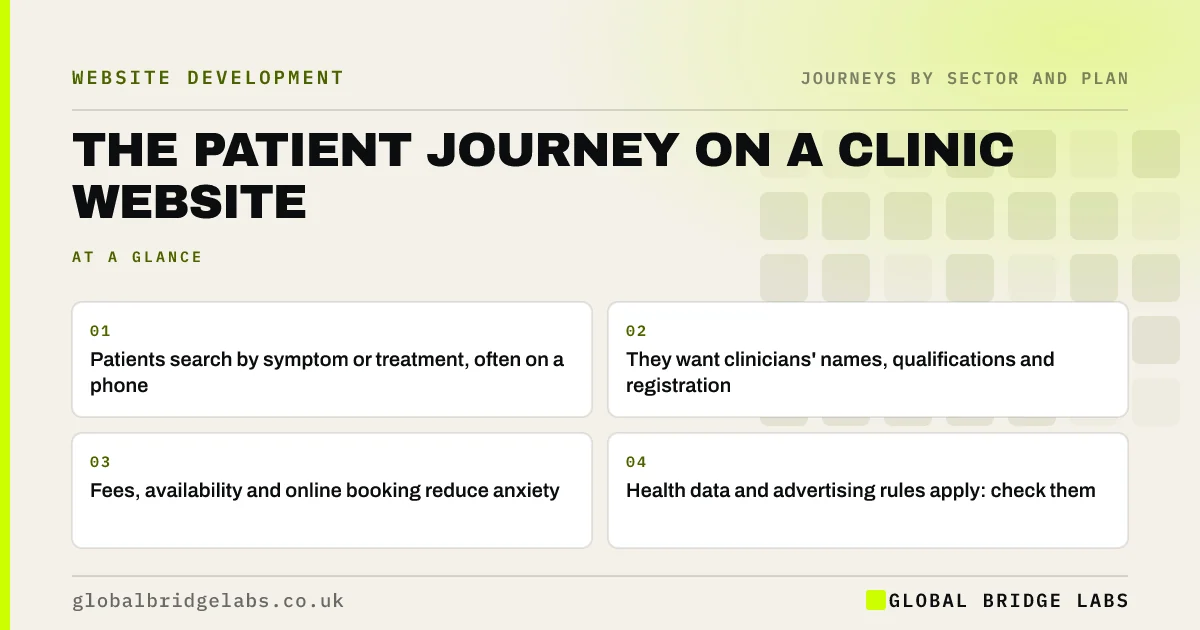
Patients choosing a private clinic, such as physiotherapy, dental, aesthetics or a specialist service, often arrive anxious or in pain. They need to know you treat their problem, who will see them, what it costs, how soon they can be seen and how to book. A clinic website designed around the patient journey answers those plainly, offers online booking, respects health advertising rules and supports patients after treatment.
- Patients search by symptom or treatment, often on a phone.
- They want clinicians' names, qualifications and registration.
- Fees, availability and online booking reduce anxiety.
- Health data and advertising rules apply: check them.
Want your clinic's patient journey reviewed? Message us on WhatsApp.
Chat on WhatsApp →What does the patient journey look like for a private clinic?
The patient journey usually starts with a symptom, a referral or a goal. The patient searches for the condition or treatment, reads an explanation, checks whether a nearby clinic treats it, looks at clinicians, reviews and fees, and books an appointment, often online. After treatment come aftercare, follow-ups and, for some services, ongoing visits.
What reassures patients on a clinic website?
Patients are reassured by clear evidence of competence and care: named clinicians with qualifications and professional registration, the clinic's regulatory status where it applies, such as Care Quality Commission (CQC) registration for regulated activities in England, plain explanations of treatments and what to expect, and reviews. Calm, plain language matters for anxious visitors.
- Clinicians' names, photos, qualifications and registration.
- Regulatory status and ratings where applicable.
- What happens at the first appointment.
- Plain explanations of conditions and treatments.
- Reviews, used in line with consumer law.
How should booking work for patients?
Booking should be quick and clear. Show availability and fees before the booking form, let patients choose clinician and time online, and ask only for what you need at that stage. Offer a phone option for patients who are unsure which appointment they need. Confirm instantly by email or text, with preparation instructions and how to change the booking.
Want your clinic's booking journey tested on a phone? Message us on WhatsApp.
Chat on WhatsApp →Which rules affect clinic websites?
Several rules apply. Health information is special category data under UK GDPR, so forms and booking systems need appropriate protection and a lawful basis. Prescription-only medicines must not be advertised to the public, which affects some aesthetics clinics. Advertising claims must be substantiated under the CAP Code. Check your regulator's guidance before publishing.
How should the website support patients after treatment?
After treatment, patients need aftercare guidance, exercise or care instructions, how to book follow-ups, what to do if something feels wrong, and how to pay or claim on insurance. Putting these on the website, and linking them from confirmation messages, reduces calls and helps patients follow advice.
When should a clinic keep the journey offline?
Keep parts offline where clinical judgement is needed, such as triage for complex symptoms or treatments with eligibility checks. The website can explain the process and make the first conversation easy, rather than pushing patients into online booking for the wrong appointment.
What does this look like in practice?
A pattern we see on clinic websites: treatment pages are thorough, but fees sit on a separate price list and the booking button opens a third-party system that asks for full medical history before showing availability. Anxious patients leave at the form.
Showing fees on each treatment page and letting patients pick a time before giving details lowers the barrier, while the clinical questions move to a secure form after booking. Across our client work we have seen a 2.4x enquiry rate from conversion changes of this kind. Global Bridge Labs (GBL) designs clinic journeys for anxious first-time patients.
Patient journey checklist
- Pages for each condition or treatment, in plain words.
- Named clinicians with qualifications and registration.
- Fees and availability before the booking form.
- Online booking with a phone alternative.
- Secure handling of health information.
- Aftercare and follow-up pages linked from confirmations.
Next step
Patients decide quickly whether a clinic feels safe and easy. We will review your site from symptom search to aftercare and show where patients drop out.
Message us on WhatsApp for a patient journey review, or book a 30-minute consultation.
Chat on WhatsApp →Sources and further reading
- Display your CQC ratings · Care Quality Commission
- Special category data · Information Commissioner's Office
- UK Code of Non-broadcast Advertising and Direct & Promotional Marketing (CAP Code) · ASA / CAP
Frequently asked questions
What is the patient journey on a clinic website?
The steps a patient takes from searching for a symptom or treatment, through checking clinicians, fees and availability, to booking, attending and receiving aftercare. A clinic website should support each step clearly and calmly, especially for anxious first-time patients.
Should a private clinic show fees on its website?
Usually yes. Fees on treatment pages help patients decide and reduce calls asking for prices. Explain what is included and what might change the cost. Check any profession-specific rules on how fees and offers are presented.
What rules apply to clinic websites in the UK?
Health information is special category data under UK GDPR, prescription-only medicines must not be advertised to the public, advertising claims must be substantiated under the CAP Code, and regulated activities may require CQC registration in England. Check your regulator's guidance.
Written by

Global Bridge Labs (GBL) is a UK–Sri Lanka partner for social media, websites and BPO. Everything here comes from client delivery, not theory.