On this page
- 01Key takeaways
- 02What is the difference between a customer journey and a user journey?
- 03How is a user flow different from both?
- 04Which one should shape a small business website?
- 05Why does the distinction matter in a website project?
- 06When is the difference not worth arguing about?
- 07What does this look like in practice?
- 08Journey and flow checklist
- 09Next step
- 10Sources and further reading
- 11Frequently asked questions
Key takeaways
A customer journey covers everything a buyer goes through with your business, across every channel and over days or months. A user journey usually covers how one person completes a goal on a specific product, such as your website. Plan the website from the customer journey, then use user journeys and user flows to design the routes on the site itself.
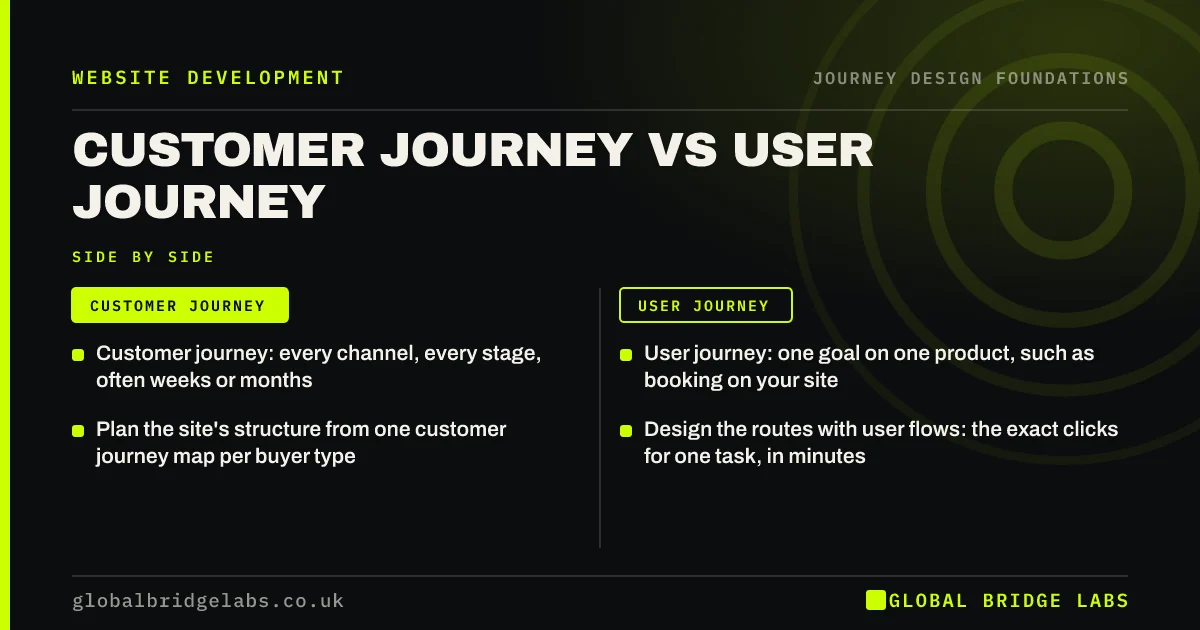
- Customer journey: every channel, every stage, often weeks or months.
- User journey: one goal on one product, such as booking on your site.
- Plan the site's structure from one customer journey map per buyer type.
- Design the routes with user flows: the exact clicks for one task, in minutes.
Not sure which you need for your website project? Ask us on WhatsApp.
Chat on WhatsApp →What is the difference between a customer journey and a user journey?
The difference is scope. A customer journey follows a buyer across every touchpoint with your business, including search, social media, phone calls, quotes and aftercare. A user journey follows a person through one product or service, such as your website or booking system, to complete a goal. One is the whole relationship; the other is one part of it.
In practice the terms overlap and many people use them interchangeably. Nielsen Norman Group (NN/g) treats a user journey as a scenario-based sequence of steps a user takes to accomplish a high-level goal, often across channels, and separates it clearly from the narrower user flow. What matters for a website project is agreeing the level of detail before anyone draws anything.
How is a user flow different from both?
A user flow is the most detailed of the three. NN/g defines it as a set of interactions describing the typical or ideal steps needed to complete a common task, and notes that flows stay within one product and capture actions and system responses rather than feelings. A flow might be: land on service page, tap Get a quote, fill four fields, see the confirmation.
- Scope: customer journey (whole relationship), user journey (one goal), user flow (one task).
- Timeframe: weeks or months, hours or days, minutes.
- Content: actions, questions and feelings; actions and goals; clicks and screens.
- Output: journey map; scenario or storyboard; flow chart or wireflow.
Which one should shape a small business website?
The customer journey should shape the website's structure and content, because it tells you which questions buyers bring and in what order. User flows then shape the detailed routes, such as booking, quoting or checkout. A small business rarely needs a separate user journey document; the customer journey map plus a few flows covers it.
Start with one customer journey map for each main buyer type. Then pick the three to five tasks that matter most on the site, usually enquire, book, get a price and find contact details, and draw a simple flow for each. That is enough to brief a designer and test the result.
Why does the distinction matter in a website project?
The distinction matters because teams that only draw user flows can build efficient routes to the wrong place. A booking flow can be three taps long and still fail if buyers needed price guidance and reviews before they were ready to book. The customer journey catches those earlier needs. The flows then make sure the final steps are quick.
It also matters for responsibility. Much of the customer journey sits outside the website: how fast you answer the phone, how quotes are written, how jobs are followed up. Website design alone cannot fix those steps, but a customer journey map shows where the site hands over and what it must promise.
When is the difference not worth arguing about?
The difference is not worth arguing about when it delays the work. If your agency calls its map a user journey and it covers search, phone and aftercare, it is a customer journey in substance. Judge the document by what it contains: real customer research, every relevant channel, and a clear list of website changes.
What does this look like in practice?
A pattern we see in redesign projects: the brief contains detailed flows for checkout or booking, and nothing about how buyers arrive or what they need before they are ready. The new site has a fast booking flow and the same drop-off as before, because visitors still leave the service page looking for prices.
Adding a one-page customer journey map to the brief changes what gets designed: price guidance, reviews near the button, and a route from articles to services. Across our client work we have seen a 2.4x enquiry rate from conversion changes of this kind. Global Bridge Labs (GBL) writes the journey first and the flows second.
Journey and flow checklist
- Agree the terms with your designer before any mapping starts.
- Draw one customer journey map per main buyer type.
- List the three to five tasks that matter most on the site.
- Draw a short user flow for each task.
- Check each flow starts where the journey map says buyers arrive.
- Mark the steps that happen off the website and who owns them.
Next step
If you have flows but no customer journey, or a journey map that never reached the designer, we can join them up and show what the site should change.
Message us on WhatsApp to review your journey map and flows, or book a 30-minute consultation.
Chat on WhatsApp →Sources and further reading
- User journeys vs. user flows · Nielsen Norman Group
- Journey mapping 101 · Nielsen Norman Group
- User research · GOV.UK Service Manual
Frequently asked questions
Is a user journey the same as a customer journey?
Not quite. A customer journey covers the whole relationship with a business across every channel. A user journey usually covers how someone completes one goal with a specific product, such as a website. The terms overlap and are often used loosely, so check what a document actually covers.
What is the difference between a user journey and a user flow?
A user journey is broad: a sequence of steps towards a high-level goal, often across channels, including thoughts and feelings. A user flow is narrow: the exact screens and actions needed to finish one task in one product, such as completing a booking form, usually shown as a flow chart.
Do I need a user journey map for my website?
Most small businesses need one customer journey map per main buyer type plus simple user flows for the three to five key tasks on the site. A separate user journey document rarely adds much at that size. Larger sites with several products may need more.
Written by

Global Bridge Labs (GBL) is a UK–Sri Lanka partner for social media, websites and BPO. Everything here comes from client delivery, not theory.