On this page
- 01Key takeaways
- 02Why is 'welcome to our website' a wasted line?
- 03What should the opening line say instead?
- 04Does removing the welcome make the site feel cold?
- 05What other opening lines waste the same space?
- 06When is a welcome line acceptable?
- 07What does this look like in practice?
- 08Opening line checklist
- 09Next step
- 10Sources and further reading
- 11Frequently asked questions
Key takeaways
"Welcome to our website" tells visitors nothing they did not already know, and it sits in the most-read spot on the page. Replace it with a line that says what you do, for whom and where. The same goes for 'Hello and welcome', 'Thank you for visiting' and 'We are a family business established in…' as opening lines.
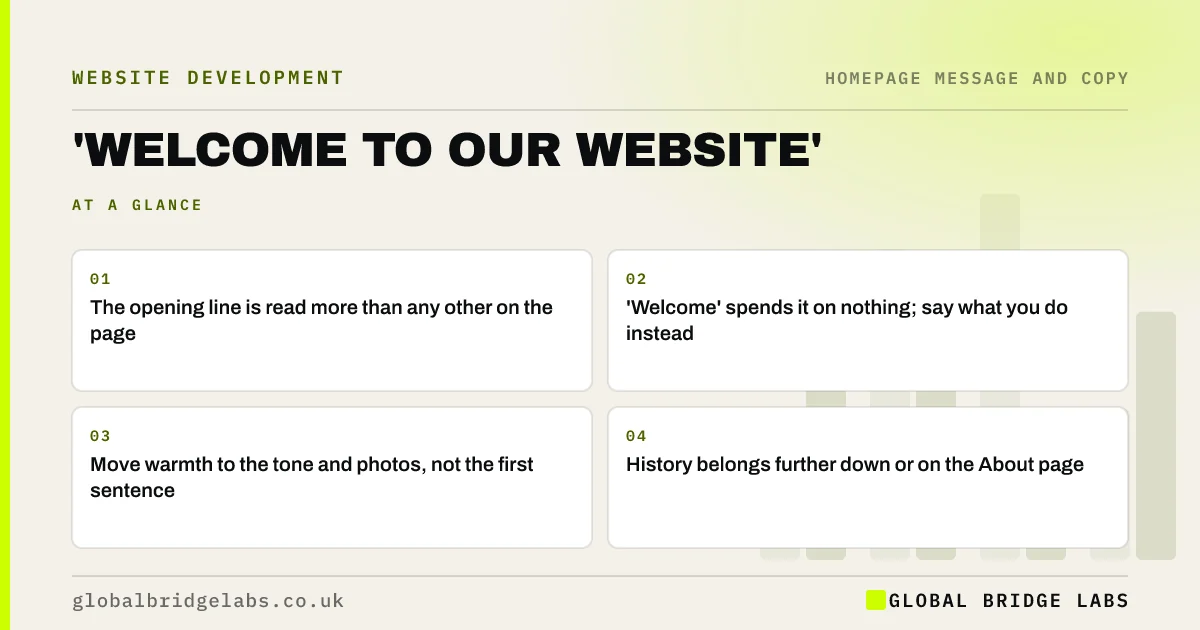
- The opening line is read more than any other on the page.
- 'Welcome' spends it on nothing; say what you do instead.
- Move warmth to the tone and photos, not the first sentence.
- History belongs further down or on the About page.
Want a new opening line for your homepage? Message us on WhatsApp.
Chat on WhatsApp →Why is 'welcome to our website' a wasted line?
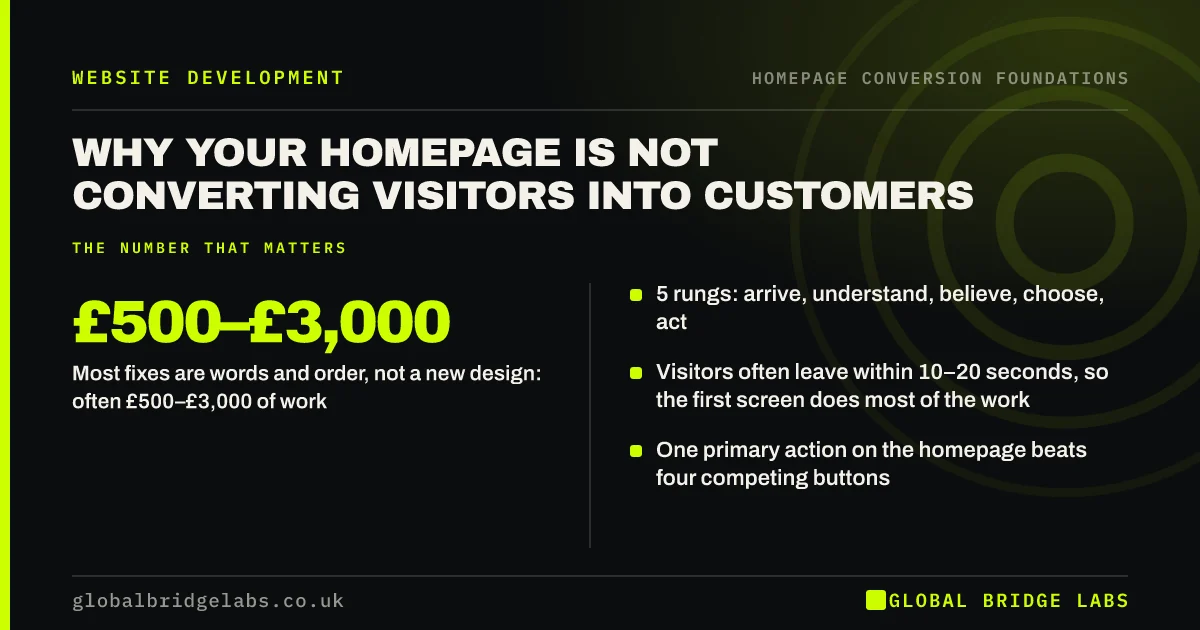
'Welcome to our website' is wasted because visitors already know they are on your website and still do not know whether you can help them. The opening line is the most-read text on the page, and Nielsen Norman Group found users often leave within 10–20 seconds. A greeting spends those seconds without answering anything.
What should the opening line say instead?
Say what you do, for whom and where, in plain words. Compare the pairs below; the second line in each gives a visitor enough to decide whether to stay.
- Before: 'Welcome to Smith and Co.' After: 'Commercial cleaning for offices across Manchester, evenings and weekends.'
- Before: 'Hello and welcome!' After: 'Dog grooming in Cardiff, with same-week appointments.'
- Before: 'Thank you for visiting.' After: 'Payroll for UK firms with 5 to 50 staff, done for a fixed monthly fee.'
Does removing the welcome make the site feel cold?
No. Warmth comes from tone, photos of real people and how quickly you reply, not from a greeting. A friendly, specific opening line feels warmer than a generic welcome because it shows you understand what the visitor came for.
What other opening lines waste the same space?
Watch for 'We are a family-run business established in 1987', 'Your one-stop shop for all your needs', 'Excellence in every project' and 'Here at…'. Each can be true and still useless as an opening, because none tells a stranger what you do.
When is a welcome line acceptable?
In a members' area, a customer portal or an intranet, where visitors already know who you are and why they came, a short greeting is harmless. On a public homepage aimed at new buyers, it is almost always better spent.
What does this look like in practice?
A pattern we see on older small business sites: the headline is the company name, followed by 'Welcome to our website'. Swapping those two lines for a specific description is a ten-minute change that often moves more visitors on to the service pages than the redesign the owner was planning.
Opening line checklist
- Remove 'welcome', 'hello' and 'thank you for visiting'.
- Name what you do in the first line.
- Add who it is for and where in the next line.
- Move founding dates and history lower down.
- Read the first line aloud to a stranger.
Next step
Write a new opening line using 'We [do what] for [whom] in [where]', then remove the 'we' and tighten it. Put it live today; it is reversible.
Message us on WhatsApp with your draft line, or book a 30-minute consultation.
Chat on WhatsApp →Sources and further reading
- How long do users stay on web pages? · Nielsen Norman Group
- How users read on the web · Nielsen Norman Group
Frequently asked questions
Should I say welcome on my homepage?
Not as the opening line. Visitors know they have arrived; they want to know whether you can help them. Use the first line to say what you do, for whom and where. Warmth can come from tone, real photos and fast replies instead.
What is a good homepage intro?
One line that names the service, the customer and the area or delivery promise, followed by a sentence with a specific result or proof point. For example: 'Commercial cleaning for Manchester offices, evenings and weekends. Rated 4.8 from 140 reviews.'
Is it bad to put the company name as the homepage headline?
Usually, because the logo already shows the name and the headline is the most valuable line on the page. Use it to describe what you do. Very well-known brands are an exception, as their name already tells visitors what they offer.
Written by

Global Bridge Labs (GBL) is a UK–Sri Lanka partner for social media, websites and BPO. Everything here comes from client delivery, not theory.