On this page
- 01Key takeaways
- 02What is advertising ROI?
- 03How do you calculate it?
- 04What does a worked example look like?
- 05Which costs belong in the sum?
- 06How do you trace sales to an offline advert?
- 07What about customers who come back?
- 08What does good tracking cost?
- 09Where does ROI fall short?
- 10What does this look like in practice?
- 11Next step
- 12Sources and further reading
- 13Frequently asked questions
Key takeaways
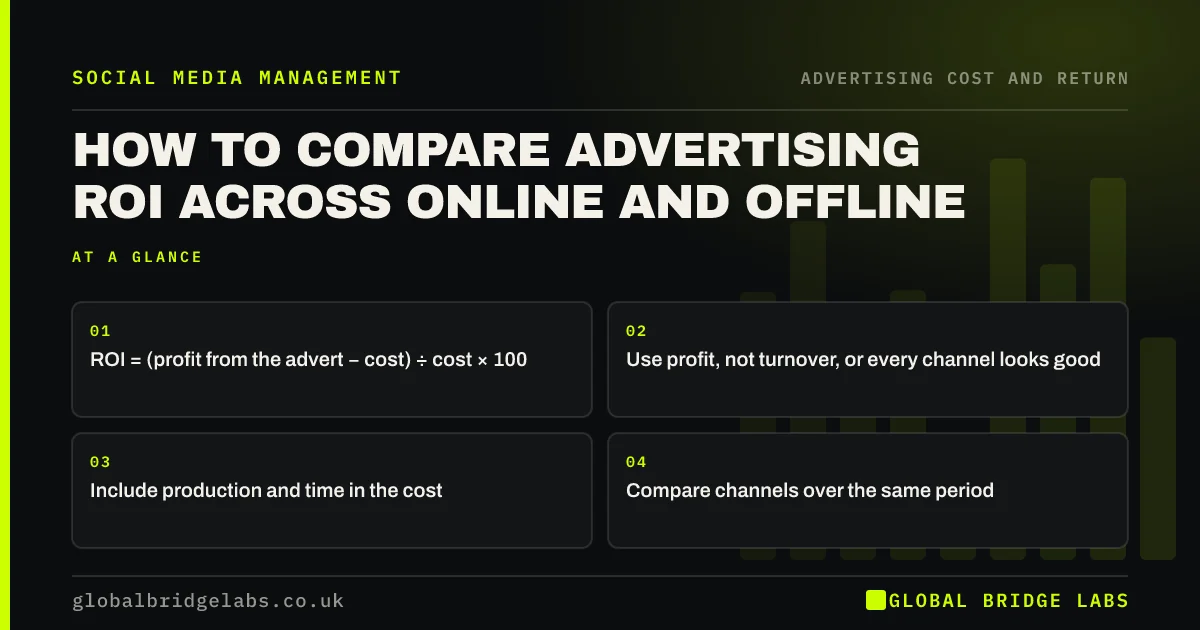
Advertising ROI for a small business is the profit an advert produced, minus what it cost, divided by what it cost. Used the same way for every channel, it lets you compare a leaflet with a social campaign. It is only as good as your tracking.
- ROI = (profit from the advert − cost) ÷ cost × 100.
- Use profit, not turnover, or every channel looks good.
- Include production and time in the cost.
- Compare channels over the same period.
Want your channels compared on return? Message us on WhatsApp.
Chat on WhatsApp →What is advertising ROI?
Return on investment (ROI) is the gain from an activity as a percentage of its cost. Return on ad spend (ROAS) is a simpler cousin: revenue divided by advert spend. ROAS is quicker, but it ignores your costs, so ROI is the safer figure for deciding where the budget goes.
How do you calculate it?
Work through the same four steps for every channel.
- 1. Count the sales traced to the channel.
- 2. Work out the gross profit on those sales.
- 3. Subtract the full cost of the channel.
- 4. Divide by that cost and multiply by 100.
What does a worked example look like?
Here is an illustrative comparison over three months. A leaflet campaign cost £900 and produced six jobs with £350 gross profit each: £2,100 of profit, an ROI of 133%. A social media campaign cost £1,800 and produced 14 jobs at the same profit: £4,900, an ROI of 172%. The figures are invented to show the method.
Which costs belong in the sum?
Every cost the channel would not exist without belongs in the sum.
- Media: space, airtime, delivery or advert spend.
- Production: design, print, photography, video.
- Fees: agency, freelancer or software.
- Time: staff hours at their real hourly cost.
How do you trace sales to an offline advert?
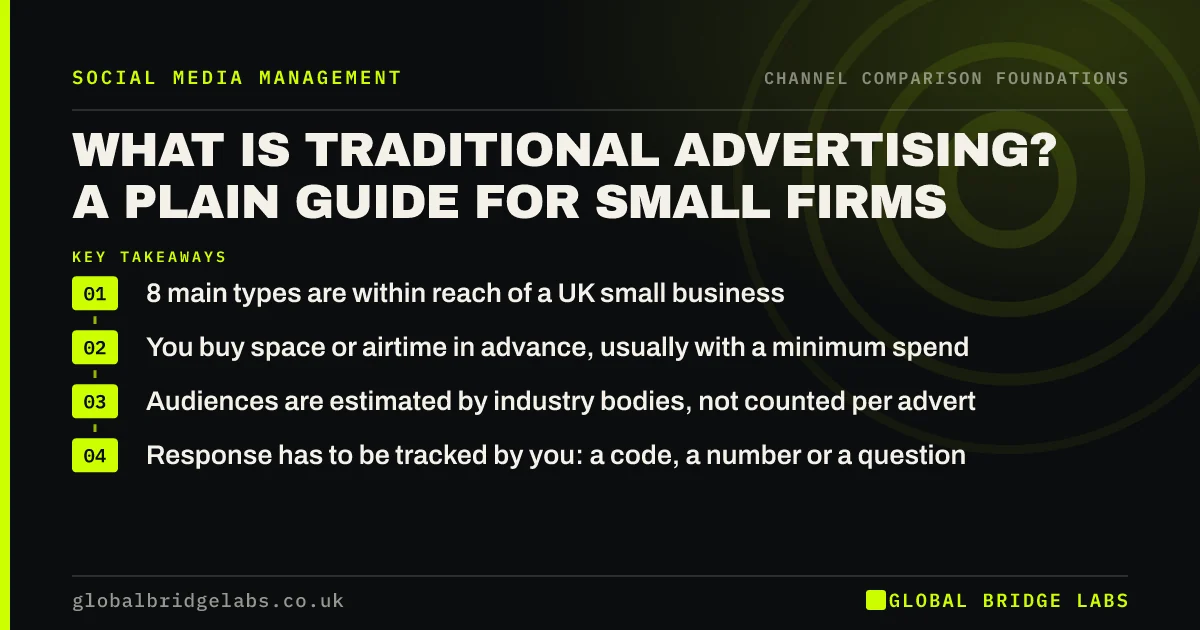
Trace offline sales with a code, a dedicated number or web address, and by asking every enquirer how they heard of you. Record the source against the customer, so that when they buy, the sale is credited. Without that link, the ROI of any traditional channel is a guess.
What about customers who come back?
If customers return, a first-sale ROI undervalues the channel. Use the profit from a typical customer over a year or more where you can estimate it. This matters most for services with repeat visits, such as salons, clinics, restaurants and maintenance contracts.
What does good tracking cost?
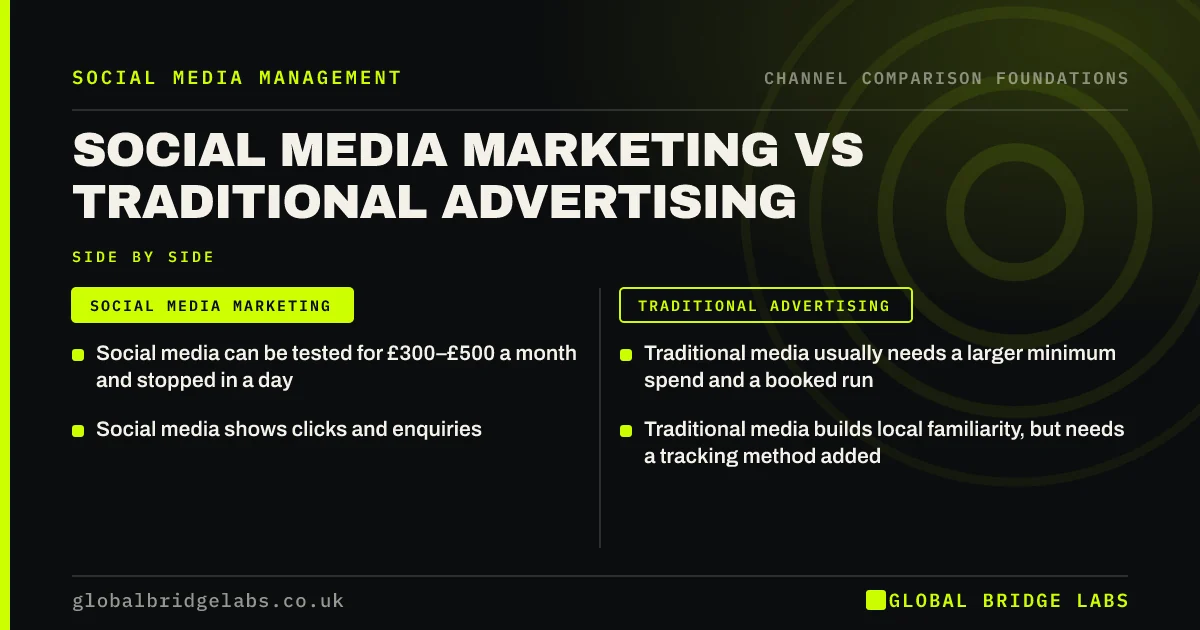
Very little. A shared enquiry log and a habit of asking cost nothing. Paid social can be tested from £300–£500 a month and reports its own results. Most UK SMEs using an agency pay £950–£2,500 a month for managed social media, which normally includes monthly reporting.
Want a simple return report set up for all your channels? Message us on WhatsApp and we will discuss your requirements.
Chat on WhatsApp →Where does ROI fall short?
ROI falls short for activity that works slowly or indirectly. A buyer may see your van, a leaflet and several posts before calling, and the last one gets the credit. Research for the IPA shows brand effects build over years. Treat ROI as a guide to response channels, not a verdict on everything.
What does this look like in practice?
A pattern we see when firms first work out returns: turnover is used in place of profit, so every channel appears to pay several times over. Redoing the sum on gross profit, with time included, changes the ranking and usually removes one channel from the plan.
Next step
Take your biggest channel and calculate its ROI for the last quarter using gross profit and full cost. Then do the same for the second biggest.
Message us on WhatsApp with the two figures and we will help you read them, or book a 30-minute consultation.
Chat on WhatsApp →Sources and further reading
- The Long and the Short of It: balancing short and long-term marketing strategies · IPA
- Get started with attribution · Google Analytics Help
- URL builders: collect campaign data with custom URLs · Google Analytics Help
Frequently asked questions
How do you calculate advertising ROI?
Take the gross profit from sales traced to the advert, subtract the full cost of the advert, divide the result by that cost and multiply by 100. For example, £2,100 profit from a £900 campaign is an ROI of 133%.
What is a good ROI for advertising?
Any positive ROI on gross profit means the advert paid for itself. Many small firms look for at least 100%, meaning two pounds of profit for each pound spent, to cover overheads and risk. The right threshold depends on your margins.
What is the difference between ROI and ROAS?
ROAS is revenue divided by advert spend, so £4 of sales per £1 spent is a ROAS of 4. ROI uses profit and includes all costs. ROAS is quicker to work out. ROI is the more reliable basis for budget decisions.
Can you measure ROI on traditional advertising?
Yes, if you add a tracking method. An offer code, a dedicated phone number, a short web address and asking every customer how they heard of you will link sales to a printed or broadcast advert well enough to calculate a return.
Written by

Global Bridge Labs (GBL) is a UK–Sri Lanka partner for social media, websites and BPO. Everything here comes from client delivery, not theory.