On this page
- 01Key takeaways
- 02What does an AI website builder do?
- 03Mistake 1: generic headlines and copy
- 04Mistake 2: invented claims and proof
- 05Mistake 3: stock and generated imagery
- 06Mistake 4: accessibility faults
- 07Mistake 5: missing business basics
- 08Mistake 6: a structure that fits nobody
- 09When is an AI website builder a sensible choice?
- 10What does this look like in practice?
- 11AI site pre-launch checklist
- 12Next step
- 13Sources and further reading
- 14Frequently asked questions
Key takeaways
An AI website builder can generate a plausible small business site in minutes, but it produces the average of what it has seen. Check for generic headlines, invented claims, stock imagery, low-contrast text, unlabelled forms and missing contact details before you publish. Treat the output as a first draft, not a finished site.
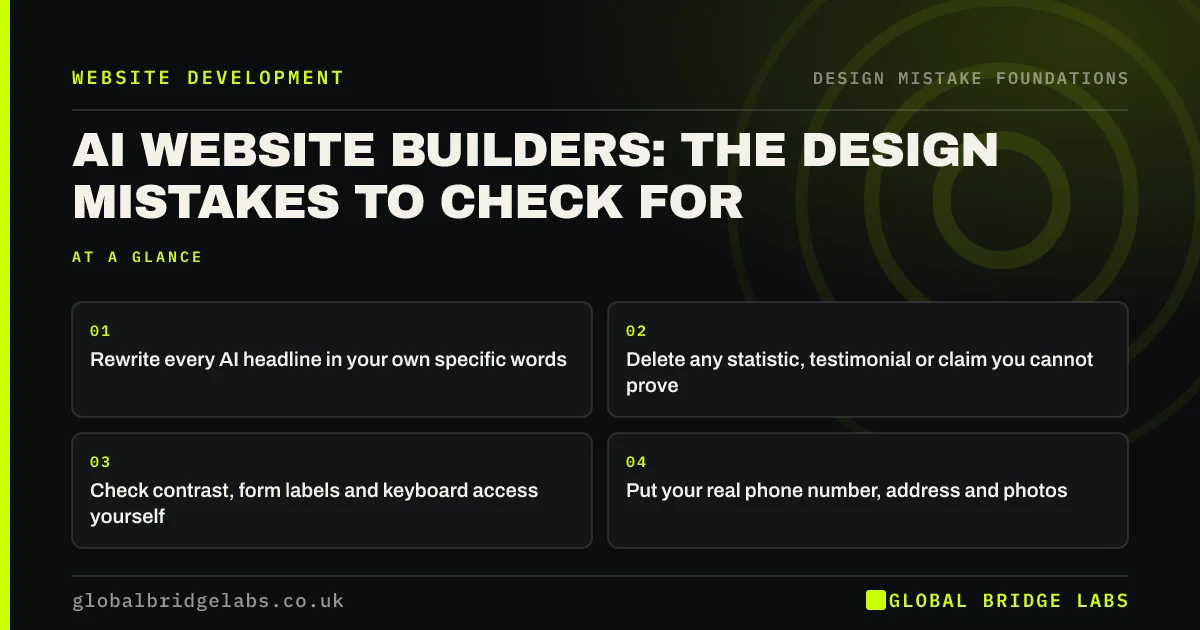
- Rewrite every AI headline in your own specific words.
- Delete any statistic, testimonial or claim you cannot prove.
- Check contrast, form labels and keyboard access yourself.
- Put your real phone number, address and photos in.
Built a site with AI and want it checked? Message us on WhatsApp.
Chat on WhatsApp →What does an AI website builder do?
An AI website builder is a tool that generates page layouts, text and images from a short description of a business. Many website platforms now include one. It speeds up the blank-page stage, but it does not know your customers, your prices or your proof, so it fills the gaps with generic content.
Mistake 1: generic headlines and copy
AI-generated copy tends towards phrases such as 'Your trusted partner for quality solutions'. It could describe any business. Replace it with what you do, for whom and where, and with the questions your customers actually ask. Specific copy is easier to read and more persuasive.
Mistake 2: invented claims and proof
AI tools can generate testimonials, customer counts, years in business or awards that are not true. Publishing invented reviews or claims can mislead consumers, which UK consumer protection law prohibits; the Digital Markets, Competition and Consumers Act 2024 specifically bans fake reviews. Delete anything you cannot evidence.
Mistake 3: stock and generated imagery
Generated images and generic stock photos are easy to spot and add little trust. Nielsen Norman Group found people ignore decorative images and pay attention to real people and products. Swap in photos of your team, premises and work as soon as you can.
Mistake 4: accessibility faults
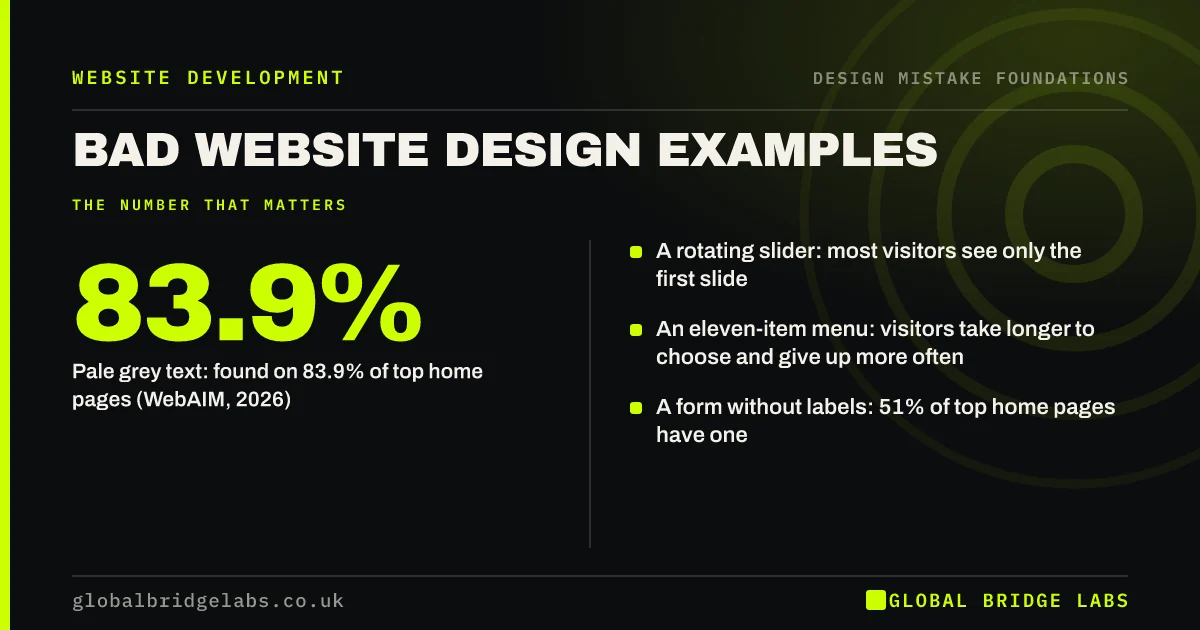
Generated designs often use fashionable pale palettes and placeholder-only form fields. Check text contrast against WCAG's 4.5:1 minimum, give every form field a visible label, add meaningful alt text to images and press Tab through the page to confirm you can see where you are.
- Colour contrast on websites: why grey text loses readers
- Alt text for business website images: how to write it
Want an accessibility check on an AI-built site? Message us on WhatsApp and we will discuss your requirements.
Chat on WhatsApp →Mistake 5: missing business basics
AI builders often leave out the details that matter most to a buyer: a real phone number, address, service area, opening hours, prices or ranges, and company details. UK companies must show certain information on their websites, including the registered name and number. Check these before launch.
Mistake 6: a structure that fits nobody
Generated sites follow a standard pattern: hero, features, testimonials, call to action. That may not match how your buyers decide. A clinic needs booking and practitioner pages; a logistics firm needs service areas and capabilities. Restructure around your buyers' questions rather than the generated outline.
When is an AI website builder a sensible choice?
An AI builder is a sensible starting point for a very small business that needs a simple online presence quickly and will edit the output carefully. It is a poor fit when you rely on the website for most new business, need integrations, or work in a regulated sector where wording matters.
What does this look like in practice?
A pattern we see: an AI-built site looks tidy but every page could belong to any competitor, and the testimonials were generated. Replacing the copy with specific answers and real reviews takes a few days and changes how the site reads more than any design change.
AI site pre-launch checklist
- Rewrite headlines in specific, plain words.
- Remove any claim, review or number you cannot prove.
- Replace generated images with real photos.
- Check contrast, labels, alt text and keyboard focus.
- Add phone, address, hours and company details.
- Restructure pages around your buyers' questions.
Next step
Read every sentence on your AI-built homepage and mark any you could not prove or that a competitor could also say.
Message us on WhatsApp for a review before you launch, or book a 30-minute consultation.
Chat on WhatsApp →Sources and further reading
- Digital Markets, Competition and Consumers Act 2024 · legislation.gov.uk
- Creating helpful, reliable, people-first content · Google Search Central
- Understanding SC 1.4.3: Contrast (Minimum) · W3C
- Running a limited company: signs, stationery and promotional material · GOV.UK
- Photos as web content · Nielsen Norman Group
Frequently asked questions
Are AI website builders good for small businesses?
They are useful for a fast first draft. The output is generic and sometimes inaccurate, so it needs careful editing: specific copy, real photos, verified claims and accessibility checks. For businesses that rely on their website for enquiries, treat AI as a starting point, not the finished product.
Can I publish AI-generated testimonials on my website?
No. Invented testimonials mislead consumers, and the Digital Markets, Competition and Consumers Act 2024 bans fake reviews. Only publish genuine reviews from real customers, ideally with their permission and a name or initial.
Does Google penalise AI-generated website content?
Google says it rewards helpful, people-first content however it is produced. Generic AI text that adds nothing new is unlikely to rank well. Specific, accurate content written for your customers is what matters, whether or not AI helped draft it.
Written by

Global Bridge Labs (GBL) is a UK–Sri Lanka partner for social media, websites and BPO. Everything here comes from client delivery, not theory.