On this page
- 01Key takeaways
- 02What does inconsistent customer service look like?
- 03What causes inconsistent customer service?
- 04How do you fix inconsistency?
- 05When does inconsistency point to outsourcing?
- 06Can outsourcing make service less consistent?
- 07How do you measure consistency?
- 08When is inconsistency acceptable?
- 09What should a customer service guide include?
- 10What does this look like in practice?
- 11Consistency checklist
- 12Next step
- 13Sources and further reading
- 14Frequently asked questions
Key takeaways
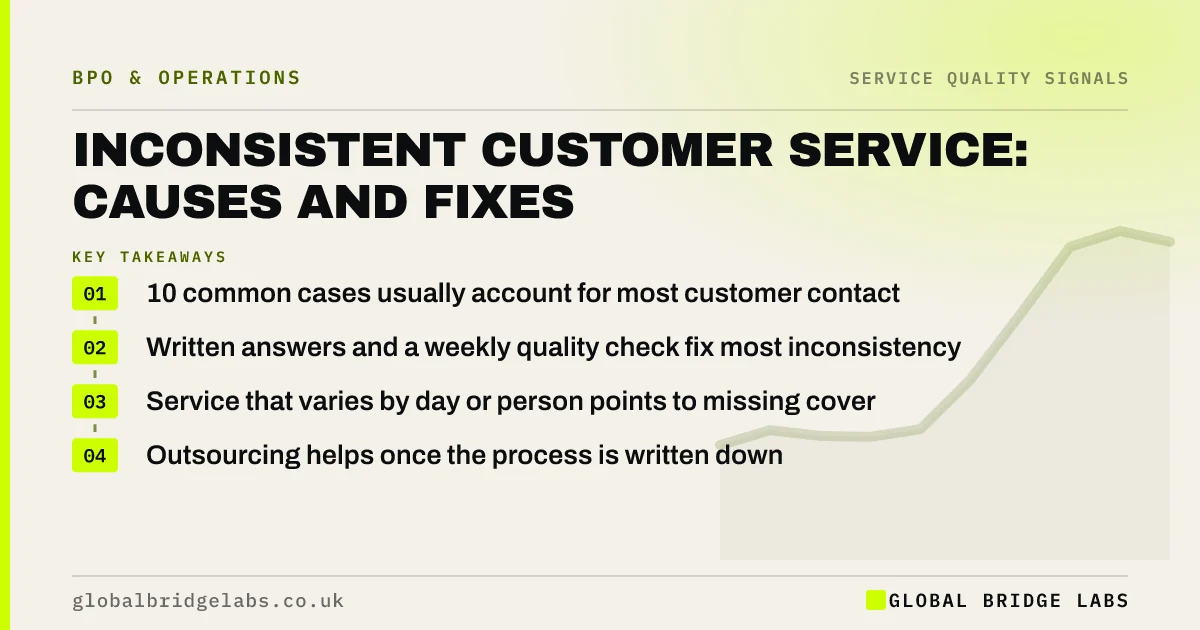
Inconsistent customer service usually comes from three things: no written answers to common questions, different people handling the same contact in different ways, and service that depends on who is in that day. Write down the ten most common cases, check a sample of replies each week, and add cover so quality does not drop when people are away.
- 10 common cases usually account for most customer contact.
- Written answers and a weekly quality check fix most inconsistency.
- Service that varies by day or person points to missing cover.
- Outsourcing helps once the process is written down.
Service quality depends on who picks up? Message us on WhatsApp.
Chat on WhatsApp →What does inconsistent customer service look like?
Inconsistent customer service means customers get different answers, speeds or tones depending on who handles them, which channel they use, or what day it is. One customer gets a refund, another with the same problem does not. Monday replies take two days; Thursday replies take an hour. Customers notice, and trust falls.
What causes inconsistent customer service?
The main causes are missing documentation, stretched capacity and unclear decision rights. When answers live in people's heads, each person gives their own version. When the team is overloaded, speed swings with the workload. When nobody knows who can approve a refund, decisions vary by who is asked.
- No written answers for common questions.
- Capacity that swings with the day of the week.
- Unclear rules for refunds, exceptions and escalations.
- Different channels handled by different people with different habits.
How do you fix inconsistency?
Write down the ten most common cases with the approved answer and who decides exceptions. Share it with everyone who handles customers, on every channel. Review a sample of 10 to 20 replies a week against it and correct drift early. Most inconsistency falls within a month of doing this.
Want a template for your ten common cases? Ask us on WhatsApp.
Chat on WhatsApp →When does inconsistency point to outsourcing?
When the process is written down but service still varies because capacity varies. If quality is good on quiet days and poor on busy ones, or good when a key person is in and poor when they are off, the gap is cover and capacity. A managed team working to the same written process adds both.
Can outsourcing make service less consistent?
It can, if the provider is given no written process, no examples and no feedback. That is why documentation comes first. With a written guide, regular calibration and a weekly scorecard, an outsourced team is often more consistent than a stretched in-house team, because following the process is its job.
How do you measure consistency?
Measure the spread, not just the average. Track reply time by day of the week and by person, and score a weekly sample of replies against the written guide. A narrowing spread shows service is becoming more consistent. First contact resolution, the share of contacts solved in one go, is a useful second measure.
When is inconsistency acceptable?
Some variation is healthy. Experienced staff using judgement for a loyal customer, or a personal touch that differs from person to person, can be strengths. The goal is consistency on the things customers rely on, such as speed, accuracy and policy, while leaving room for warmth and judgement.
What should a customer service guide include?
Keep it short enough to use. A good guide covers the ten most common questions with an approved answer, the rules for refunds and exceptions, who to escalate to and how fast, and a few examples of tone. Store it where every channel's handlers can find it, and update it when a new question starts appearing regularly.
- Approved answers for the ten most common questions.
- Rules for refunds, credits and exceptions.
- Escalation contacts and response times.
- Examples of good replies showing the right tone.
What does this look like in practice?
A pattern we see in UK clinics and practices: two receptionists give different answers on cancellation fees, and patients complain. A one-page guide to the ten most common questions, plus outsourced booking cover for busy mornings, removes most of the variation because the same answers are given by everyone, at every hour.
Consistency checklist
Use this to make service consistent.
- Write the approved answer for the ten most common cases.
- Set clear rules for refunds and exceptions.
- Share one guide across every channel.
- Review 10 to 20 replies a week against it.
- Track reply time by day and by person.
- Add cover where quality drops on busy days.
Next step
Tell us where your service varies. We will help you find the cause and tell you whether outsourcing would make it more consistent.
Message us on WhatsApp about service consistency, or book a 30-minute consultation.
Chat on WhatsApp →Sources and further reading
- UK Customer Satisfaction Index · Institute of Customer Service
- Contracts and liabilities between controllers and processors · Information Commissioner's Office
- Consumer Contracts (Information, Cancellation and Additional Charges) Regulations 2013 · legislation.gov.uk
Frequently asked questions
How do you make customer service consistent?
Write down the approved answers for your ten most common cases, set clear rules for exceptions, share one guide across all channels, and check a weekly sample of replies against it. Add cover so service does not drop on busy days or when key people are away.
Why is customer service quality different on different days?
Usually because capacity varies. Busy days, absences and peaks stretch the same people, so replies slow and quality slips. If quality is good on quiet days and poor on busy ones, the fix is capacity and cover rather than training.
Is outsourced customer service consistent?
It can be very consistent when the provider works from a written guide, receives feedback and is measured weekly. Without documentation, it will be as inconsistent as the process it inherits. Documentation and calibration are what make the difference.
Written by

Global Bridge Labs (GBL) is a UK–Sri Lanka partner for social media, websites and BPO. Everything here comes from client delivery, not theory.