On this page
- 01Key takeaways
- 02Who are UK small business owners as buyers?
- 03Where do they actually gather?
- 04What language works with owner-managers?
- 05What do they actually want to hear about?
- 06What stops them buying?
- 07What does this look like in practice?
- 08When will an owner-manager actually read you?
- 09Next step
- 10Sources and further reading
- 11Frequently asked questions
Key takeaways
UK owner-managers buy like consumers: fast, alone, often in the evening, and after asking a peer. They are reached in sector Facebook groups and WhatsApp networks far more reliably than through formal B2B channels.
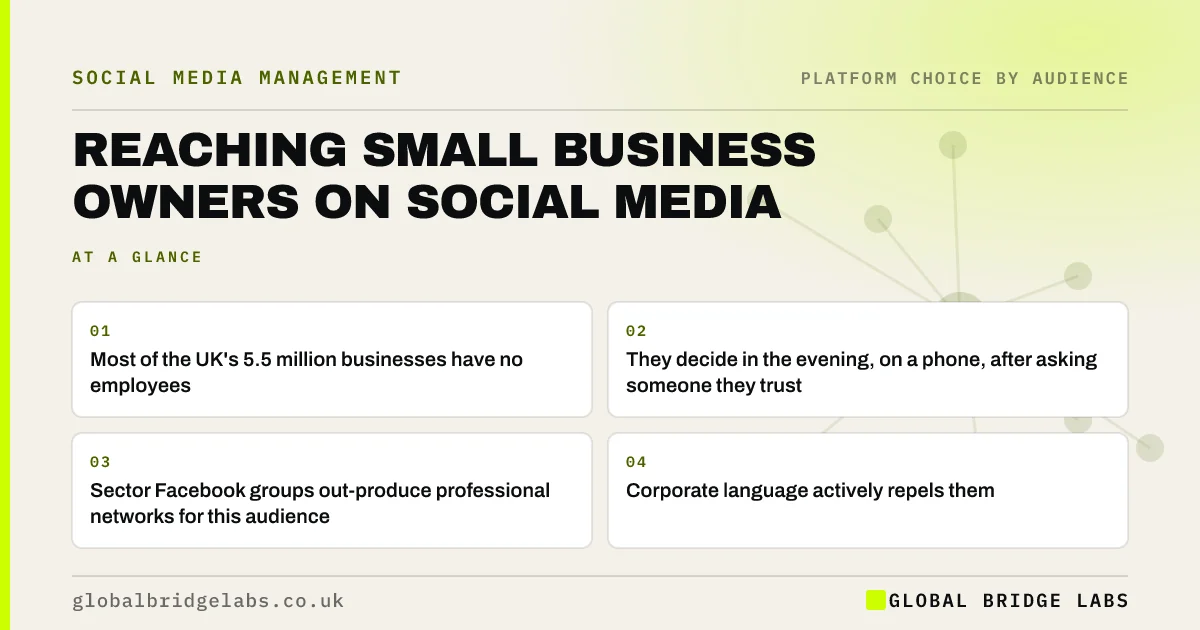
- Most of the UK's 5.5 million businesses have no employees. Your buyer is one person.
- They decide in the evening, on a phone, after asking someone they trust.
- Sector Facebook groups out-produce professional networks for this audience.
- Corporate language actively repels them. Write the way they talk.
- Time is their scarcest resource. Lead with what it saves, not what it does.
Selling to UK owner-managers? We will find where they gather on WhatsApp.
Chat on WhatsApp →Who are UK small business owners as buyers?
One person, usually spending their own money, usually deciding outside working hours because working hours are spent on the work. Department for Business and Trade estimates put the UK private sector at around 5.5 million businesses, with the overwhelming majority having no employees at all.
That single fact invalidates most B2B marketing advice for this market. There is no buying committee, no procurement process and no budget cycle. There is a person on a phone at nine in the evening deciding whether you seem worth a conversation.
Where do they actually gather?
In sector communities rather than on general business platforms. Five places that consistently out-produce professional networks for this audience.
- Trade-specific Facebook groups, which exist for almost every UK sector.
- WhatsApp groups formed around trade bodies, courses and local networks.
- YouTube, where they search for how to solve a specific operational problem.
- Local business networks, whose online presence mirrors offline relationships.
- Supplier communities, where their suppliers' customers already congregate.
What language works with owner-managers?
Theirs. Corporate marketing language reads as expensive and as evidence that you do not understand a business where the owner also does the invoicing.
Write about the specific problem in the specific words they use: chasing invoices, no time to post, the phone going unanswered while on a job. Every abstraction you add moves you further from the person reading, and this audience has no patience for language that does not immediately describe their Tuesday.
We will write in your buyers' language, not marketing language. Ask on WhatsApp.
Chat on WhatsApp →What do they actually want to hear about?
Time, then money, then risk, in that order. Time is the constraint every owner-manager feels most acutely, and a service that returns hours is easier to sell than one that improves a metric.
Be concrete about it. Saves roughly six hours a week on admin lands better than improves operational efficiency, because the first is a number they can check against their own week and the second is a phrase they have learned to ignore.
What stops them buying?
Three things, and price is only one of them. Uncertainty about price, which they will not ask about and will instead assume is too high. Fear of a long commitment, because they have been locked into contracts before. And doubt that you understand a business their size.
All three are addressed by publishing ranges, stating your minimum term plainly, and describing the sort of business you work with in concrete terms. A page saying we work with UK firms of 2 to 20 people does more qualifying than any amount of positioning copy.
What does this look like in practice?
A UK bookkeeping practice marketed on a professional network with content about compliance changes and regulatory updates. The audience was other accountants. Enquiries from actual small business owners were rare.
Moving the effort into three trade Facebook groups, answering questions about VAT and expenses in plain language without linking, produced a steady flow of enquiries within a quarter. The content was simpler, the audience was correct, and the recommendation came from peers rather than from the practice itself.
When will an owner-manager actually read you?
Early morning, lunchtime and after nine in the evening, because the working day belongs to the work. A post published at eleven on a Tuesday reaches owner-managers who are not looking at their phones.
This is one of the few cases where posting time genuinely matters, and it is different from the general advice. Test evenings specifically: for audiences of tradespeople, hospitality operators and independent retailers, the gap between a 10am post and a 9pm post can be substantial.
It also changes your reply expectations. Messages from this audience arrive outside office hours, and a business that answers at nine the next morning is still answering faster than most competitors.
Set an expectation on your profile so the out-of-hours message does not sit unanswered in silence.
Next step
Find the three largest Facebook groups for the sectors you sell into and read a week of posts. The language your buyers use about their own problems is sitting there, and it will be nothing like the language in your current marketing.
Message us on WhatsApp and we will map the communities your buyers are already in.
Chat on WhatsApp →Sources and further reading
- Business population estimates for the UK and regions 2025 · Department for Business and Trade
- Meta Business Help Centre · Meta
Frequently asked questions
Where do UK small business owners spend time online?
In sector-specific Facebook groups, in WhatsApp networks formed around trade bodies and courses, and on YouTube when they are searching for a fix to a specific operational problem. These consistently out-produce formal professional networks for owner-managed UK businesses, because that is where their peers already are.
Do small business owners buy like consumers or like companies?
Like consumers, in most cases. The great majority of UK businesses have no employees at all, so there is no buying committee and no procurement process, just one person deciding on a phone in the evening after asking someone they trust.
What messaging works with owner-managers?
Time first, then money, then risk, and all of it stated concretely. Saves roughly six hours a week on admin lands far better than improves operational efficiency, because the first can be checked against their own week and the second cannot.
Why do small business owners not enquire?
Uncertainty about price, which they assume is too high rather than asking; fear of a long commitment after being locked into contracts before; and doubt that you work with businesses their size. Publishing ranges and your minimum term fixes all three.
Written by
Global Bridge Labs (GBL) is a UK–Sri Lanka partner for social media, websites and BPO. Everything here comes from client delivery, not theory.