On this page
- 01Short answer
- 02What does each channel do best?
- 03Why is social media alone risky?
- 04When might social media be enough for now?
- 05How should the website and social media work together?
- 06What does it cost to add a website?
- 07What does this look like in practice?
- 08Website and social checklist
- 09Next step
- 10Sources and further reading
- 11Frequently asked questions
Short answer
Yes, most UK small businesses need a website even if they are active on social media. Social media builds attention and relationships, but you do not own it, it is hard to find through search, and it cannot hold detailed service, pricing and proof information. A website is the asset you control, and where most considered enquiries happen.
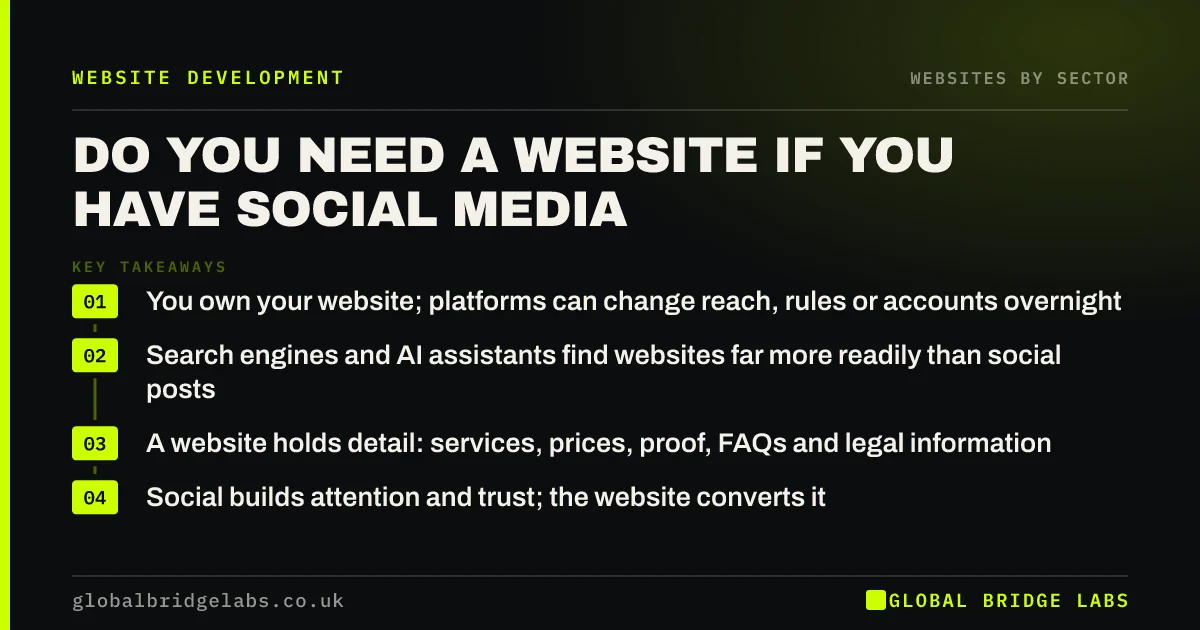
- You own your website; platforms can change reach, rules or accounts overnight.
- Search engines and AI assistants find websites far more readily than social posts.
- A website holds detail: services, prices, proof, FAQs and legal information.
- Social builds attention and trust; the website converts it.
- Link them: every social profile and post should lead to a relevant page.
Relying on social media alone? Message us on WhatsApp and we will tell you what a simple site would add.
Chat on WhatsApp →What does each channel do best?
A website is a set of pages a business owns and controls, designed to inform, persuade and convert visitors from any source. Social media channels are platforms owned by other companies, where businesses publish content to build attention and relationships within the platform's rules.
They are complementary. Social media is strong at reach, personality and repeat contact. A website is strong at search visibility, detail, credibility and conversion.
Think of it as the difference between meeting someone at an event and visiting their office. Social media is where people first notice you and get a feel for the business. The website is where they check you are real, see what you charge and decide to make contact.
Why is social media alone risky?
You rent space on social platforms. Organic reach can fall with an algorithm change, accounts can be restricted or hacked, and platforms can change their rules or features at any time. Years of audience-building can become far less valuable overnight.
Social content is also hard to find later. Posts scroll away, and people searching Google for your service are more likely to land on a competitor's website than on your Instagram grid.
- Reach controlled by the platform's algorithm.
- Account restrictions or hacks with slow recovery.
- Limited space for pricing, detail and proof.
- Weak visibility in search and AI answers.
- No control over layout, tracking or data.
When might social media be enough for now?
A brand-new business testing demand, a very small local operation with most work from word of mouth, or a creator-led business whose audience lives on one platform might start with social media and a Google Business Profile only.
Even then, a simple one-page site with services, contact details and reviews costs little and protects against platform risk. Treat social-only as a starting point, not a long-term plan.
How should the website and social media work together?
Use social media to earn attention and the website to convert it. Link every profile to the most relevant page, not just the homepage. Use UTM tags on links so you can see which posts drive enquiries. Put social proof from platforms on the website, with permission.
Repurpose website content for social, and social questions for the website. The questions people ask in comments are often the FAQs your service pages are missing.
Want your social profiles and website linked so you can see what drives enquiries? Message us on WhatsApp.
Chat on WhatsApp →What does it cost to add a website?
A simple builder site can cost £15 to £40 a month plus your time. A professional small business site typically costs £1,500 to £5,000 from a freelancer, and more from an agency for larger sites. Running costs, domain, hosting and maintenance, are usually modest.
Across our client work, we have seen a +184% average social reach lift in the first 90 days and a 2.4x enquiry rate after a website rebuild. Reach grows fastest on social. Enquiries grow fastest when the website is ready to receive them.
What does this look like in practice?
A pattern in hospitality and retail: a business with a strong Instagram following and no website, which loses its account access for several weeks after a security problem and has no other way for customers to find menus, prices or booking.
A simple website with booking, menus and contact details, linked from the social profiles, would have kept the business visible and bookable throughout. It is insurance as much as marketing.
Website and social checklist
Use both channels deliberately.
- Own a domain and a simple website.
- Link every profile to a relevant page.
- Tag links with UTMs.
- Publish detail on the website, attention on social.
- Turn social questions into website FAQs.
- Show social proof on the website.
- Keep business details consistent everywhere.
Next step
If your business runs on social media alone, we will talk through what a simple website would add, and what it would cost, with you in 30 minutes.
Message us on WhatsApp to discuss a website alongside your social media, or book a 30-minute consultation.
Chat on WhatsApp →Sources and further reading
- Online Nation: how the UK uses online services · Ofcom
- URL builders: collect campaign data with custom URLs · Google Analytics Help
- Google Business Profile Help · Google
Frequently asked questions
Do I need a website if I have a Facebook page?
For most businesses, yes. A Facebook page builds relationships but you do not own it, reach depends on the algorithm, and it is weak in search results. A website holds detailed services, pricing and proof, ranks in search and AI answers, and stays under your control.
Is Instagram enough for a small business?
It can be a starting point for businesses that sell visually, but relying on it alone is risky. Accounts can be restricted, reach can fall, and people searching Google are unlikely to find your profile. A simple website protects the business and captures search demand.
Should I spend money on a website or social media first?
If people already search for your service, a clear website usually comes first, because it captures existing demand. If nobody knows you exist yet, social media builds awareness. Most businesses need both, with the website ready to convert the attention social media creates.
How do I link my website and social media?
Link every social profile to the most relevant page, add UTM tags to links so you can track which posts drive visits and enquiries, show social proof on the website with permission, and keep business details identical across all channels.
Written by

Global Bridge Labs (GBL) is a UK–Sri Lanka partner for social media, websites and BPO. Everything here comes from client delivery, not theory.