On this page
- 01Key takeaways
- 02What does it mean if you are embarrassed by your website?
- 03How do you turn the feeling into a list?
- 04Is it a real problem or self-consciousness?
- 05What does it cost if nobody shares the link?
- 06When does it justify a redesign?
- 07What should you fix first?
- 08What can you fix in a fortnight?
- 09What does this look like in practice?
- 10Embarrassment audit
- 11Next step
- 12Sources and further reading
- 13Frequently asked questions
Key takeaways
When owners or sales staff avoid sending people to the website, it is a real signal: the site no longer supports how you sell. The question is whether the embarrassment is about content, which is fixable in days, or about structure and platform, which needs a redesign. Write down exactly what makes you wince.
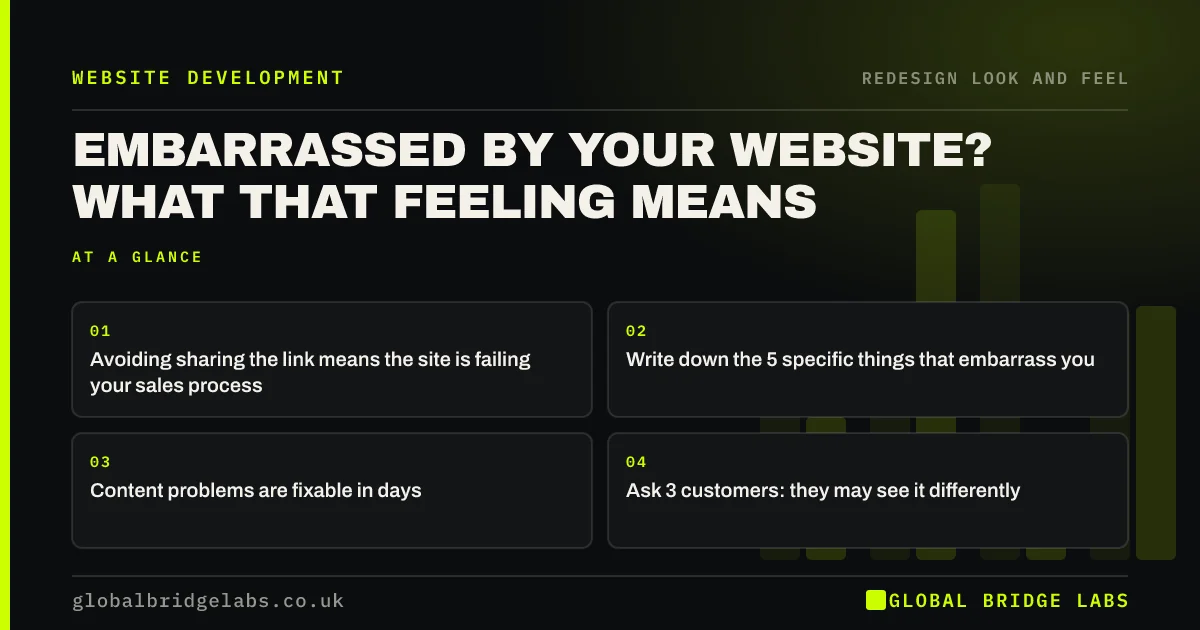
- Avoiding sharing the link means the site is failing your sales process.
- Write down the 5 specific things that embarrass you.
- Content problems are fixable in days. Structure needs a redesign.
- Ask 3 customers: they may see it differently.
Embarrassed to share your website? Tell us why on WhatsApp.
Chat on WhatsApp →What does it mean if you are embarrassed by your website?
Being embarrassed by your website usually means it no longer reflects the business you run: the quality of your work, your prices, your services or your team. It is a useful signal because it shows up in behaviour, such as not sending the link or apologising for the site, which quietly costs enquiries.
How do you turn the feeling into a list?
Open the site on a phone and write down each thing that makes you wince. Be specific: 'the team photo is from 2019', not 'it looks old'. Most lists fall into three groups.
- Content: old photos, wrong prices, missing services, stale news.
- Credibility: no reviews, no case studies, no real people.
- Structure or platform: slow, awkward on mobile, hard to edit.
Send us your list on WhatsApp and we will sort it into fix now and redesign.
Chat on WhatsApp →Is it a real problem or self-consciousness?
Test it. Ask three recent customers what they thought of the site and whether it influenced them. Compare it with two competitors buyers mention. If customers and the comparison agree it is weak, it is real. If not, the problem may be familiarity: you see it every day, they see it once.
What does it cost if nobody shares the link?
More than it seems. Referrals and sales conversations usually end with a buyer checking your website. If your team avoids sending it, or sends a PDF instead, the site is not doing its job at the moment of highest intent. Proof of your work is then missing exactly when it matters most.
When does it justify a redesign?
When the list is mostly structural: the site cannot show your work well, it is slow and awkward on phones, or nobody can edit it. Or when the business has moved upmarket and the design signals a lower price level than you now charge. Content fixes will not solve those.
What should you fix first?
The things buyers see at the moment of sharing: the homepage first screen, the team or About page, and the case studies or gallery. Updating those three areas with current photos, real work and plain descriptions often removes most of the embarrassment within a fortnight.
What can you fix in a fortnight?
Most content and credibility problems can be fixed in two weeks without a designer. Updating photos, rewriting the homepage headline, adding recent case studies and correcting prices are content jobs, and they account for most of what owners find embarrassing.
Plan it as a short sprint: week one gathers photos, reviews and case study details; week two updates the pages. At the end, send the link to three people you trust and ask whether they would be happy to share it. If the answer is yes, the redesign can wait.
- Week 1: gather photos, reviews and case studies.
- Week 2: update homepage, team and work pages.
- Correct prices, services and contact details.
- Ask three trusted people for honest feedback.
What does this look like in practice?
A pattern in UK professional services: partners send prospects a capabilities PDF because the website shows the firm as it was five years ago. Updating the team page, adding three recent case studies and rewriting the homepage lets them send the link again, and the PDF is retired.
Embarrassment audit
Work through these in one sitting.
- Open the site on a phone and list every wince.
- Sort the list into content, credibility and structure.
- Ask three customers what they thought of the site.
- Fix content and credibility items within two weeks.
- Re-check whether you would now share the link.
- Plan a redesign only if structural items remain.
Next step
If you avoid sharing your website, we will go through your list with you in 30 minutes and tell you what can be fixed this month and what needs a redesign.
Message us on WhatsApp to talk it through, or book a 30-minute consultation.
Chat on WhatsApp →Sources and further reading
- User research · GOV.UK Service Manual
- Creating helpful, reliable, people-first content · Google Search Central
- Writing to GOV.UK standards: writing guidelines · GOV.UK
Frequently asked questions
Should I redesign my website if I am embarrassed by it?
Only if the problems are structural, such as a site that is slow or hard to use on phones, a platform nobody can edit, or a design that signals the wrong price level. If the problems are content, such as old photos, missing services or no proof, fix those first; it is faster and cheaper.
What if my sales team will not send people to our website?
Ask them exactly why and write it down. Their reasons are the most practical brief you will get. The site should support the moment after a conversation, when buyers check you out, so it needs current proof, clear services and an easy next step.
How do I know if my website reflects my business well?
Compare what the site says with what you sell today: services, prices, team, quality of work and the customers you serve. Ask three recent customers what they thought. If the site describes the business as it was years ago, it is not reflecting you well.
What should I update first on an embarrassing website?
Start with what buyers see first: the homepage first screen, the team or About page, and the gallery or case studies. Current photos, real work and plain descriptions of your services usually remove most of the problem quickly. Then review whether the feeling has gone.
Written by

Global Bridge Labs (GBL) is a UK–Sri Lanka partner for social media, websites and BPO. Everything here comes from client delivery, not theory.