On this page
- 01Key takeaways
- 02What are creator usage rights?
- 03How are usage rights priced?
- 04What is whitelisting?
- 05What should the agreement say?
- 06When are broad rights not worth paying for?
- 07What does this look like in practice?
- 08Usage rights checklist
- 09Next step
- 10Sources and further reading
- 11Frequently asked questions
Key takeaways
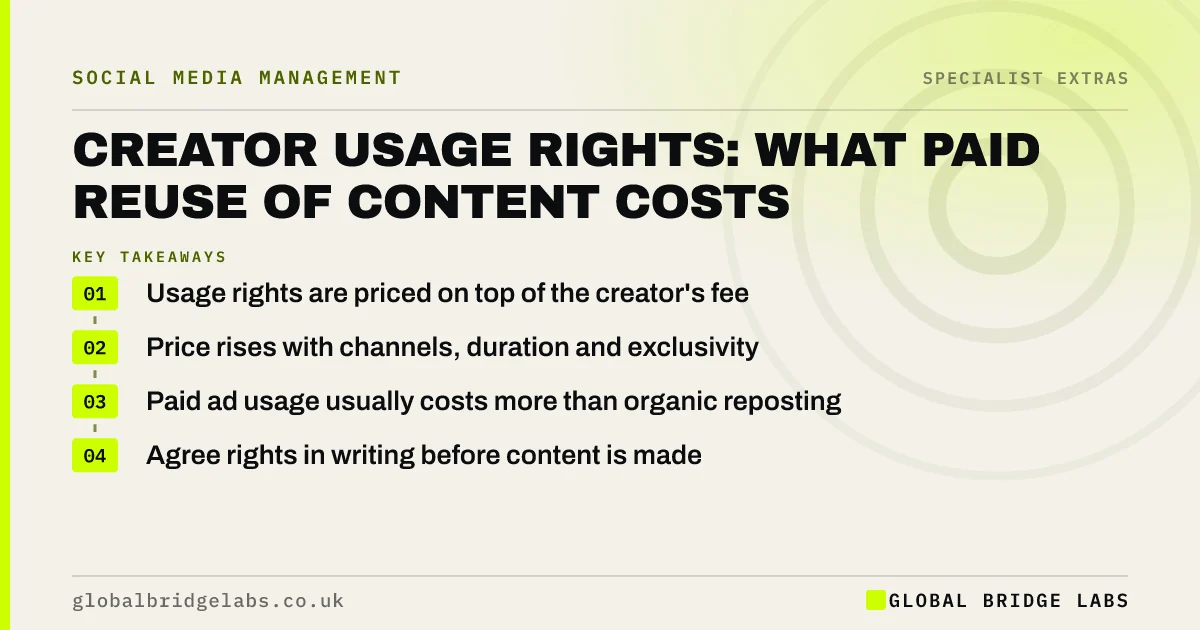
An influencer usage rights fee pays for reusing a creator's content beyond their own feed, such as in your ads or on your website. It is usually priced on top of the creation fee and rises with the channels, duration and exclusivity you want. Agree it in writing before the content is made.
- Usage rights are priced on top of the creator's fee.
- Price rises with channels, duration and exclusivity.
- Paid ad usage usually costs more than organic reposting.
- Agree rights in writing before content is made.
Want creator content you can actually reuse? Message us on WhatsApp.
Chat on WhatsApp →What are creator usage rights?
Creator usage rights are permissions to use content made by an influencer or user-generated content (UGC) creator in specific ways: on your organic channels, in paid ads, on your website or in print, for a set period. Copyright usually stays with the creator unless it is assigned.
How are usage rights priced?
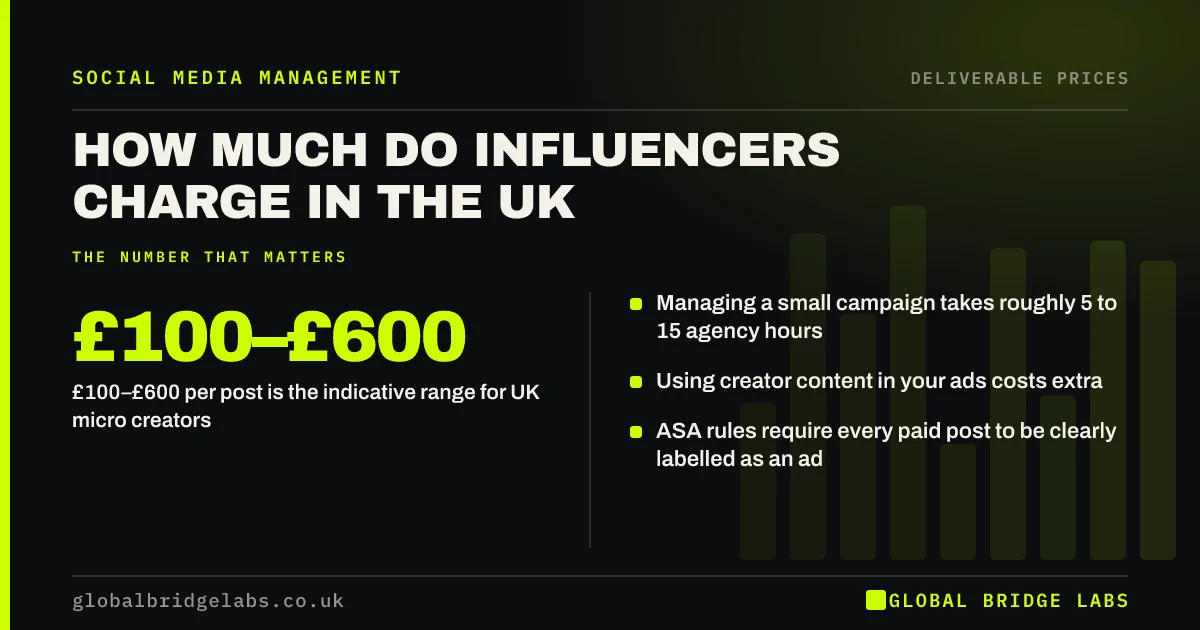
Creators price usage on top of their creation fee, for example the indicative £100–£600 a micro creator charges per post. The rights fee rises with more channels, a longer period, paid ad use and exclusivity that stops them working with competitors. Ask for each option priced separately.
- Organic reposting on your channels: usually the cheapest.
- Paid ad usage: usually more.
- Longer periods: more.
- Exclusivity in your category: often the most.
Want creator rights priced into your campaign? Send us the plan on WhatsApp and we will discuss your requirements.
Chat on WhatsApp →What is whitelisting?
Whitelisting, sometimes called creator licensing or partnership ads, means running ads through or alongside the creator's own account, so the ad appears with their name. It needs the creator's permission inside the platform and usually a separate fee, because their name and audience are involved.
What should the agreement say?
The agreement should list the content, the channels, paid ad use, the start and end dates, any exclusivity, whether you can edit the content and what happens when the period ends. Without a written agreement, reuse can lead to disputes or takedowns.
When are broad rights not worth paying for?
Broad, long rights are not worth paying for before you know the content works. Start with a short period for paid ads, test the content, and extend rights only for the pieces that perform. Paying for a year of rights on every video wastes budget.
What does this look like in practice?
A pattern we see with UK e-commerce clients: a creator video performs well organically, but nobody agreed ad usage, so it cannot be promoted. Global Bridge Labs (GBL) agrees short paid usage in every creator brief, then extends rights only for the videos that bring sales.
Usage rights checklist
Agree these before the content is made.
- Channels the content may appear on.
- Paid ad use and whitelisting.
- Start and end dates.
- Exclusivity, if any.
- Editing rights and raw footage.
Next step
Tell us how you want to use creator content. We will tell you what rights to ask for and how to keep the cost sensible.
Message us on WhatsApp for a creator rights plan, or book a 30-minute consultation.
Chat on WhatsApp →Sources and further reading
- How copyright protects your work · GOV.UK
- Influencers' guide to making clear that ads are ads · ASA / CAP
- Click-to-message ads · Meta
Frequently asked questions
How much do influencer usage rights cost?
Usage rights are priced on top of the creator's fee, for example the indicative £100–£600 a UK micro creator charges per post. The rights fee rises with more channels, longer periods, paid ad use and exclusivity. Ask creators to price each option separately.
Can I use an influencer's post in my ads?
Only with their written permission. Paid ad use is usually a separate licence from the original post. Agree the channels, period and any whitelisting in writing, and label the ad clearly as advertising.
How long should usage rights last?
Start short, such as one to three months for paid ads, and extend for content that performs. Long rights on untested content waste budget. Agree what happens at the end of the period, including removing ads.
Do I own content I pay a creator to make?
Not automatically. Copyright usually stays with the creator unless the contract assigns it to you. Most creator agreements grant a licence for specific uses instead, so check exactly what you are buying.
Written by

Global Bridge Labs (GBL) is a UK–Sri Lanka partner for social media, websites and BPO. Everything here comes from client delivery, not theory.