On this page
- 01Key takeaways
- 02Why is formal A/B testing unrealistic for small accounts?
- 03What should you test first?
- 04How do you run a fair test?
- 05How do you read the result honestly?
- 06Can paid promotion help testing?
- 07When is testing not worth the effort?
- 08What does this look like in practice?
- 09Content testing checklist
- 10Next step
- 11Sources and further reading
- 12Frequently asked questions
Key takeaways
Testing social media content with a small audience means comparing post types over several weeks, not splitting one post into two versions. Change one thing, run each version at least four times, and judge on buyer signals. Small accounts cannot prove fine differences, but they can find large ones.
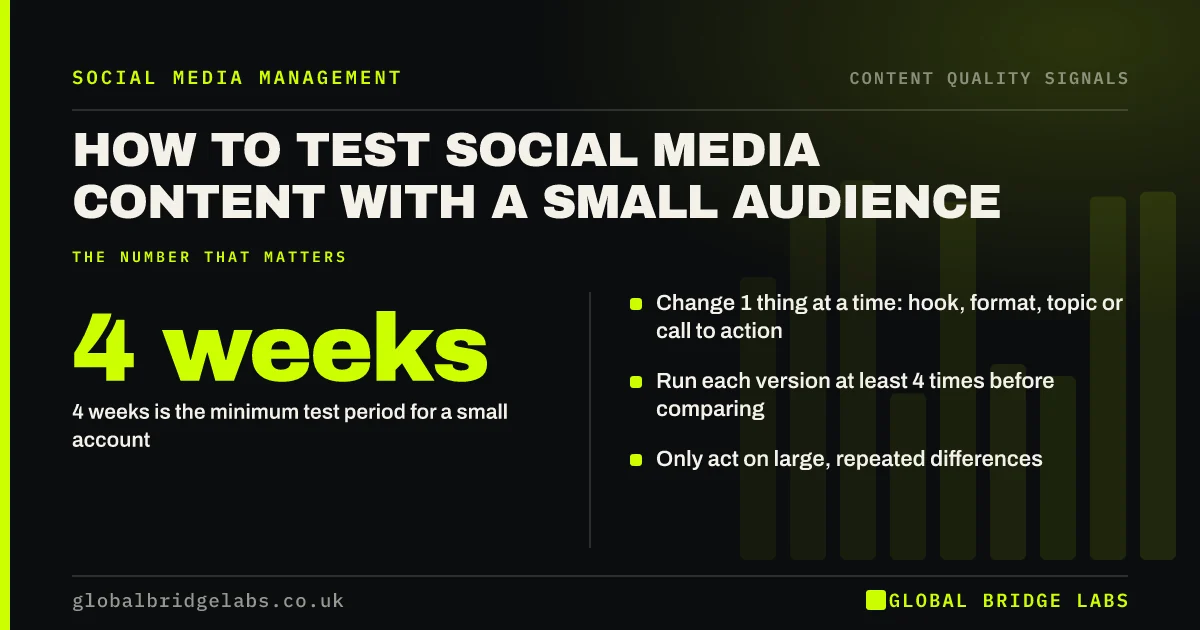
- Change 1 thing at a time: hook, format, topic or call to action.
- Run each version at least 4 times before comparing.
- 4 weeks is the minimum test period for a small account.
- Only act on large, repeated differences.
Want a simple test designed for your account? Message us on WhatsApp.
Chat on WhatsApp →Why is formal A/B testing unrealistic for small accounts?
Formal A/B testing needs large samples to separate a real difference from chance, often thousands of views per version. A small account reaching a few hundred people per post cannot supply that. What it can do is repeat a comparison enough times that a clear winner shows.
What should you test first?
Test the things most likely to change who responds: the type of post, the hook, whether a price signal is included, and the call to action. Leave colours, fonts and posting minute until the large questions are settled. Start with the one you most disagree about internally.
- Post type: proof post against tip post.
- Hook: question against result.
- Price signal: with a range against without.
- Call to action: message against link.
How do you run a fair test?
Write down the question and what you expect. Alternate the two versions on the same days and times for four weeks, keeping everything else alike. Record the same measures for each post. Compare the averages at the end, not post by post as you go.
- State the question and your prediction.
- Alternate versions on matching days.
- Keep topic, length and image style similar.
- Record saves, profile visits, messages and enquiries.
- Compare averages after four weeks.
Send us the question you want answered on WhatsApp and we will discuss your requirements.
Chat on WhatsApp →How do you read the result honestly?
Act only on differences that are large and repeated. If one version beat the other in three of four pairs by a wide margin, adopt it. If results are mixed or close, treat it as no difference and choose on effort. One exceptional post proves nothing.
Can paid promotion help testing?
Yes. A small budget can put two versions in front of the same defined audience at the same time, which removes much of the noise. Even £5 to £10 a day for a week gives a fairer comparison than organic posts a week apart. Keep the audience identical for both.
When is testing not worth the effort?
Testing is not worth the effort when the basics are missing. If posts lack a next step or the bio does not say what you do, fix those first. No test is needed to know they matter. Test once the foundations are in place and the question is truly open.
What does this look like in practice?
A pattern we see with UK small businesses that test properly for the first time: the result contradicts the owner's assumption about as often as it confirms it, most commonly on whether to mention price.
Content testing checklist
For each test.
- One variable is changed.
- The question and prediction are written down.
- Each version runs at least four times.
- Days and times are matched.
- Buyer signals are recorded for every post.
- Only a large, repeated difference leads to a change.
Next step
Pick the one content question your team argues about most. Write it down with your prediction and start the four-week test on Monday.
Message us on WhatsApp for the four-week test sheet, or book a 30-minute consultation.
Chat on WhatsApp →Sources and further reading
- Sample size calculator for A/B tests · Evan Miller
- Meta Business Help Centre · Meta
- Minimise A/B testing impact in Google Search · Google Search Central
Frequently asked questions
How do I test social media content?
Change one thing, such as the hook or the post type, and alternate the two versions on matching days for at least four weeks. Record saves, profile visits, messages and enquiries, and compare the averages at the end. Write the question down first.
Can small accounts A/B test posts?
Not in the strict statistical sense, because the audience is too small. They can run repeated comparisons that reveal large differences. A modest paid budget, showing both versions to the same audience, makes the comparison fairer. Keep the budget, timing and audience the same for both.
What should I test first?
Test what changes who responds: post type, opening line, whether you include a price signal and the call to action. Cosmetic details such as colours are unlikely to produce a difference you can detect. Pick the question your team disagrees about most.
How long should a content test run?
At least four weeks for organic posts, with each version published a minimum of four times. Shorter tests are dominated by chance, such as the day of the week or one unusually popular post. Compare averages across the whole period, not individual posts.
Written by

Global Bridge Labs (GBL) is a UK–Sri Lanka partner for social media, websites and BPO. Everything here comes from client delivery, not theory.