On this page
- 01Key takeaways
- 02How much time does social media take per week?
- 03What are the hours actually spent on?
- 04Which hidden costs do plans forget?
- 05How do you cut the hours without cutting quality?
- 06When is outsourcing the hours the right answer?
- 07What does this look like in practice?
- 08How do you track the hours honestly?
- 09Next step
- 10Sources and further reading
- 11Frequently asked questions
Key takeaways
Budget 3-8 hours a week per channel depending on format, and remember that publishing is only about a fifth of the work. The hours that break plans are community management, native adaptation and the reporting nobody schedules.
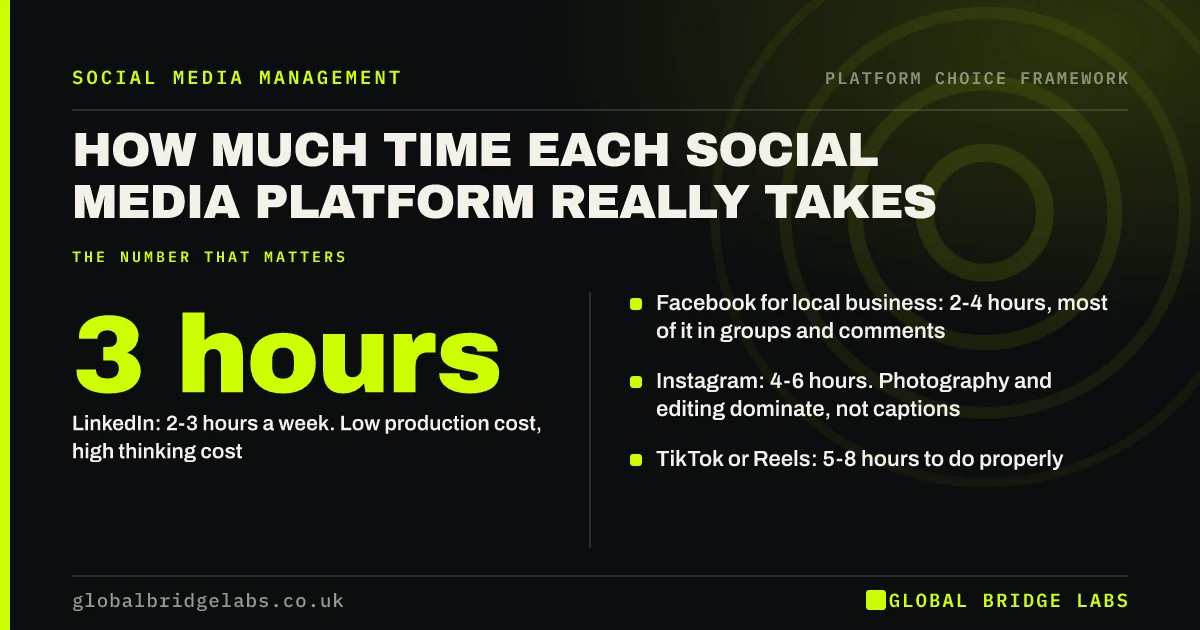
- LinkedIn: 2-3 hours a week. Low production cost, high thinking cost.
- Facebook for local business: 2-4 hours, most of it in groups and comments.
- Instagram: 4-6 hours. Photography and editing dominate, not captions.
- TikTok or Reels: 5-8 hours to do properly. Video is a production commitment.
- YouTube or Pinterest: 6-10 hours a week for long form, 1-2 for pins.
Want your real weekly hours worked out before you commit? Message us on WhatsApp.
Chat on WhatsApp →How much time does social media take per week?
Between 3 and 8 hours per channel for a small UK business doing the job properly, with text-first channels at the low end and video-led channels at the top. A two-channel plan therefore costs somewhere between 6 and 14 hours a week, which is most of a part-time marketing role.
That is the number to budget against, because the alternative is discovering it in month three when quality has already slipped and the person doing it has started to dread Monday.
What are the hours actually spent on?
Not publishing, which is the assumption behind almost every underestimate. A realistic breakdown for one photo-led channel at three posts a week.
- Planning and idea capture: 30 minutes.
- Production, shooting and editing: 2-3 hours. This is the real cost.
- Copywriting and native adaptation: 45 minutes.
- Scheduling and publishing: 30 minutes.
- Comments, direct messages and reviews: 1-2 hours, and it does not batch.
- Reporting and review: 30 minutes a week or 2 hours a month.
Which hidden costs do plans forget?
Three, and together they usually account for the gap between the plan and reality. Community management is the largest: replies do not batch, they arrive when they arrive, and they are where enquiries actually convert. Native adaptation is the second: the same asset needs different crops, captions and hooks per platform, and cross-posting identical content performs visibly worse.
The third is context switching. Fifteen minutes on a channel three times a day costs more than 45 minutes, because each switch carries a restart cost. This is the strongest practical argument for fewer channels and fixed time blocks.
We take the community management load off UK teams. Ask us how on WhatsApp.
Chat on WhatsApp →How do you cut the hours without cutting quality?
Four moves, in order of return. Batch production into one session a fortnight so the setup cost is paid once. Build a library of repeatable formats so each post is assembly rather than invention. Fix community management into two 20-minute windows a day rather than constant checking. And cut a channel, which is by far the largest single saving available.
What does not work is scheduling further ahead. A month of scheduled posts with nobody replying to messages produces a busy-looking account and no enquiries.
When is outsourcing the hours the right answer?
When the constraint is capacity rather than judgement. If you know what to say and cannot find the hours to say it, outsourcing production and community management works well. If you do not yet know what to say, outsourcing produces polished content about nothing.
The sequence that works is strategy first, in-house, then production and response handling moved out once the pillars, tone and approval route are written down. UK salary comparisons can be checked against ONS earnings data, but the comparison that matters is not agency versus staff cost. It is either of those against the hours you currently do not have.
What does this look like in practice?
A UK independent estate agency budgeted two hours a week across three channels. The actual requirement was closer to nine, so what happened instead was a burst of posting for three weeks followed by a month of silence, repeated indefinitely.
Cutting to one channel with a fortnightly two-hour batching session and two daily 15-minute reply windows brought the commitment to around four hours a week, which the office manager could genuinely hold. Consistency arrived for the first time in two years, and consistency is what both the algorithm and the local audience were waiting for.
How do you track the hours honestly?
For two weeks, write down every minute spent on anything social: deciding what to post, taking photographs, editing, writing, publishing, replying and checking the numbers. Include the time spent thinking about it while doing something else, because that is real cost even though it does not look like work.
Almost every business finds a gap of two to four hours a week between the plan and the reality. Knowing the true number is what makes the channel decision honest, because a plan built on hours you do not have will fail in month three regardless of how good the content is.
Next step
Track your social media hours honestly for two weeks, including replies and the time spent deciding what to post. Compare the total with your plan. Almost everyone finds a gap, and closing it by cutting a channel is quicker and more effective than trying to find the hours.
Message us on WhatsApp and we will build a channel plan that fits the hours you actually have.
Chat on WhatsApp →Sources and further reading
- Employee earnings in the UK (Annual Survey of Hours and Earnings) · Office for National Statistics
- Meta Business Help Centre · Meta
Frequently asked questions
How many hours a week should a small business spend on social media?
Six to fourteen hours for a two-channel plan, depending on format. Text-first channels cost 2-3 hours each, photo-led channels 4-6, and video-led channels 5-8. Publishing is only about a fifth of that; production and replies dominate.
Which social media platform takes the least time?
Pinterest once a library exists, at roughly 1-2 hours a week, because it behaves like a search engine and content keeps working for months. LinkedIn is the least time-hungry of the true social feeds at 2-3 hours, since it needs thinking rather than production.
Can scheduling tools reduce social media hours?
They save publishing time, which is the smallest cost. They do not touch production, native adaptation or replies, which are where the hours go. Expect a saving of roughly 30 minutes a week per channel, not a transformation.
Is it worth outsourcing social media to save time?
Yes when you know what to say and lack the hours to say it. Outsource production and community management after your pillars, tone and approval route are written down. Outsourcing before that produces polished content about nothing in particular.
Written by
Global Bridge Labs (GBL) is a UK–Sri Lanka partner for social media, websites and BPO. Everything here comes from client delivery, not theory.