On this page
- 01Key takeaways
- 02How does team size affect channel count?
- 03What does each staffing level support?
- 04Why does adding people not always help?
- 05What should be owned by one person?
- 06When should you outsource rather than hire?
- 07What does this look like in practice?
- 08What should you document before you grow?
- 09Next step
- 10Sources and further reading
- 11Frequently asked questions
Key takeaways
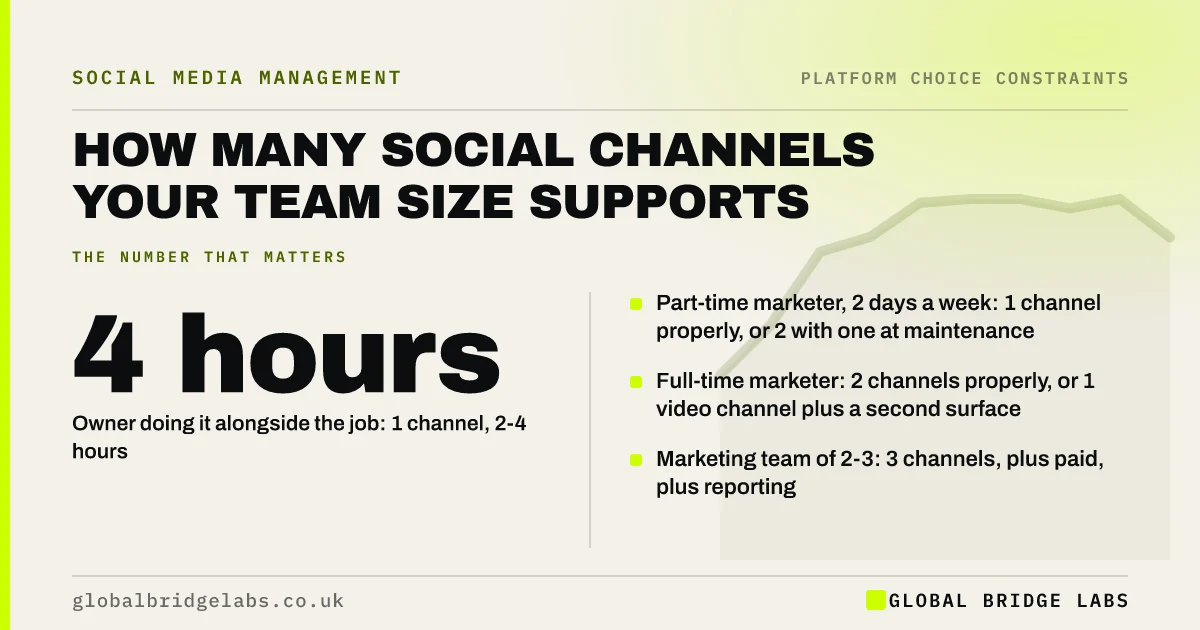
Channel capacity is set by hours, not headcount. A business with one part-time marketer supports one channel properly. Two channels needs roughly 12 hours a week. Three needs a dedicated person, and four rarely makes sense at any small business size.
- Owner doing it alongside the job: 1 channel, 2-4 hours.
- Part-time marketer, 2 days a week: 1 channel properly, or 2 with one at maintenance.
- Full-time marketer: 2 channels properly, or 1 video channel plus a second surface.
- Marketing team of 2-3: 3 channels, plus paid, plus reporting.
- Adding people without adding process makes output slower, not faster.
Not sure what your team can sustain? Tell us the setup on WhatsApp.
Chat on WhatsApp →How does team size affect channel count?
Through available hours rather than headcount, which sounds obvious and is routinely ignored when plans are made. A business with four people does not have four people's worth of marketing capacity; it usually has whatever is left of one person's week.
Work out the genuinely available marketing hours in a normal busy week, then allocate roughly six hours per channel for a properly run one. That arithmetic produces a more honest answer than any discussion of ambition.
What does each staffing level support?
Five common UK small business configurations and what each can genuinely hold.
- Owner alongside the job: 1 channel, 2 posts a week, replies twice daily.
- Admin doing marketing part-time: 1 channel properly plus a Google Business Profile.
- Dedicated part-time marketer: 1 channel at full cadence, or 2 with one on maintenance.
- One full-time marketer: 2 channels, or 1 video channel with a secondary surface.
- Team of 2-3: 3 channels with paid campaigns and proper reporting.
Why does adding people not always help?
Because coordination cost rises faster than capacity when there is no process. Two people sharing a channel with no agreed approval route, tone guide or content plan will produce less than one person working alone, and the output will be inconsistent.
The prerequisite for a second person is written pillars, a tone guide, a clear approval rule and a single owner of the inbox. Without those, the second person spends their time asking questions and the first person spends theirs answering them.
We will document your process so adding people actually adds output. Ask on WhatsApp.
Chat on WhatsApp →What should be owned by one person?
The inbox, always. Shared responsibility for replies means messages go unanswered because everyone assumes someone else has seen it, and that is where enquiries are lost.
Content production can be shared, scheduling can be shared, and reporting can rotate. Community management should have exactly one owner per channel with a named cover arrangement for holidays. This single rule prevents most of the failures we see in small marketing teams.
When should you outsource rather than hire?
When you need one channel run consistently rather than a marketing function built. A full-time UK marketing hire carries salary, employer National Insurance, pension contributions and holiday cover, and ONS earnings data makes the total cost easy to underestimate.
Outsourcing production and community management while keeping strategy and approvals in-house is the arrangement that works most often for UK businesses under about 25 staff. It buys consistency without buying a permanent overhead, and it can be scaled back down.
What does this look like in practice?
A UK equipment supplier hired a second marketing person to add two channels and found output fell for a quarter. There was no tone guide, no approval rule and no owner for the inbox, so both people checked with each other constantly.
Writing four pages of process, pillars, tone, approval and inbox ownership, resolved it in a fortnight. The same two people then ran three channels comfortably. The constraint had been coordination rather than capacity the whole time.
What should you document before you grow?
Four pages, and they are worth more than a fifth channel. Your content pillars, your tone, your approval rule, and who owns the inbox.
Content pillars stop every post starting from a blank page. Tone stops two people sounding like two businesses. The approval rule stops work stalling while somebody waits for an answer nobody knew they owed. Inbox ownership stops enquiries being missed.
None of it takes longer than an afternoon to write, and it is the difference between a second person adding output and a second person adding coordination. Businesses that skip it usually conclude, wrongly, that they need a third person.
Write it before the hire rather than after, so the new person has something to read in week one rather than a series of questions to ask.
Next step
Count your genuinely available weekly marketing hours and divide by six. That is how many channels you can run properly. If the answer is one and you are running three, the staffing question has already been answered.
Message us on WhatsApp and we will size your channel plan to your team.
Chat on WhatsApp →Sources and further reading
- Employee earnings in the UK (Annual Survey of Hours and Earnings) · Office for National Statistics
- Rates and thresholds for employers 2026 to 2027 · HM Revenue & Customs
Frequently asked questions
How many social media channels can a small team manage?
Roughly one channel per six genuinely available marketing hours a week. An owner doing it alongside the job supports one channel; a full-time marketer supports two; a team of two or three supports three with paid and reporting.
Why does adding marketing staff not increase output?
Because coordination cost rises faster than capacity when there is no process. Two people sharing a channel with no tone guide, approval rule or content plan will produce less than one person working alone, and what they produce will be less consistent.
What should have a single owner in a marketing team?
The inbox, always, with one named owner per channel and a named holiday cover arrangement. Shared reply responsibility means messages go unanswered because everyone assumes somebody else has seen them, and that is precisely where enquiries get lost.
Should you hire or outsource social media?
Outsource when you need one channel run consistently rather than a whole marketing function built. A full-time UK hire carries salary, employer National Insurance, pension contributions and holiday cover, and the total is easy to underestimate.
Written by

Global Bridge Labs (GBL) is a UK–Sri Lanka partner for social media, websites and BPO. Everything here comes from client delivery, not theory.