On this page
- 01Key takeaways
- 02What is platform dependency risk?
- 03How exposed is your business?
- 04Why does a second social channel not help?
- 05How do you secure the account itself?
- 06What should you do about your data?
- 07What does this look like in practice?
- 08How do you turn followers into contacts?
- 09Next step
- 10Sources and further reading
- 11Frequently asked questions
Key takeaways
You rent your social audience and the landlord can change the terms without notice. Measure your exposure by asking what share of enquiries would disappear if one account vanished tomorrow, then reduce it with owned channels rather than more social channels.
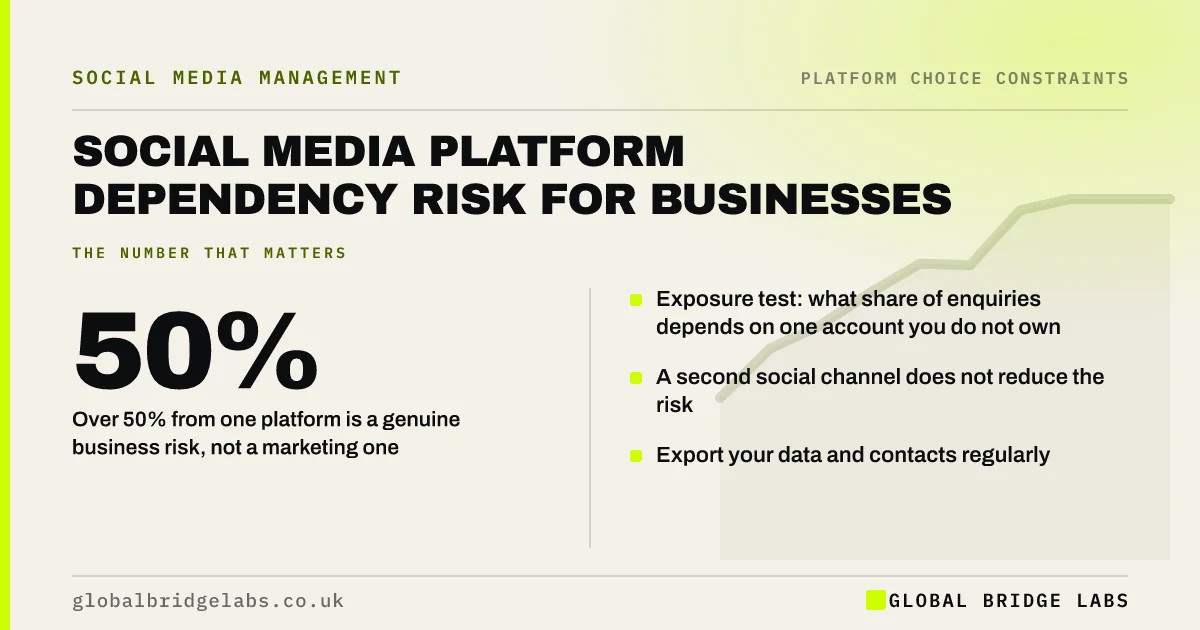
- Exposure test: what share of enquiries depends on one account you do not own?
- Over 50% from one platform is a genuine business risk, not a marketing one.
- A second social channel does not reduce the risk. An owned channel does.
- Export your data and contacts regularly. Most businesses never have.
- Secure the account properly. Most suspensions and losses are avoidable.
Want your platform exposure assessed? Message us on WhatsApp.
Chat on WhatsApp →What is platform dependency risk?
The risk that a business loses access to its customers because a third party changed something. It takes four forms: an algorithm change that reduces reach, a policy change that restricts your category, an account suspension, and a platform declining or closing.
All four have happened to UK businesses, and none of them come with notice or a useful appeal process. The relevant question is not whether it will happen but what share of your revenue would be affected when it does.
How exposed is your business?
Answer five questions honestly. The result is usually more alarming than people expect.
- What share of enquiries came from one platform in the last 6 months?
- Could you contact your customers if that account disappeared today?
- Do you hold customer contact details outside the platform?
- How many people can access the account, and is recovery possible if one leaves?
- Have you ever exported your data from it?
Why does a second social channel not help?
Because it carries the same category of risk and, frequently, the same owner. Two accounts under one corporate parent can be suspended together, and both are subject to the same kind of policy and algorithm change.
Diversification only works across different kinds of risk. An email list, a customer database and a website you control are genuinely different, because nobody can suspend them. That is why the mitigation for platform risk is owned channels rather than more channels.
We will build the owned channel behind your social presence. Ask on WhatsApp.
Chat on WhatsApp →How do you secure the account itself?
Most account losses we see are avoidable and have nothing to do with policy. Turn on two-factor authentication, make sure more than one trusted person has administrator access, and never tie the account to a personal profile that could be lost.
Keep the recovery email and phone number current, and check them annually. A business locked out because the recovery email belonged to a member of staff who left three years ago is a remarkably common and entirely preventable situation. The NCSC's small business guidance covers the basics well.
What should you do about your data?
Export it on a schedule, and hold customer contact details outside the platform. Most platforms allow a full export, and most businesses have never run one.
Under UK GDPR you are responsible for personal data you hold inside a platform account, so the export is also good practice for your records. Store it where your other customer data lives, apply your retention policy, and diary the next export for six months' time.
What does this look like in practice?
A UK vintage clothing seller took around 80% of orders through one social account with roughly 30,000 followers and no email list. The account was suspended in error and took eleven weeks to recover, during which the business had no way to reach a single customer.
It survived on savings. Afterwards, an email list was built from order records and now carries a meaningful share of sales independently. The lesson cost a quarter's revenue and was entirely preventable with an afternoon of work beforehand.
How do you turn followers into contacts?
By giving people a reason to hand over an email address or start a conversation, repeatedly and without apology. Nobody joins a list because you have one.
The reasons that work are specific and immediate: first access to availability, a price list, a checklist you would otherwise be asked for, or being told when something is back in stock. A monthly newsletter is not a reason.
Do it continuously rather than as a campaign. Converting even a small share of your audience each month compounds, and after a year you have something nobody can suspend, which is the only real answer to platform risk.
Track the number monthly alongside your follower count, because it is the figure that actually reduces your exposure.
Make the ask part of your normal posting rhythm rather than a campaign, so it keeps working in the months when nobody is thinking about risk.
Next step
Work out what share of your enquiries came from one platform last quarter. If it is over half, spend this month building a way to contact those customers directly, because you currently cannot.
Message us on WhatsApp and we will reduce your platform dependency this quarter.
Chat on WhatsApp →Sources and further reading
- Small Business Guide: cyber security · National Cyber Security Centre
- Right to be informed (privacy information) · Information Commissioner's Office
Frequently asked questions
What is social media platform dependency risk?
The risk of losing access to your customers because a third party changed something: an algorithm change, a policy change, an account suspension, or a platform declining. None arrive with notice or a useful appeal process.
How do you reduce dependency on a social platform?
With owned channels rather than more social channels. An email list, customer database and your own website are genuinely different kinds of risk, because nobody can suspend them. A second social account carries the same exposure.
How do you protect a business social media account?
Turn on two-factor authentication, give administrator access to more than one trusted person, never tie the account to a personal profile that could be lost with a leaver, and check that the recovery email and phone number still belong to the business annually.
Should you export your social media data?
Yes, on a schedule. Most platforms allow a full export and most businesses have never run one. You remain responsible under UK GDPR for personal data held inside the account, so it is also good records practice.
Written by

Global Bridge Labs (GBL) is a UK–Sri Lanka partner for social media, websites and BPO. Everything here comes from client delivery, not theory.