On this page
- 01Key takeaways
- 02Why forecast sales from social media?
- 03How do you build the forecast?
- 04How do you forecast the effect of changes?
- 05How does the forecast help with staffing?
- 06How do you check the forecast?
- 07What are the limits of forecasting?
- 08What does this look like in practice?
- 09Forecast checklist
- 10Next step
- 11Sources and further reading
- 12Frequently asked questions
Key takeaways
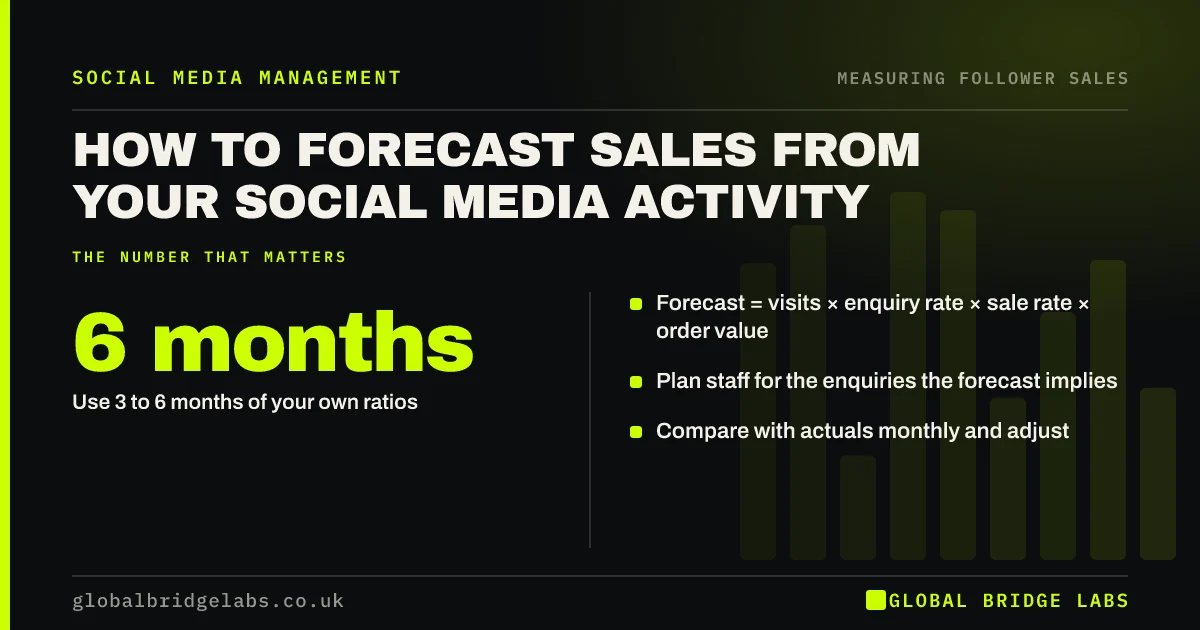
Forecast sales from social media by multiplying your own funnel ratios: expected reach or profile visits, times the share who enquire, times the share who buy, times average order value. Use the last three to six months of your own numbers, not industry averages, and check the forecast against actuals every month.
- Forecast = visits × enquiry rate × sale rate × order value.
- Use 3 to 6 months of your own ratios.
- Plan staff for the enquiries the forecast implies.
- Compare with actuals monthly and adjust.
Want a simple social media sales forecast built? Message us on WhatsApp.
Chat on WhatsApp →Why forecast sales from social media?
Forecasting turns social media from a cost into a planned source of revenue. It lets you set a budget against expected sales, plan who will answer enquiries, and spot quickly when something changes. A forecast that is roughly right is far more useful than none.
How do you build the forecast?
Start from the stage you can best predict, usually profile visits or website sessions from social, then apply your own ratios. Use a three- to six-month average for each ratio to smooth out unusual months.
- Profile visits next month: 800.
- Visit to enquiry: 3% = 24 enquiries.
- Enquiry to sale: 25% = 6 customers.
- Average order value: £900 = £5,400 forecast sales.
- All figures are illustrative.
How do you forecast the effect of changes?
Model a change by adjusting one ratio at a time. If faster replies are expected to lift enquiry-to-sale from 25% to 33%, the same 24 enquiries give 8 customers, or £7,200. Keep the assumption modest and test it, rather than assuming every improvement at once.
Want to model what a change could be worth? Message us on WhatsApp and we will discuss your requirements.
Chat on WhatsApp →How does the forecast help with staffing?
The forecast tells you how many enquiries to expect, which tells you how many hours replying and quoting will take. If a campaign is forecast to double enquiries, plan who will answer them before it runs. Unanswered enquiries are the most expensive way for a forecast to fail.
How do you check the forecast?
Compare forecast and actual at each stage every month. If visits were right but enquiries were low, the path or offer changed. If enquiries were right but sales were low, follow-up or price changed. The stage that missed tells you where to look.
What are the limits of forecasting?
Forecasts depend on platforms behaving as before, and they do not: reach changes with algorithm updates, seasons shift demand, and one viral post distorts a month. Treat the forecast as a range, review it monthly and do not commit fixed costs on the top of the range.
What does this look like in practice?
A pattern we see: a business runs a campaign that doubles enquiries for a fortnight, but nobody planned for the volume and many go unanswered. A one-line forecast before the campaign would have shown the hours needed.
Forecast checklist
- Collect three to six months of funnel numbers.
- Calculate average ratios.
- Forecast each stage for next month.
- Plan staffing for forecast enquiries.
- Compare with actuals monthly.
- Use a range, not a single number.
Next step
Write next month's forecast on one line using your own ratios, and put a reminder in your diary to compare it with actuals.
Message us on WhatsApp and we will help build the forecast, or book a 30-minute consultation.
Chat on WhatsApp →Sources and further reading
- About key events · Google Analytics Help
- Meta Business Help Centre · Meta
- LinkedIn Pages best practices · LinkedIn
Frequently asked questions
How do I forecast sales from social media?
Multiply expected profile visits or website sessions from social by your own enquiry rate, sale rate and average order value, using three to six months of your own data. Treat the result as a range and compare it with actual results each month.
Can I use industry averages to forecast?
Only as a last resort for a new business. Industry averages mix sectors, prices and definitions. Your own ratios, even from a few months, predict your results far better. Replace any assumed figures with real ones as soon as you have them.
How accurate are social media sales forecasts?
Roughly accurate at best, because reach, seasons and individual posts vary. A forecast that lands within a reasonable range is useful for budgeting and staffing. The bigger value is the monthly comparison, which shows which stage changed.
Written by

Global Bridge Labs (GBL) is a UK–Sri Lanka partner for social media, websites and BPO. Everything here comes from client delivery, not theory.