On this page
- 01Key takeaways
- 02Which platform is best for recruiting?
- 03What should a recruitment post contain?
- 04Why does short-form video work for early-career hiring?
- 05Should the careers feed be separate?
- 06What are the UK legal considerations?
- 07What does this look like in practice?
- 08Should you post when nothing is open?
- 09Next step
- 10Sources and further reading
- 11Frequently asked questions
Key takeaways
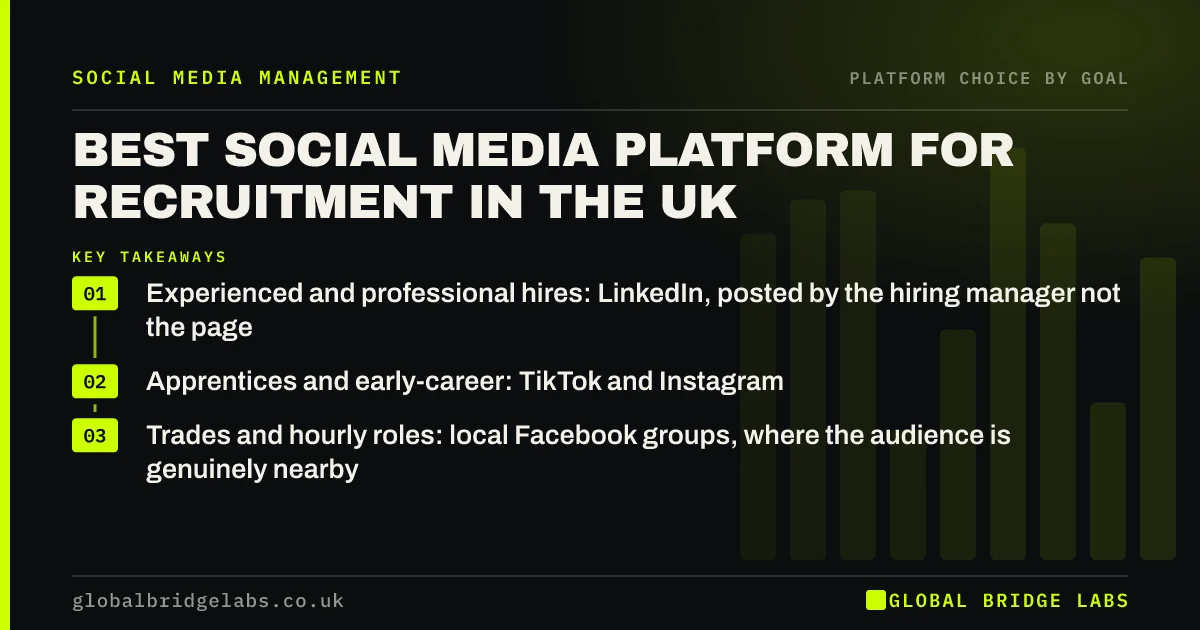
Your recruitment channel is rarely your sales channel. LinkedIn works for experienced and professional hires. Short-form video and local Facebook groups work for apprentices, trades and hourly roles. Posting a job to your sales feed reaches the wrong people entirely.
- Experienced and professional hires: LinkedIn, posted by the hiring manager not the page.
- Apprentices and early-career: TikTok and Instagram, showing the work not the values.
- Trades and hourly roles: local Facebook groups, where the audience is genuinely nearby.
- Show pay ranges. Job posts without pay get substantially fewer good applications.
- Separate the careers feed from the sales feed. They speak to different people.
Struggling to hire? Tell us the role on WhatsApp and we will name the channel.
Chat on WhatsApp →Which platform is best for recruiting?
It depends on the role, and the mismatch between hiring channel and sales channel catches most UK employers out. A business whose customers are on LinkedIn may need to hire people who have never opened it.
The rule that holds: go where the candidate spends attention, not where the customer does. For a plumbing firm hiring an apprentice, that is short-form video and local groups. For the same firm hiring a contracts manager, it is LinkedIn.
What should a recruitment post contain?
Specifics, and the pay range above all. Vague posts get volume and no quality; specific posts get fewer applications and better ones.
- The pay range. Omitting it reduces good applications more than any other factor.
- The hours, the location and whether travel is involved. Be exact.
- What the first 90 days actually look like, day to day.
- Who they would work with, by name and role.
- How to apply in one step. A ten-field form loses most of the good candidates.
Why does short-form video work for early-career hiring?
Because it shows the work rather than describing it, and younger candidates choose between jobs they can picture. A 30-second video of an actual day on site tells a 19-year-old more than a page of copy about values.
It also reaches people who are not looking. Most good candidates are not actively job hunting, and a video that makes a trade look interesting reaches them while a job advert never would. This is the strongest argument for running a careers presence continuously rather than only when a vacancy opens.
- Short-form video for small businesses without a studio
- Reaching students and graduates on social media in the UK
We will build a careers feed that runs year round. Message us on WhatsApp.
Chat on WhatsApp →Should the careers feed be separate?
Yes, once hiring is a continuous need rather than an occasional one. A feed that alternates between selling to customers and recruiting staff teaches both audiences that the account is not for them.
The cheap version is a clearly separated surface rather than a whole second channel: a highlight, a pinned post, or a careers tab, updated whenever something is open. The expensive mistake is running a second full channel for a role you hire once every two years.
What are the UK legal considerations?
Recruitment advertising is covered by the Equality Act 2010, so job posts must not directly or indirectly discriminate on protected characteristics. Phrasing like young and energetic or recent graduate can create indirect age discrimination even where no exclusion was intended.
Be careful with imagery too: a careers feed showing only one demographic communicates something you may not have intended and narrows your applicant pool. Write the requirements as capabilities the job genuinely needs and review the language before posting.
What does this look like in practice?
A UK groundworks contractor could not fill apprentice positions through the usual routes. Its LinkedIn presence was solid and irrelevant, because 17-year-olds were not there.
Filming one plain video a week on site, showing what the work involves and what an apprentice actually earns in year one, produced a stream of local enquiries within two months. The videos were shot on a phone, badly lit and entirely convincing, which is the point. Polished recruitment content reads as advertising; a real site does not.
Should you post when nothing is open?
Yes, and it is what separates businesses that fill roles quickly from those that panic-advertise. Most good candidates are not looking, so a careers presence that only appears when you have a vacancy reaches nobody who was not already job hunting.
A post a month showing what the work is actually like builds a small pool of people who have decided they would like to work for you before you need them. When a role opens, you have somewhere to announce it that already has the right audience rather than starting from an advert.
Next step
Ask your three most recent hires where they were when they decided to apply. That answer will name your recruitment channel more reliably than any platform comparison, and it is usually different from where your customers are.
Message us on WhatsApp and we will plan a recruitment channel for the roles you need.
Chat on WhatsApp →Sources and further reading
- Equality Act 2010 · legislation.gov.uk
- LinkedIn Pages best practices · LinkedIn
Frequently asked questions
Which social media platform is best for recruitment?
LinkedIn for experienced and professional hires, posted by the hiring manager rather than by the company page. Short-form video and local Facebook groups for apprentices, trades and hourly roles, where the candidates you want are not on professional networks at all.
Should job adverts include the salary?
Yes. Omitting the pay range reduces good applications more than any other single factor, because strong candidates screen out unknown pay rather than spending an hour on an application that may turn out to waste their time entirely.
Can you use the same account for sales and recruitment?
Only for occasional hiring, using a clearly separated surface such as a pinned post or highlight. For continuous hiring, separate the feeds, because alternating between customers and candidates teaches both audiences the account is not for them.
What are the legal rules for recruiting on social media in the UK?
Job advertising falls under the Equality Act 2010, so posts must not discriminate directly or indirectly on protected characteristics. Phrases such as young and energetic or recent graduate can create indirect age discrimination even where no exclusion was intended, so review the wording before posting.
Written by

Global Bridge Labs (GBL) is a UK–Sri Lanka partner for social media, websites and BPO. Everything here comes from client delivery, not theory.