On this page
- 01Short answer
- 02What changed?
- 03Where does it still work?
- 04How do you run it in two hours a week?
- 05Should you delete the account?
- 06What does this look like in practice?
- 07How do you monitor mentions without being active?
- 08What should you do with an account you are keeping quiet?
- 09Next step
- 10Sources and further reading
- 11Frequently asked questions
Short answer
For most UK small businesses, X is no longer a primary channel. It still has real value in three narrow cases: customer service for consumer-facing brands, reaching journalists and industry press, and specific technical or professional communities. Outside those, the hours are better spent elsewhere.
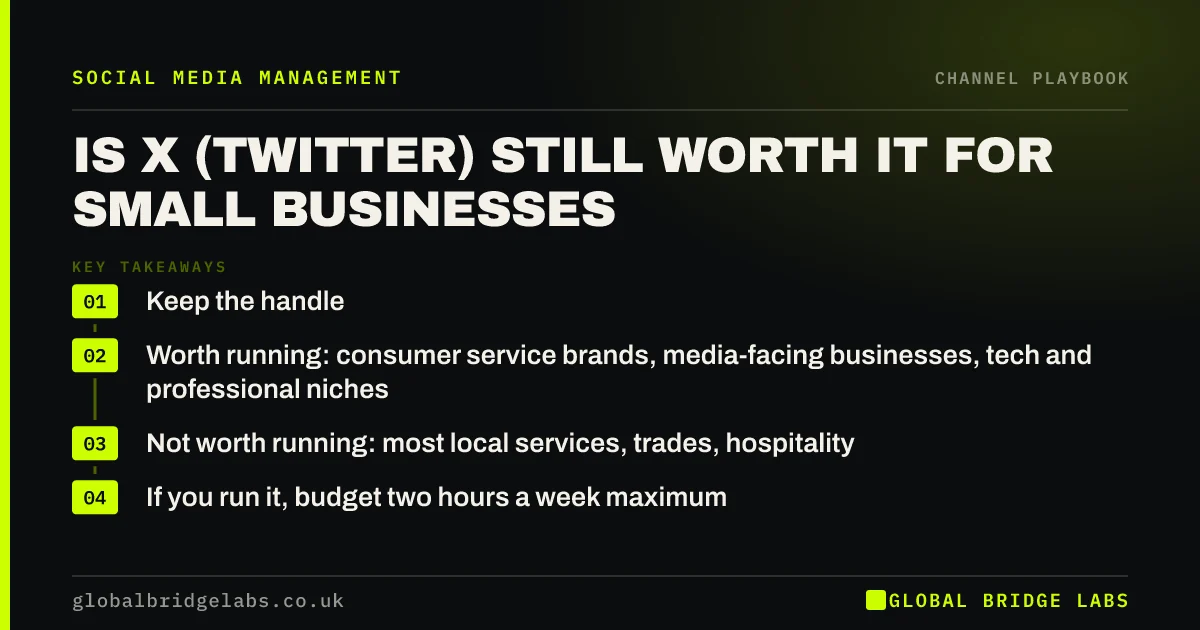
- Keep the handle. Claiming your brand name costs nothing and prevents impersonation.
- Worth running: consumer service brands, media-facing businesses, tech and professional niches.
- Not worth running: most local services, trades, hospitality and B2B selling to non-technical buyers.
- If you run it, budget two hours a week maximum.
- Monitor mentions regardless. Reputation issues surface here first.
Want a straight answer on whether to keep your account? Message us on WhatsApp.
Chat on WhatsApp →What changed?
Audience composition and advertiser confidence have shifted substantially, and the practical effect for small businesses is that organic reach to a UK commercial audience is harder to achieve than it was.
This is not a reason to delete the account. It is a reason to be honest about priority. A channel that takes four hours a week and produces one enquiry a quarter is not free, because those hours came from somewhere.
Where does it still work?
Three cases, each genuine.
Customer service for consumer brands, where people still complain publicly and expect a public response. Media relations, where UK journalists remain active and reachable. And technical or professional communities, particularly software, finance, policy and academia, where specific conversations continue to happen there and nowhere else.
- Consumer service: visible complaints handled visibly.
- Media: journalists, editors and industry press are still findable.
- Technical niches: developer, finance, policy and research communities.
- Local news and event amplification in some UK cities.
How do you run it in two hours a week?
Set alerts for your brand name, reply to anything that mentions you, and repurpose three posts a week from content you already made for other channels. That is the entire operation.
Do not build a bespoke content programme for it unless it is one of the three cases above. Repurposed content and responsive service is the right level of investment for an account you are keeping mainly for defensive reasons.
Send us your handle and your sector on WhatsApp and we will tell you whether to invest or maintain.
Chat on WhatsApp →Should you delete the account?
No. Keep the handle, because abandoning a brand name invites impersonation and squatting, both of which are harder to resolve than maintaining a quiet account.
If you are not going to post, leave a pinned message directing people to the channel you do maintain, with current contact details, and keep mention monitoring on. A dormant account with a clear signpost is fine. A dormant account with a 2023 post and no explanation is not.
What does this look like in practice?
A common misallocation: a small e-commerce team spends a few hours a week on X, producing content specifically for it, and can attribute almost no revenue to any of it.
Reducing it to mention monitoring plus repurposed posts, and moving the reclaimed hours to short-form video, usually costs nothing that was working. The one thing that improves on X is response time to service mentions, because nobody is spending their time producing original content for the platform any more.
How do you monitor mentions without being active?
Set three saved searches and check them weekly: your business name, your business name with common misspellings, and your name without the legal suffix. Most damaging mentions do not tag your account, which is exactly why searching beats relying on notifications.
Add your founders' names if they are publicly associated with the business, and any product or service name distinctive enough to be searched. Ten minutes a week covers it.
Have a documented route for what happens when something is found. Who is told, who replies, and within what time. A monitoring habit with no response procedure simply means you find out earlier and still do nothing.
- Saved searches: brand name, misspellings, name without suffix.
- Add founder names and distinctive product names.
- Ten minutes weekly is sufficient for a maintenance account.
- Document who responds and how fast before you need it.
What should you do with an account you are keeping quiet?
Put it into a defined maintenance state rather than leaving it ambiguous, so a visitor understands it is deliberate rather than abandoned.
Four steps. Update the bio to say where you are active and how to contact you. Pin a current post directing people there. Make sure the profile details, including the website and location, match every other platform. And keep two-factor authentication on, because a dormant account with a reused password is the most commonly compromised asset a small business holds.
Review it once a year alongside your audit. If the three conditions that would justify activity have appeared, reconsider; otherwise leave it as it is and spend the hour somewhere it pays.
- Bio states where you are active.
- Pinned post with current contact details.
- Profile details identical across platforms.
- Two-factor authentication on. Dormant accounts get compromised.
- Annual review as part of the audit.
Next step
Channel decisions are about where hours produce the most. For most UK small businesses, X is now a maintenance channel rather than a growth one, and that is a legitimate position to hold openly.
Message us on WhatsApp for an honest review of which channels deserve your hours.
Chat on WhatsApp →Sources and further reading
- Online Nation: how the UK uses online services · Ofcom
- Publishing consumer reviews and complying with consumer protection law · Competition and Markets Authority
Frequently asked questions
Should my small business still be on X?
Keep the handle to prevent impersonation, but treat it as a primary channel only if you are a consumer brand handling public service issues, you need reach with journalists, or your buyers are in a technical community that still gathers there.
How much time should I spend on X?
Two hours a week maximum unless it is one of the three cases where it still performs. That covers mention monitoring, replies and three repurposed posts. Building bespoke content for it is rarely justified for a UK small business now.
Is it bad to have an inactive social account?
Yes, if it looks abandoned without explanation, because a prospective customer may conclude you have stopped trading. Leave a pinned post directing people to the channel you maintain, with current contact details, and keep monitoring mentions.
Does X still matter for customer service?
For consumer-facing brands, yes. Public complaints still appear there and are still visible to others searching your name. Even businesses that post nothing should monitor mentions, because reputation issues frequently surface on X before anywhere else.
Written by

Global Bridge Labs (GBL) is a UK–Sri Lanka partner for social media, websites and BPO. Everything here comes from client delivery, not theory.