On this page
- 01Short answer
- 02Why is early adoption usually a bad bet for small businesses?
- 03What are the three signals worth acting on?
- 04How do you run a 60-day test?
- 05How do you claim a handle properly?
- 06How do you watch a platform without joining it?
- 07What are the risks of building on a new platform?
- 08Next step
- 09Sources and further reading
- 10Frequently asked questions
Short answer
Claim the handle immediately, and post nothing until three signals appear: your customers are there, the platform has a distribution mechanism that favours small accounts, and you can repurpose existing content into its format. Until then, the hours belong to the two channels that already pay.
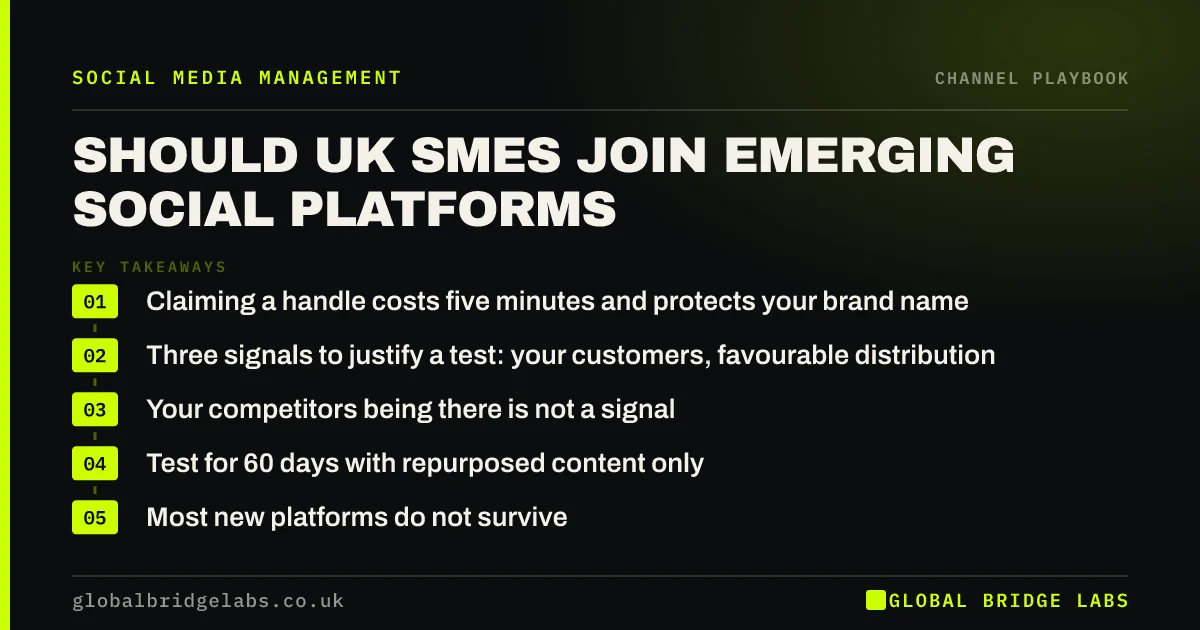
- Claiming a handle costs five minutes and protects your brand name.
- Three signals to justify a test: your customers, favourable distribution, cheap repurposing.
- Your competitors being there is not a signal. Your customers being there is.
- Test for 60 days with repurposed content only. Never build bespoke content for an unproven platform.
- Most new platforms do not survive. That is the base rate, not pessimism.
Wondering whether to test a new platform? Ask us on WhatsApp before you commit the hours.
Chat on WhatsApp →Why is early adoption usually a bad bet for small businesses?
Because the advantage of being early only pays if the platform succeeds, and most do not. A large business can absorb that risk across a portfolio of experiments. A small business is spending the only marketing hours it has.
The asymmetry matters. Being three months late to a platform that works costs you very little, because growth curves are long. Being early to a platform that fails costs you an entire quarter of content production.
What are the three signals worth acting on?
First, your actual customers mention it unprompted, or you see them there. Not people in your industry, and not commentary about it: your buyers.
Second, the distribution mechanism favours new accounts, which usually means recommendation-led feeds rather than follower-led ones. This is what made short video viable for small businesses with no audience.
Third, your existing content fits the format with minor adaptation. If the platform needs a genuinely new content type, the cost is not a test, it is a programme.
How do you run a 60-day test?
Repurposed content only, three posts a week, one owner, and a single question at the end: did anyone who was not already a customer start a conversation with us.
Set the decision rule before you start. Continue, stop, or maintain with minimal effort. Without a rule agreed in advance, tests become permanent commitments by default, which is how small teams end up on five platforms.
- Three posts a week, repurposed, for 60 days.
- One named owner, maximum one hour a week.
- Success measure: conversations with non-customers, not follower growth.
- Decision rule agreed before the test starts.
- If stopping, leave a pinned signpost rather than an abandoned profile.
We will design the test and the decision rule with you. Message us on WhatsApp.
Chat on WhatsApp →How do you claim a handle properly?
Register with a business email address that is not tied to one person, use the exact brand name you use elsewhere, complete the basic profile with your website, and add it to your access review list.
Then set a pinned post or bio line directing people to where you are active. This turns a dormant account from a liability into a signpost, which is the correct state for a platform you are watching rather than working.
How do you watch a platform without joining it?
Spend twenty minutes a quarter, not an hour a week. Check three things: whether any of your actual customers have mentioned it, whether the distribution still favours new accounts, and whether anyone in your sector is reporting enquiries rather than follower counts.
The signal that matters most is the third one. Early platform commentary is dominated by people whose business is commenting on platforms, and their incentives are not yours. A trades business posting about enquiries from a new platform is worth more than twenty articles about its growth rate.
Keep a one-line note per quarter for each platform you are watching. After a year you will have a record of whether the conditions are improving or whether the discussion has simply continued without anything changing underneath it.
- Twenty minutes a quarter, not an hour a week.
- Watch for customers mentioning it, not commentators discussing it.
- Look for businesses reporting enquiries, not growth rates.
- Keep a dated one-line note so you can see the trend.
What are the risks of building on a new platform?
Three, and the third is the one businesses discover too late.
The platform fails, and the audience you built disappears with it. The terms change, and reach or commercial features you relied on are withdrawn or priced. And the audience is rented rather than owned, which is true of every platform but bites hardest where you have no other route to those people.
The mitigation is the same in all three cases: move relationships off-platform as early as you reasonably can. A follower is a platform asset; an email address, a phone number with consent, or a saved customer record is yours. Any new platform test should include a route by which some proportion of the audience becomes contactable outside it.
- Platforms fail, and audiences do not transfer.
- Terms and reach change without notice.
- Followers are rented. Contact details are owned.
- Build an off-platform route into any test from the start.
Next step
Discipline about new platforms is what protects the consistency on the two channels that produce your enquiries. Saying no is part of the strategy.
Message us on WhatsApp for an honest view of whether a new platform is worth your hours.
Chat on WhatsApp →Sources and further reading
- Online Nation: how the UK uses online services · Ofcom
- Business population estimates · Department for Business and Trade
Frequently asked questions
Should I join every new social media platform?
No. Claim the handle to protect your brand name, then wait for three signals: your customers being there, a distribution mechanism that favours small accounts, and content you can repurpose cheaply. Your competitors being there is not a signal.
What is the risk of being late to a platform?
Low. Growth curves on successful platforms run for years, so arriving three months late costs very little. The larger risk is being early to a platform that fails, which costs a quarter of content production you cannot get back.
How long should I test a new platform?
Sixty days with repurposed content only, three posts a week, one owner and a maximum of an hour a week. Agree the continue, stop or maintain decision before you start, or the test quietly becomes a permanent commitment.
Should I claim my brand name on platforms I will not use?
Yes. It takes five minutes, prevents impersonation and handle squatting, and lets you add a pinned signpost to the channels you do maintain. Register with a shared business email rather than an individual's account.
Written by

Global Bridge Labs (GBL) is a UK–Sri Lanka partner for social media, websites and BPO. Everything here comes from client delivery, not theory.