On this page
- 01Short answer
- 02Is Facebook still worth it for UK small businesses?
- 03How do you use local Facebook groups properly?
- 04What should a business page contain?
- 05How much should you spend on Facebook ads?
- 06What about Facebook reviews?
- 07What does this look like in practice?
- 08Should you run your own Facebook group?
- 09Next step
- 10Sources and further reading
- 11Frequently asked questions
Short answer
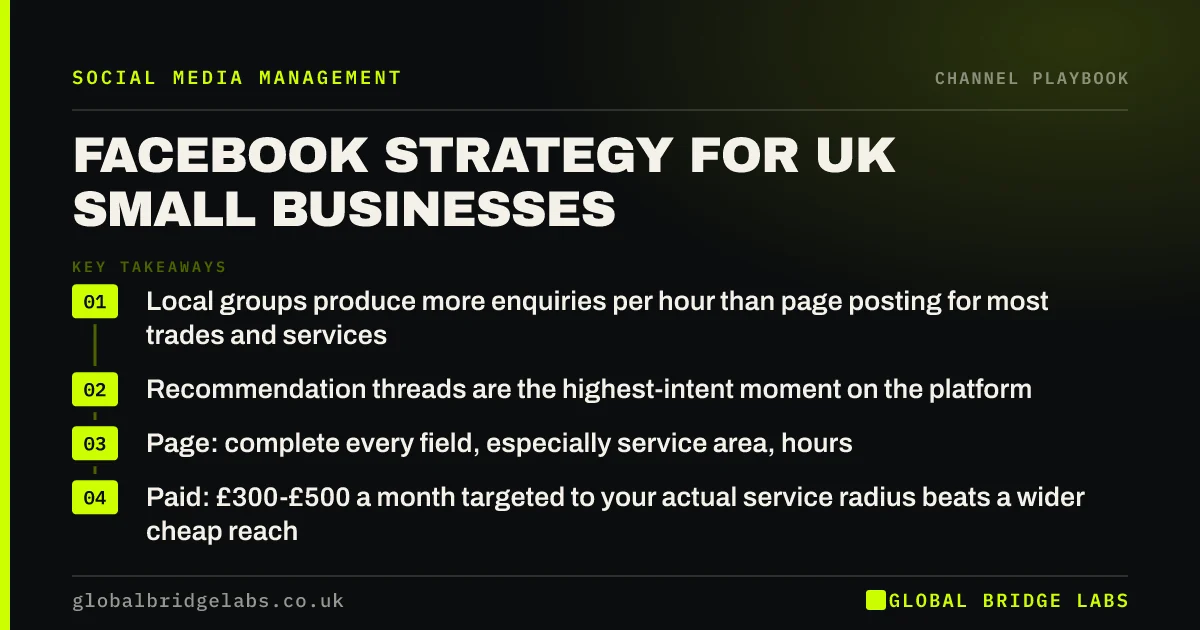
For local UK businesses, Facebook's value is no longer the page. It is local community groups, recommendation threads, and cheap geographically targeted paid reach. Run the page as a credibility asset, spend your organic effort in groups, and use a small always-on paid budget to stay visible in your postcodes.
- Local groups produce more enquiries per hour than page posting for most trades and services.
- Recommendation threads are the highest-intent moment on the platform. Be findable when your name is mentioned.
- Page: complete every field, especially service area, hours and price range signals.
- Paid: £300-£500 a month targeted to your actual service radius beats a wider cheap reach.
- Reviews on the page carry real weight in local buying decisions.
Want your local Facebook setup audited? Message us on WhatsApp with your page and area.
Chat on WhatsApp →Is Facebook still worth it for UK small businesses?
Yes, for local consumer services, and this remains one of the most common strategic mistakes we see: businesses abandoning Facebook based on national trend commentary while their actual customers are still there.
The distribution has changed, not the audience. Organic page reach is low, so effort has moved to groups and paid. If you serve homeowners, run a venue, or trade in a specific town, Facebook is still likely to be your highest-converting social channel.
How do you use local Facebook groups properly?
Join the groups covering your service area, read the rules, and participate as a person rather than a business. The value is almost entirely in recommendation threads, where someone asks for a plumber, a caterer or an accountant and receives replies from neighbours.
Two rules make this work. Never self-promote where the rules forbid it, because removal costs you the group permanently. And make sure your customers know your page name, because the recommendation that converts is the one from someone else.
- Join 3-5 groups covering your actual service area, not all of them.
- Answer questions in your specialism without pitching. Recognition comes from usefulness.
- Ask satisfied customers to mention you when they see a relevant request.
- Respond to every mention of your business, promptly and without a sales pitch.
- Follow group rules exactly. One breach undoes a year of goodwill.
What should a business page contain?
Treat the page as a landing page rather than a feed. Complete the service area, hours, contact methods, services list with indicative pricing where you can, and a pinned post that answers the three questions people ask before contacting you.
The single most underused field for UK local businesses is the service area. It affects both what Facebook shows to whom and whether a visitor concludes you cover them, which is the question that determines whether they bother enquiring.
How much should you spend on Facebook ads?
For a local business, £300-£500 a month is the range at which results become readable. Target the radius you genuinely serve rather than the widest area you would accept work from, because a wider target spends your budget reaching people you will never quote.
Start by promoting posts that already earned engagement organically. It is the cheapest test available: the message has already been validated for free, and you are only buying additional distribution.
Send us your service radius and monthly budget on WhatsApp and we will tell you what it should return.
Chat on WhatsApp →What about Facebook reviews?
Reviews on your page function as local proof and are checked by buyers alongside Google. Ask for them at the same moment you ask for a Google review, and reply to every one, including the critical ones.
Never incentivise reviews conditionally on being positive. The Competition and Markets Authority treats incentivised and fake reviews as misleading consumers, and for a local business the reputational exposure is far worse than the rating benefit.
What does this look like in practice?
A pattern worth checking before you abandon Facebook: a trades business stops posting because reach has collapsed and concludes the platform is finished. The enquiry log frequently says otherwise, with a meaningful share of new customers mentioning a local recommendation.
What usually works is moving the effort rather than increasing it: three local groups, a rebuilt page carrying service area and pricing ranges, and a few hundred pounds a month of tightly targeted paid reach. Page posting stays minimal, because that is no longer where the platform pays.
Should you run your own Facebook group?
Usually not. Groups need consistent moderation and a reason for members to return that does not depend on you posting, and most small business groups are quiet within three months.
The exceptions are genuine communities of interest rather than customer bases: a group about restoring a particular type of property, a local trade network, a support community around a specific problem you happen to solve. Those work because the value is between members.
Before starting one, be honest about who moderates it in six months. Participating in existing local groups delivers most of the benefit for a fraction of the ongoing cost, and it puts you in front of people who are already there.
- Most small business groups are quiet within three months.
- Groups work when the value is between members, not from you.
- Name the moderator for month six before you start.
- Participating in existing groups usually beats founding one.
Next step
If you have written Facebook off, check your enquiry log before you commit to that. For local UK businesses it is still frequently the highest-converting channel available.
Message us on WhatsApp for a local Facebook audit covering page, groups and paid setup.
Chat on WhatsApp →Sources and further reading
- Meta Business Help Centre · Meta
- Google Business Profile Help · Google
Frequently asked questions
Is Facebook dead for small businesses?
No, but page reach is. For local UK consumer services the value has moved to community groups, recommendation threads and cheap geographically targeted paid reach. Check your own enquiry log before abandoning it based on national trend commentary.
Can I promote my business in local Facebook groups?
Only where the rules allow it, and usually on designated days. The higher-value approach is answering questions in your specialism without pitching, so that when a recommendation thread appears, other members name you rather than you naming yourself.
How much should a local business spend on Facebook ads?
£300-£500 a month, targeted to the radius you genuinely serve. Start by promoting posts that already performed organically, since the message has been validated for free and you are only paying for additional distribution.
Do Facebook reviews matter?
Yes, particularly for local services, where buyers check them alongside Google. Ask for both at the same moment, reply to every review including critical ones, and never incentivise reviews on condition that they are positive.
Written by

Global Bridge Labs (GBL) is a UK–Sri Lanka partner for social media, websites and BPO. Everything here comes from client delivery, not theory.