On this page
- 01Short answer
- 02Why is Pinterest not really social media?
- 03Which UK small businesses should use it?
- 04How do you set it up properly?
- 05How much effort does it need?
- 06How do you measure it?
- 07What should you pin, and what should it link to?
- 08How do you structure boards for search?
- 09Next step
- 10Sources and further reading
- 11Frequently asked questions
Short answer
Pinterest is a visual search engine where content has a lifespan measured in months rather than hours. It suits UK businesses selling anything people plan for: interiors, weddings, food, fashion, gardens, property and home improvement. It is a poor fit for urgent or reactive services.
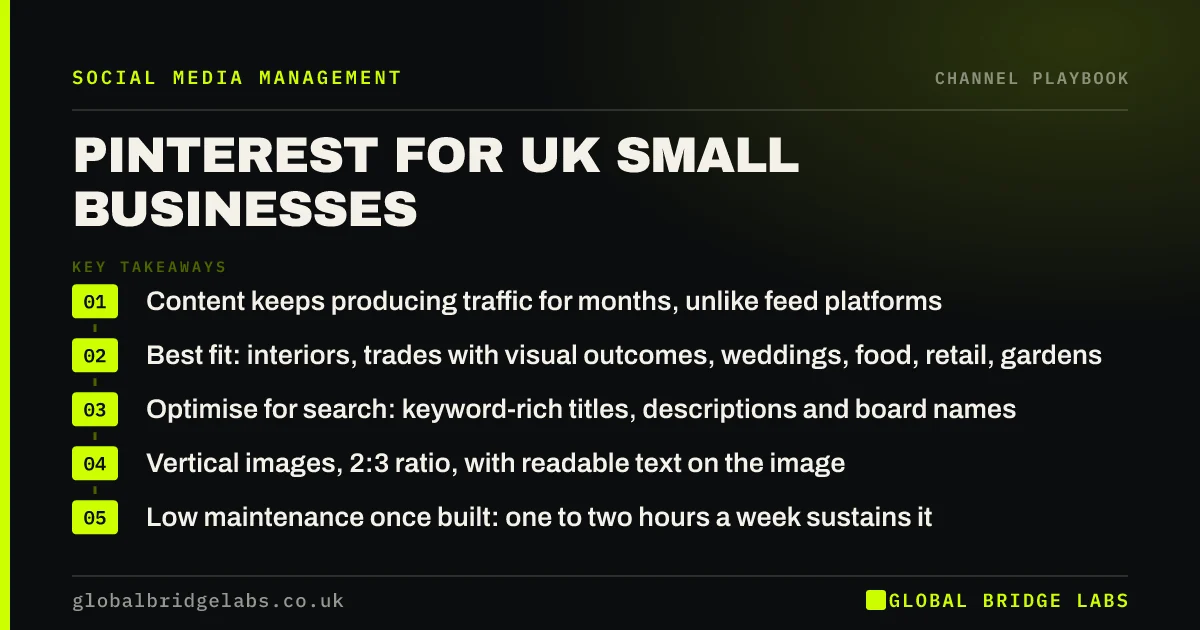
- Content keeps producing traffic for months, unlike feed platforms.
- Best fit: interiors, trades with visual outcomes, weddings, food, retail, gardens.
- Optimise for search: keyword-rich titles, descriptions and board names.
- Vertical images, 2:3 ratio, with readable text on the image.
- Low maintenance once built: one to two hours a week sustains it.
Not sure Pinterest fits your business? Ask us on WhatsApp and we will tell you straight.
Chat on WhatsApp →Why is Pinterest not really social media?
Because almost nobody is there to interact with other people. They are there to plan something, which means they are in an earlier and more considered part of the buying process than on any feed platform.
The practical consequence is that Pinterest content behaves like search content. It builds slowly, has a long life, and rewards keyword clarity far more than personality or timing.
Which UK small businesses should use it?
Businesses whose customers plan and save before they buy. A kitchen fitter, a florist, a wedding venue, a landscaper, a furniture maker and a food producer all have a natural fit, because the customer collects ideas for weeks before enquiring.
It suits emergency and reactive services poorly. Nobody plans a boiler failure on a mood board, and effort there is better spent on Google Business Profile and local Facebook groups.
How do you set it up properly?
Treat every element as a search field. Board names should be phrases people search, not clever titles. Descriptions should read naturally while containing the terms a planner would type, including UK-specific phrasing such as utility room or airing cupboard that US-centric advice will not mention.
Claim your website in the business account so pins linking to your site are attributed, and enable rich pins so product and article metadata carries through.
- Business account, website claimed, rich pins enabled.
- Boards named as search phrases, ten to fifteen boards maximum.
- Vertical 2:3 images with legible text overlay.
- Every pin links to a specific relevant page, never the homepage.
- UK spelling and UK terminology throughout.
How much effort does it need?
An initial build of a day or two to create boards and an opening library, then one to two hours a week. That is materially less than Instagram, which is why it suits small teams that already produce visual work.
The main ongoing job is turning work you photograph anyway into pins with good titles. If you are already doing the photography for Instagram, the marginal cost is close to zero.
We will audit whether Pinterest is worth an hour a week for you. Message us on WhatsApp.
Chat on WhatsApp →How do you measure it?
Measure outbound clicks to your site and the enquiries those sessions produce, not impressions or saves. Pinterest impressions are generous and mean very little on their own.
Because the lifespan is long, judge it at six months rather than 90 days. A library built in month one is usually still increasing its traffic in month five, which is the opposite of how feed platforms behave.
What should you pin, and what should it link to?
Pin the outcome, not the process. Pinterest users are collecting images of finished things they want, which means the completed kitchen, the styled table, the planted border and the finished room all outperform work-in-progress content that would do well on Instagram.
Every pin should link to a page that matches what the image promised. A pin of a finished bathroom linking to your homepage wastes the intent; linking to a bathroom page with photographs, a price range and a clear enquiry route converts it.
Build in sets rather than singles. One project photographed properly produces six to ten pins across different boards, each with its own search phrasing, and that is how a small library becomes a traffic source within a few months.
- Pin finished outcomes, not process.
- Link every pin to a specific matching page, never the homepage.
- Produce six to ten pins per project, spread across boards.
- Write titles as UK search phrases, using UK terminology.
How do you structure boards for search?
Build boards around what someone is planning, not around your product categories. Small kitchen ideas is a board people search; Our Kitchen Range is not, even though it contains the same photographs.
Ten to fifteen boards is enough for most small businesses. Each should have a description written in natural sentences containing the phrases people use, and each should hold at least fifteen pins before you create another, since thin boards perform poorly and dilute the whole account.
Name boards the way UK users search: utility room, airing cupboard, back garden, front room. Advice written for US audiences will lead you to American terms that almost nobody here types.
- Boards named for what people plan, not what you sell.
- Ten to fifteen boards, each with fifteen or more pins.
- Natural-sentence descriptions containing real search phrases.
- UK terminology throughout.
Next step
For the right business, Pinterest is the lowest-maintenance traffic channel in social media. For the wrong one, it is a day wasted. The difference is entirely whether your customers plan before they buy.
Message us on WhatsApp and we will tell you whether Pinterest earns its hours for your business.
Chat on WhatsApp →Sources and further reading
Frequently asked questions
Is Pinterest worth it for a small business?
It is if your customers plan before buying, which covers interiors, weddings, food, gardens, retail and visual trades. Content keeps producing traffic for months rather than hours, and maintenance is only one to two hours a week once the library exists.
How is Pinterest different from Instagram?
Pinterest is a visual search engine with long content lifespans and planning intent. Instagram is a feed with short lifespans and social intent. Pinterest rewards keyword clarity in titles and board names; Instagram rewards personality, timing and video.
How often should I pin?
Consistency matters more than volume. Five to ten quality pins a week sustains momentum, and most can be created from photography you already take for other channels, which makes the marginal cost close to zero.
How long before Pinterest produces results?
Six months rather than 90 days. Pins build traffic slowly and continue growing for months, so a library created in month one is often still increasing its click volume in month five. Judge it on outbound clicks and enquiries, not impressions.
Written by

Global Bridge Labs (GBL) is a UK–Sri Lanka partner for social media, websites and BPO. Everything here comes from client delivery, not theory.