On this page
- 01Key takeaways
- 02Where does UK Gen Z actually spend attention?
- 03Why do business accounts get ignored?
- 04What content works with this audience?
- 05How does in-app search change what you write?
- 06What are the UK advertising rules with younger audiences?
- 07What does this look like in practice?
- 08How do you sell without sounding like a seller?
- 09Next step
- 10Sources and further reading
- 11Frequently asked questions
Key takeaways
UK Gen Z attention sits with short-form video and messaging, and they search inside those apps rather than on the web. The barrier is rarely platform choice. It is that most business accounts sound like advertising, which this audience filters out faster than any other.
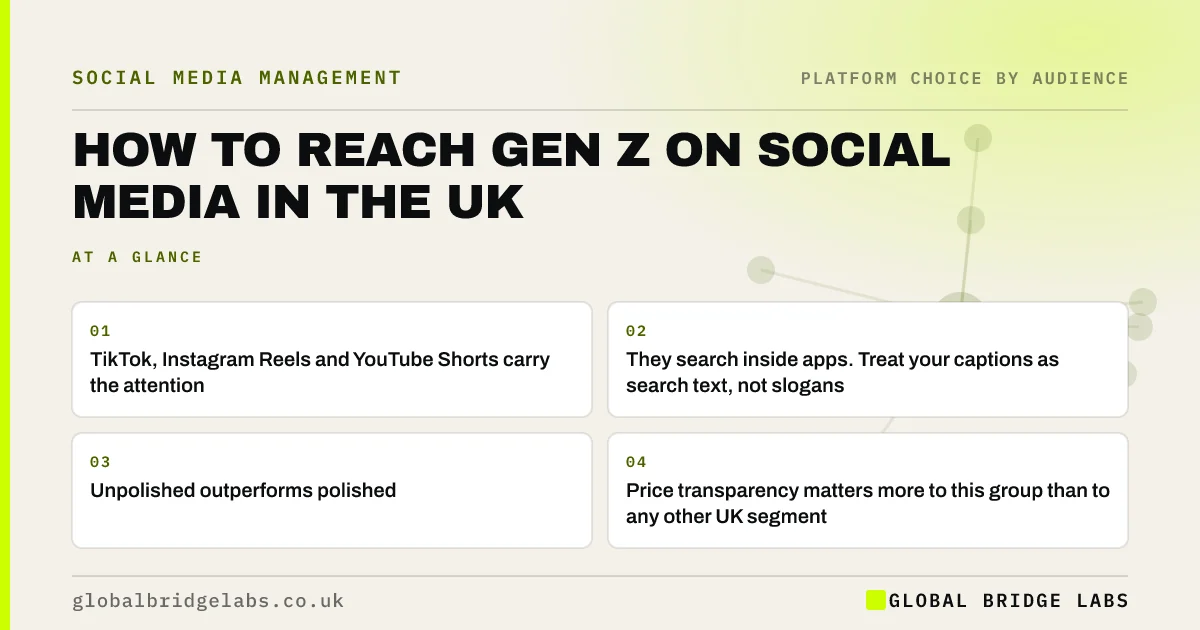
- TikTok, Instagram Reels and YouTube Shorts carry the attention. Messaging carries the decision.
- They search inside apps. Treat your captions as search text, not slogans.
- Unpolished outperforms polished. Production value signals advertising.
- Price transparency matters more to this group than to any other UK segment.
- Values are checked, not assumed. Claims without evidence read as marketing.
Trying to reach a younger UK audience? Tell us your sector on WhatsApp.
Chat on WhatsApp →Where does UK Gen Z actually spend attention?
In short-form vertical video and in private messaging, with discovery and decision happening in different places. Ofcom's Online Nation research consistently shows the youngest adult bands concentrated in video-first platforms and messaging rather than in traditional feeds.
The more useful observation for a business is behavioural rather than demographic: this group searches inside apps. Someone looking for a barber, a gym or a café frequently types it into a video app rather than a search engine, which changes how you should write captions.
Why do business accounts get ignored?
Because they look like advertising, and this audience has spent its whole life filtering advertising. Five signals that get an account scrolled past in under a second.
- High production value with no person in it. Reads as a brand, not a human.
- Copy written in marketing voice: solutions, passionate, journey, excited to announce.
- Stock footage or generic AI imagery, which is identified instantly.
- Claims without proof, particularly about ethics, sourcing or sustainability.
- Hiding price, which reads as a tactic rather than as commercial caution.
What content works with this audience?
The work itself, shown plainly by the person doing it. A 30-second clip of a real process, shot on a phone, with a caption written the way someone would speak, consistently outperforms produced content in this segment.
Honesty about price is the second lever and it is underused. Publishing what something costs, and why, does more for credibility with UK under-27s than any values statement, because it is verifiable and most competitors will not do it.
- Short-form video for small businesses without a studio
- Choosing social media platforms without making video
We will make content that does not sound like advertising. Ask on WhatsApp.
Chat on WhatsApp →How does in-app search change what you write?
It turns captions into search text. If people type manchester barber fade into a video app, a caption saying fresh trim never appears, while one saying fade, Manchester city centre, walk-ins Thursday does.
Write the first line of every caption as the phrase someone would type. It reads slightly less cleverly and it gets found, which is the trade every small business should take. This single change frequently produces more improvement than a new content format.
What are the UK advertising rules with younger audiences?
Anything paid for or incentivised must be obviously identifiable as advertising. The ASA and CAP are explicit that labels must be clear and upfront, not buried in hashtags at the end of a caption, and enforcement of influencer content has been consistent.
This matters commercially as well as legally with this audience, because undisclosed promotion is spotted and punished socially. A clearly labelled paid partnership performs better than a disguised one that gets called out.
What does this look like in practice?
A UK independent gym spent a year on produced content: branded graphics, motivational copy, professional photography. Membership enquiries from under-25s stayed flat.
Switching to phone-shot clips of actual sessions, with the coach talking to camera about what a beginner session involves and exactly what it costs, changed the pattern within about eight weeks. The content looked worse and worked better, because it answered the question a nervous 22-year-old actually has.
How do you sell without sounding like a seller?
By showing the work and stating the price, then stopping. This audience is not hostile to being sold to; it is hostile to being persuaded, which is a different thing and much more common in marketing copy.
The practical version is to remove every sentence that exists to convince rather than to inform. What it is, what it costs, who it suits, what it looks like, how to get it. Anything beyond that reads as pressure, and pressure is what gets an account muted.
The businesses that do well here sound like a knowledgeable person answering a question, because that is what a short video from a real practitioner actually is.
Next step
Take your last five posts and read the first line of each as if you were typing it into a search bar. If none of them would ever be typed by a customer, you have found the cheapest improvement available to you.
Message us on WhatsApp and we will rewrite your captions as search text.
Chat on WhatsApp →Sources and further reading
Frequently asked questions
Which social media platform is best for reaching Gen Z in the UK?
Short-form video platforms carry the attention and private messaging carries the decision. The more useful point is behavioural rather than demographic: this group searches inside apps, so captions should be written as the phrase someone would type rather than as a slogan.
Why does polished content perform badly with younger audiences?
Because production value signals advertising, and this audience has spent its entire life learning to filter advertising out. Phone-shot clips of real work, narrated by the person actually doing it, consistently outperform produced content with this segment.
Does price transparency matter to Gen Z buyers?
More than to any other UK segment. Publishing what something costs and why is verifiable in a way that values statements are not, and most competitors will not do it, which makes it a credibility advantage as well as a courtesy.
Do I need to label paid posts aimed at young audiences?
Yes. The ASA and CAP require advertising to be obviously identifiable, with labels clear and upfront rather than buried in end-of-caption hashtags. Undisclosed promotion is also spotted socially, which damages more than a clear label ever would.
Written by
Global Bridge Labs (GBL) is a UK–Sri Lanka partner for social media, websites and BPO. Everything here comes from client delivery, not theory.