On this page
- 01Key takeaways
- 02What are the two models?
- 03What does each provider cost in attention?
- 04Where do multi-provider setups break?
- 05When is more than one provider right?
- 06How do you manage the risk of one provider?
- 07How should the comparison be made?
- 08What does this look like in practice?
- 09Provider structure checklist
- 10Next step
- 11Sources and further reading
- 12Frequently asked questions
Key takeaways
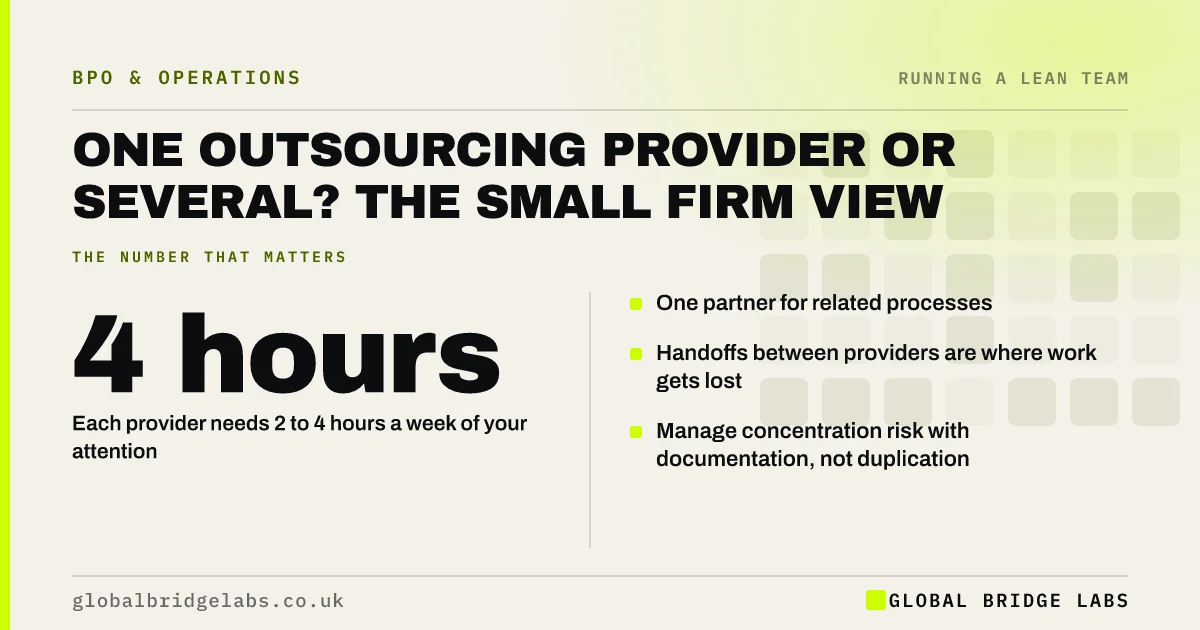
On single vs multiple outsourcing providers, most small businesses are better served by one managed partner for related work, plus separate specialists only where the skill is different. Each provider needs briefing, checking and a relationship. Splitting small volumes spreads your attention and weakens each provider's understanding of your business.
- One partner for related processes. Specialists only for distinct skills.
- Each provider needs 2 to 4 hours a week of your attention.
- Handoffs between providers are where work gets lost.
- Manage concentration risk with documentation, not duplication.
Juggling several suppliers? Message us on WhatsApp with who does what.
Chat on WhatsApp →What are the two models?
In a single-provider model, one partner runs several of your processes, such as customer contact, admin and marketing production. In a multi-provider model, different suppliers each run one. The first gives simplicity and context. The second gives specialisation and less reliance on any one supplier.
What does each provider cost in attention?
Each provider costs management attention, whatever its fee. Briefings, weekly reviews, quality checks, invoices and contract renewals multiply with every supplier. For a small team with a few hours a week to give, three providers can use up the time that outsourcing was meant to free.
Where do multi-provider setups break?
Multi-provider setups break at the joins. An enquiry taken by a call service has to reach the team doing bookings, which has to reach whoever invoices. Each supplier does its part and the customer falls between them. One provider running the chain end to end removes those handoffs.
- Information lost between suppliers.
- Nobody accountable for the whole journey.
- Different tones and standards.
- Several sets of logins and data contracts.
When is more than one provider right?
More than one provider is right when the work needs clearly different expertise, such as regulated accounting, legal work or specialist engineering, or when volume is large enough to split for resilience. A sensible rule for small firms: one partner per family of related work, and a new one only for a skill the first cannot show.
- Fractional teams: senior skills without a full-time salary
- White label outsourcing: how agencies scale without hiring
Want to discuss your requirements across operations, web and social in one conversation? Message us on WhatsApp.
Chat on WhatsApp →How do you manage the risk of one provider?
Manage the risk of one provider by keeping your independence, not by duplicating suppliers. Hold the process guides, own the systems and accounts, keep notice terms reasonable and ask about the provider's continuity arrangements. Under UK GDPR you also need a processor contract with each supplier that handles personal data, so fewer is simpler.
How should the comparison be made?
Compare on total cost and total effort. Add each option's fees, then add your own hours at their real value. Consider who is accountable when something goes wrong across a customer journey. The cheapest set of individual quotes is often the most expensive arrangement to run.
What does this look like in practice?
A pattern we see in UK small businesses that outsourced piece by piece: a call answering service, a freelance bookkeeper, a virtual assistant, a web freelancer and a social media agency, each briefed separately by the owner. Consolidating the related work with one managed partner cuts the owner's coordination time sharply.
Provider structure checklist
Review this once a year.
- List every provider and what it does.
- Record your weekly hours spent on each.
- Mark handoffs between providers.
- Group work into families of related processes.
- Check which providers could cover a whole family.
- Confirm data contracts exist for each.
- Keep specialists only where skills are distinct.
Next step
Send us a list of your current suppliers and what each does. We will show you where consolidation would save time and where a specialist should stay.
Message us on WhatsApp for a supplier structure review, or book a 30-minute consultation.
Chat on WhatsApp →Sources and further reading
- The Sourcing and Consultancy Playbooks · Cabinet Office
- Controllers and processors · Information Commissioner's Office
- Small Business Guide: cyber security · National Cyber Security Centre
Frequently asked questions
Is it better to use one outsourcing provider or several?
For most small businesses, one provider for related work is better. It reduces management time, removes handoffs and gives the provider fuller context. Use additional providers where a clearly different specialism is needed or where volume is large enough to justify splitting.
What are the risks of using multiple outsourcing providers?
The risks are coordination overhead, work lost at handoffs, inconsistent standards and unclear accountability when a problem crosses suppliers. Each provider also needs its own contract, data protection terms and review rhythm, which adds to the load on a small management team.
What is concentration risk in outsourcing?
Concentration risk is the exposure that comes from relying heavily on a single supplier. If that supplier fails or performs badly, several functions are affected. It is managed by owning documentation and systems, keeping notice terms reasonable and checking the provider's continuity plans.
When should a small business add a second provider?
Add a second provider when you need a skill your current partner cannot demonstrate, when regulation requires a specialist, or when one function has grown large enough that splitting it improves resilience. Do not add one simply to compare prices on small volumes.
Written by

Global Bridge Labs (GBL) is a UK–Sri Lanka partner for social media, websites and BPO. Everything here comes from client delivery, not theory.