On this page
Key takeaways
A rollback plan sets out how to return to the old site if launch goes badly wrong, such as broken checkout, site-wide errors or a new site that cannot be fixed quickly. Keep the old site and its hosting ready for at least two weeks, agree in advance what would trigger a rollback and who decides, and know exactly which settings need reversing.
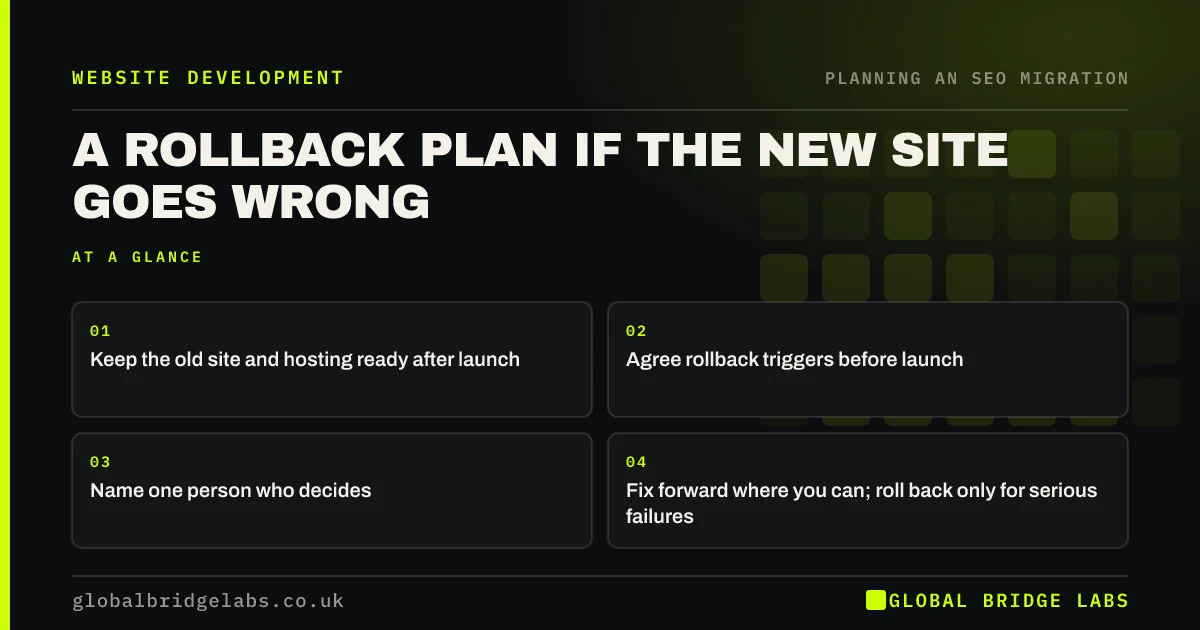
- Keep the old site and hosting ready after launch.
- Agree rollback triggers before launch.
- Name one person who decides.
- Fix forward where you can; roll back only for serious failures.
Want help writing a rollback plan? Message us on WhatsApp.
Chat on WhatsApp →When would you roll back?
Rollback is for serious failures that cannot be fixed within hours. Most SEO problems, such as a missing redirect or a noindex tag, are better fixed on the new site than reversed. Agree the triggers in writing before launch, so nobody has to decide under pressure.
- Checkout, booking or enquiry forms do not work.
- Large parts of the site return server errors.
- Security or data problems on the new platform.
- A failure the developer cannot fix within an agreed time.
What do you need to keep ready?
A rollback is only possible if the old site still exists and can be switched back quickly.
- The old site files, database and hosting account.
- The old DNS settings, written down.
- A list of what changed at launch: DNS, redirects, Search Console.
- The person with access to the domain registrar.
How do you roll back without making it worse?
Switch DNS back to the old host and remove any redirects pointing from old URLs to new ones, otherwise visitors bounce between sites. If you used the Change of Address tool, cancel it. Then take time to understand what failed before relaunching. Rolling back and forth repeatedly confuses search engines more than one careful relaunch.
Want a second opinion before you roll back? Message us on WhatsApp.
Chat on WhatsApp →What does this look like in practice?
A pattern we see: a shop launches and the payment integration fails for some card types. Because the old hosting was kept and the rollback steps were written down, the team switches back within an hour, fixes the integration on staging and relaunches two days later. Search traffic barely notices.
Rollback plan checklist
- Keep old site and hosting for two weeks or more.
- Write down old DNS settings.
- Agree rollback triggers in advance.
- Name the person who decides.
- List the steps to reverse launch changes.
Next step
Before launch, write a one-page rollback plan with triggers, the decision maker and the steps to switch back. Share it with the developer and keep the old hosting paid for at least two weeks.
Message us on WhatsApp about your launch plan, or book a 30-minute consultation.
Chat on WhatsApp →Sources and further reading
- Site moves with URL changes · Google Search Central
- Redirects and Google Search · Google Search Central
- How HTTP status codes and network errors affect Google Search · Google Search Central
Frequently asked questions
Do I need a rollback plan for a website migration?
Yes, especially for online shops and sites that take bookings or enquiries. You may never use it, but it means a serious failure can be reversed in hours rather than days. Keep the old site and hosting ready, agree triggers and name who decides.
How long should I keep the old site after launch?
Keep the old site files, database and hosting for at least two weeks, and longer for large or complex migrations. Keep the files and an export for much longer, because you may need old content, titles or settings months later when investigating a problem.
Is rolling back bad for SEO?
A quick rollback after a serious failure usually does little lasting harm, especially if it happens within days. Repeatedly switching between old and new sites is worse, because search engines keep reprocessing URLs. Fix forward for small issues and roll back only for serious failures.
Written by

Global Bridge Labs (GBL) is a UK–Sri Lanka partner for social media, websites and BPO. Everything here comes from client delivery, not theory.