On this page
- 01Key takeaways
- 02What do rising customer complaints tell you?
- 03How do you find the cause of complaints?
- 04Which complaints point to outsourcing?
- 05Which complaints should you fix another way?
- 06What do complaints cost a small business?
- 07How do you handle complaints during the fix?
- 08How do you know the fix has worked?
- 09Which complaints spike at predictable times?
- 10What does this look like in practice?
- 11Complaints checklist
- 12Next step
- 13Sources and further reading
- 14Frequently asked questions
Key takeaways
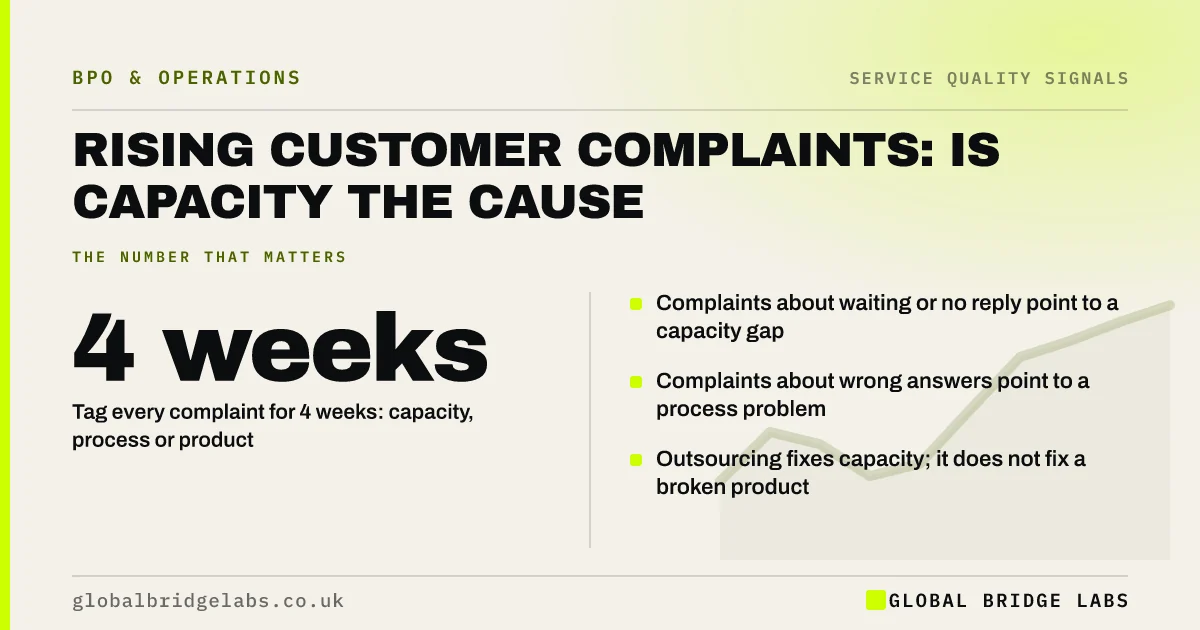
Rising customer complaints usually have one of three causes: capacity, process or product. When complaints mention waiting, chasing or no reply, capacity is the cause and outsourcing can help. When they mention wrong answers or errors, fix the process first. When they are about the product itself, outsourcing will not help.
- Tag every complaint for 4 weeks: capacity, process or product.
- Complaints about waiting or no reply point to a capacity gap.
- Complaints about wrong answers point to a process problem.
- Outsourcing fixes capacity; it does not fix a broken product.
Complaints creeping up? Message us on WhatsApp with what customers are saying.
Chat on WhatsApp →What do rising customer complaints tell you?
Rising customer complaints tell you that something in the customer experience has slipped, but not what. The same number of complaints can come from slow replies, inconsistent answers, delivery errors or a product fault. Before choosing a fix, sort complaints by cause. Capacity problems are the ones outsourcing solves.
How do you find the cause of complaints?
Tag every complaint for four weeks with one cause and one channel. Keep the tags simple so everyone uses them. Then count. Most businesses find that two or three causes account for most complaints, and that waiting and chasing feature more than they expected.
- Capacity: waited too long, no reply, had to chase.
- Process: wrong answer, lost information, inconsistent handling.
- Product: fault, quality, delivery damage.
- Policy: disagreed with a rule, such as refunds or fees.
Which complaints point to outsourcing?
Complaints about waiting, chasing, unanswered emails, missed calls and no updates point to a capacity gap, and outsourcing the first line of contact is a direct fix. So do complaints that spike at predictable times, such as Mondays, after campaigns or in peak season, when the team simply cannot keep up.
Want help sorting your complaints by cause? Send us a sample on WhatsApp.
Chat on WhatsApp →Which complaints should you fix another way?
Complaints about wrong or inconsistent answers need a written process and training before outsourcing, or the provider inherits the problem. Complaints about the product or policy need changes to the product or policy. Outsourcing those would only mean someone else apologising for the same issue.
What do complaints cost a small business?
Complaints cost handling time, refunds and, above all, repeat business. Each complaint takes staff time to investigate and answer, and unhappy customers often leave without complaining at all, so recorded complaints understate the problem. Public reviews then affect future buyers who never contact you.
How do you handle complaints during the fix?
Keep complaint handling in-house or with your most experienced people while the cause is fixed. Reply quickly, acknowledge the problem and say what is changing. Customers are more forgiving of a known problem with a clear fix than of silence. Log each complaint so you can see whether the fix is working.
How do you know the fix has worked?
Compare complaints by cause before and after. If outsourcing the first line was the fix, complaints about waiting and chasing should fall within six to eight weeks, while other causes stay about the same. If capacity complaints fall but process complaints rise, the handover needs better documentation.
Which complaints spike at predictable times?
Capacity complaints cluster. They rise on Mondays after weekend messages pile up, after marketing campaigns, at month end and in seasonal peaks. Plot complaints by week against volume and you will usually see the pattern. Predictable spikes are the easiest to fix, because extra capacity can be booked for those periods in advance.
- Mondays, after weekend backlogs.
- The days after campaigns and promotions.
- Month end, when invoicing and orders peak.
- Seasonal peaks such as Christmas or summer.
What does this look like in practice?
A pattern we see in UK e-commerce brands after growth: complaints double, and the founder assumes the team is careless. Four weeks of tagging shows most complaints are about waiting for a reply on order status. Outsourcing order status replies cuts those complaints sharply, and the in-house team has time to fix the delivery issues behind the rest.
Complaints checklist
Use this to act on rising complaints.
- Tag every complaint by cause and channel for four weeks.
- Count complaints by cause.
- Outsource first-line contact if capacity dominates.
- Document and train if process dominates.
- Fix the product or policy if they dominate.
- Compare complaints by cause after eight weeks.
Next step
Tell us what customers are complaining about. We will tell you whether it is a capacity problem that outsourcing can fix.
Message us on WhatsApp about your complaints, or book a 30-minute consultation.
Chat on WhatsApp →Sources and further reading
- UK Customer Satisfaction Index · Institute of Customer Service
- Publishing consumer reviews and complying with consumer protection law · Competition and Markets Authority
- Consumer Contracts (Information, Cancellation and Additional Charges) Regulations 2013 · legislation.gov.uk
Frequently asked questions
Why are my customer complaints increasing?
Usually because of capacity, process or product problems. Tag complaints by cause for four weeks to find out which. Complaints about waiting and chasing mean capacity; wrong answers mean process; faults mean product. Each needs a different fix.
Can outsourcing reduce customer complaints?
Yes, when complaints are about waiting, chasing or no reply. An outsourced first line answers faster and more consistently. It will not reduce complaints about product faults or unclear processes; those need fixing at the source first.
Should complaints handling be outsourced?
Usually not at first. Keep complaints with experienced in-house people while the cause is being fixed. Once the outsourced team has a track record on routine contact, simple complaint categories with clear rules can move across one at a time.
Written by

Global Bridge Labs (GBL) is a UK–Sri Lanka partner for social media, websites and BPO. Everything here comes from client delivery, not theory.