On this page
- 01Key takeaways
- 02Why does a product launch create a support spike?
- 03How do you forecast launch support volume?
- 04What should you prepare before launch?
- 05When should you outsource launch support?
- 06How do you use launch support to improve the product?
- 07What are the risks of under-planning support?
- 08How do you scale support back after the launch?
- 09What does this look like in practice?
- 10Launch support checklist
- 11Next step
- 12Sources and further reading
- 13Frequently asked questions
Key takeaways
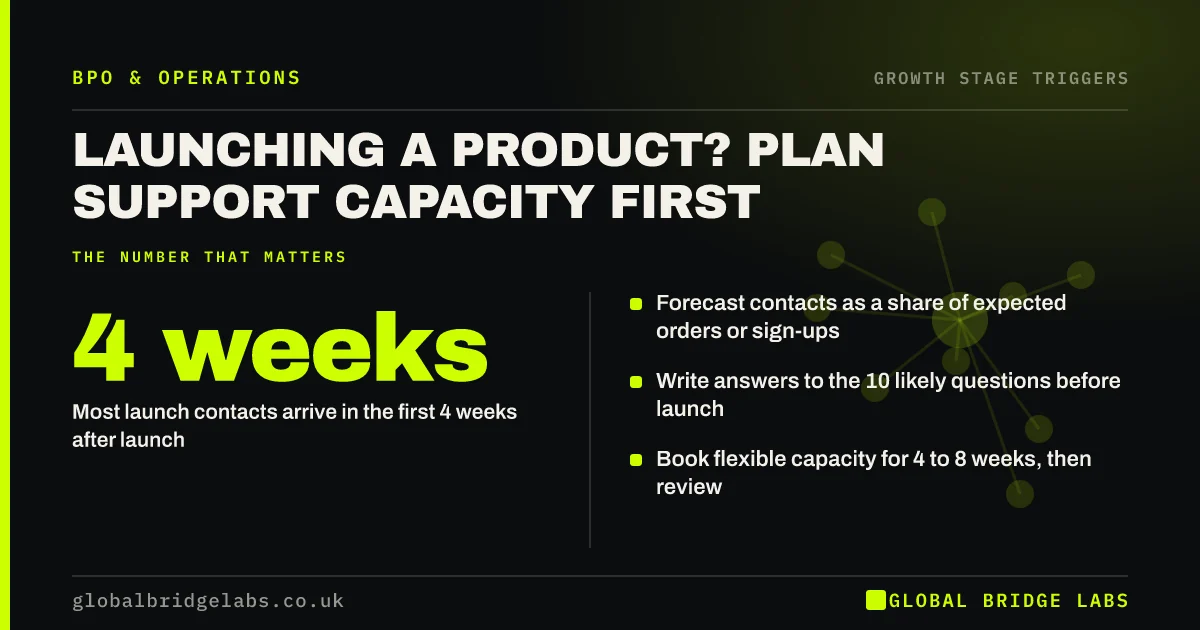
Customer support for a product launch needs planning before launch day, because questions spike in the first weeks and slow replies damage the launch. Forecast contacts from expected orders, prepare answers to likely questions, and add flexible capacity for 4 to 8 weeks. Outsourced support can be trained in advance and scaled back after the spike.
- Most launch contacts arrive in the first 4 weeks after launch.
- Forecast contacts as a share of expected orders or sign-ups.
- Write answers to the 10 likely questions before launch.
- Book flexible capacity for 4 to 8 weeks, then review.
Launching soon? Message us on WhatsApp with the date and expected volume.
Chat on WhatsApp →Why does a product launch create a support spike?
New customers have questions about set-up, delivery, compatibility and billing, and existing customers ask how the new product affects them. Early issues, such as unclear instructions, add more. The spike arrives on a known date, which makes it one of the easiest capacity problems to plan for, and one of the most damaging to ignore.
How do you forecast launch support volume?
Start from expected orders or sign-ups and apply a contact rate from past launches or similar products. If 2,000 orders are expected in the first month and one in five usually contacts support, plan for 400 contacts, weighted towards the first fortnight. Add a buffer for problems.
- Expected orders or sign-ups in the first month.
- Contact rate from previous launches or similar products.
- Average handling time per contact.
- A buffer of 25% to 50% for launch issues.
Want help forecasting your launch volume? Send us the numbers on WhatsApp.
Chat on WhatsApp →What should you prepare before launch?
Prepare answers, escalation routes and tracking. Write replies to the ten questions you expect most, agree who handles technical problems and refunds, and tag launch contacts so you can see issues early. Brief whoever will answer, in-house or outsourced, at least a week before launch with the product in their hands.
When should you outsource launch support?
Outsource when the forecast exceeds your team's spare capacity, when the launch covers evenings and weekends, or when you want the product team free to fix issues rather than answer emails. Outsourced support trained before launch can scale back after the spike on short notice terms.
How do you use launch support to improve the product?
Tag every contact by topic and review the tags daily in the first two weeks. Repeated questions show unclear instructions, missing information or product faults. Fixing those quickly reduces contacts and improves reviews. A good support team, in-house or outsourced, sends a short daily summary of themes to the product team.
What are the risks of under-planning support?
Slow replies in launch week turn curious buyers into refund requests and bad reviews, just when reviews carry most weight. Product and engineering teams also get pulled into support and stop fixing the issues causing the contacts. Planning support is cheaper than recovering a launch.
How do you scale support back after the launch?
Agree the plan before launch. Set a review point, usually four to six weeks after launch, and a rule for reducing hours once weekly contacts return to a set level. Keep the written answers and the launch themes, because they become the basis of your support guide and the brief for the next launch.
- Review contact volumes weekly after the first fortnight.
- Reduce hours once volume falls below a set level.
- Keep the launch answers in the permanent support guide.
- Record the actual contact rate for the next launch forecast.
What does this look like in practice?
A pattern we see in UK consumer brands launching a new product line: the in-house team of two handles normal volume well, but launch week brings four times the usual emails. An outsourced team trained on the product the week before takes the routine questions, and the in-house team handles faults and feeds themes to the product lead.
Launch support checklist
Use this in the month before launch.
- Forecast contacts from expected orders and a contact rate.
- Add a 25% to 50% buffer.
- Write answers to the ten likely questions.
- Agree escalation routes for faults and refunds.
- Brief and train support a week before launch.
- Tag contacts and review themes daily for two weeks.
Next step
Tell us your launch date and expected volume. We will tell you what support capacity you need and how to have it ready on day one.
Message us on WhatsApp about your launch, or book a 30-minute consultation.
Chat on WhatsApp →Sources and further reading
- UK Customer Satisfaction Index · Institute of Customer Service
- Publishing consumer reviews and complying with consumer protection law · Competition and Markets Authority
- Consumer Contracts (Information, Cancellation and Additional Charges) Regulations 2013 · legislation.gov.uk
Frequently asked questions
How do I prepare customer support for a product launch?
Forecast contacts from expected orders, write answers to the likely questions, agree escalation routes for faults and refunds, and train whoever will answer at least a week before launch. Add flexible capacity for the first 4 to 8 weeks and review daily themes.
How many support contacts should I expect at launch?
Estimate from expected orders or sign-ups multiplied by a contact rate from past launches or similar products, then add a buffer of 25% to 50% for issues. Contacts usually peak in the first two to four weeks.
Can I outsource support just for a launch?
Yes. Many providers offer short-term or scalable arrangements. Train the team before launch day, let them handle routine questions during the spike, and scale back afterwards on short notice terms. Some businesses keep a smaller seat for ongoing cover.
Written by

Global Bridge Labs (GBL) is a UK–Sri Lanka partner for social media, websites and BPO. Everything here comes from client delivery, not theory.