On this page
Key takeaways
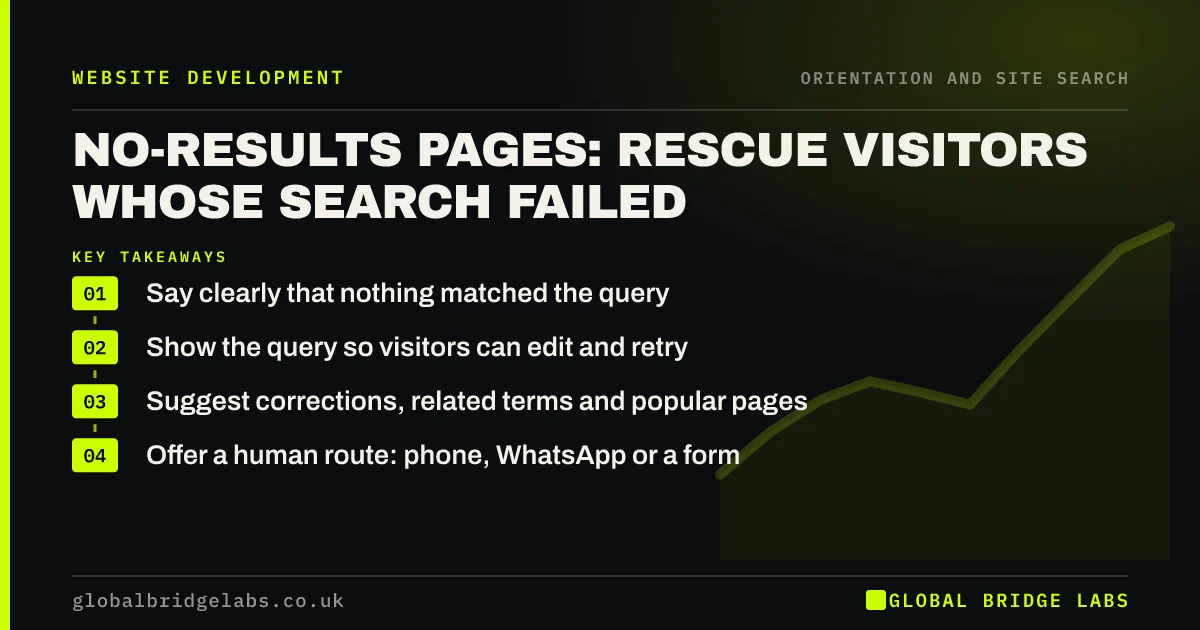
A no-results page is where a visitor's search has failed, so it is a last chance to keep them. Say plainly that nothing matched, show the query in an editable box, suggest spelling corrections and related terms, link popular pages and offer a human route such as WhatsApp or phone. Review failed searches monthly to fix the gaps.
- Say clearly that nothing matched the query.
- Show the query so visitors can edit and retry.
- Suggest corrections, related terms and popular pages.
- Offer a human route: phone, WhatsApp or a form.
Want your failed searches reviewed and fixed? Message us on WhatsApp.
Chat on WhatsApp →Why does the no-results page matter?
A visitor who searched was looking for something specific. A blank page saying 'No results' tells them the site cannot help, even if the answer exists under another word. Nielsen Norman Group's error-recovery heuristic asks interfaces to help users recognise, diagnose and recover from errors, and a failed search is exactly that.
What should the page include?
Treat it as a helpful page, not an error. Each element gives the visitor another way forward.
- A plain statement: 'No results for "boiler serivce"'.
- The query in an editable box.
- 'Did you mean' spelling suggestions.
- Links to the main services or most popular pages.
- A short tip, such as trying fewer words.
- Contact options: phone, WhatsApp or form.
How do you reduce failed searches?
Look at the searches that returned nothing. In GA4, enhanced measurement can capture site search terms, and many search tools report zero-result queries. Each one is a missing synonym, a spelling to handle, or content you do not have. Fix the most common ones first.
Want your zero-result searches turned into fixes? Message us on WhatsApp and we will discuss your requirements.
Chat on WhatsApp →Should no-results pages be indexed?
No. Search results pages, including no-results pages, are thin and endless. Keep them out of search engines with a noindex tag, so Google does not waste crawl effort or show them in results.
What does this look like in practice?
A pattern we see: a site's no-results page shows only 'Nothing found' on a blank background. Search logs show common queries for 'opening hours' and 'parking', which the site answers on the contact page. Adding synonyms and links to contact and services on the no-results page turns dead ends into routes.
No-results page checklist
- Plain message with the query shown.
- Editable search box.
- Spelling suggestions.
- Links to key and popular pages.
- Contact options.
- Noindex tag.
- Monthly review of zero-result terms.
Next step
Search your site for a misspelt version of your main service and see what happens.
Message us on WhatsApp for a site search review, or book a 30-minute consultation.
Chat on WhatsApp →Sources and further reading
- 10 usability heuristics for user interface design · Nielsen Norman Group
- Search: visible and simple · Nielsen Norman Group
- Enhanced measurement events · Google Analytics Help
Frequently asked questions
What should a no results page say?
State plainly that nothing matched, repeat the search so visitors can edit it, suggest spelling corrections or related terms, link to popular pages and offer contact options. The aim is to give the visitor another route rather than a dead end.
How do I find searches that return no results?
Many site search tools report zero-result queries. In Google Analytics 4, enhanced measurement can record site search terms, which you can compare with your content. Review them monthly and add synonyms or content for the common ones.
Should search results pages be indexed by Google?
Generally no. Internal search results pages are thin and can be generated endlessly. Add a noindex tag so search engines focus on your real content pages.
Written by

Global Bridge Labs (GBL) is a UK–Sri Lanka partner for social media, websites and BPO. Everything here comes from client delivery, not theory.