On this page
Key takeaways
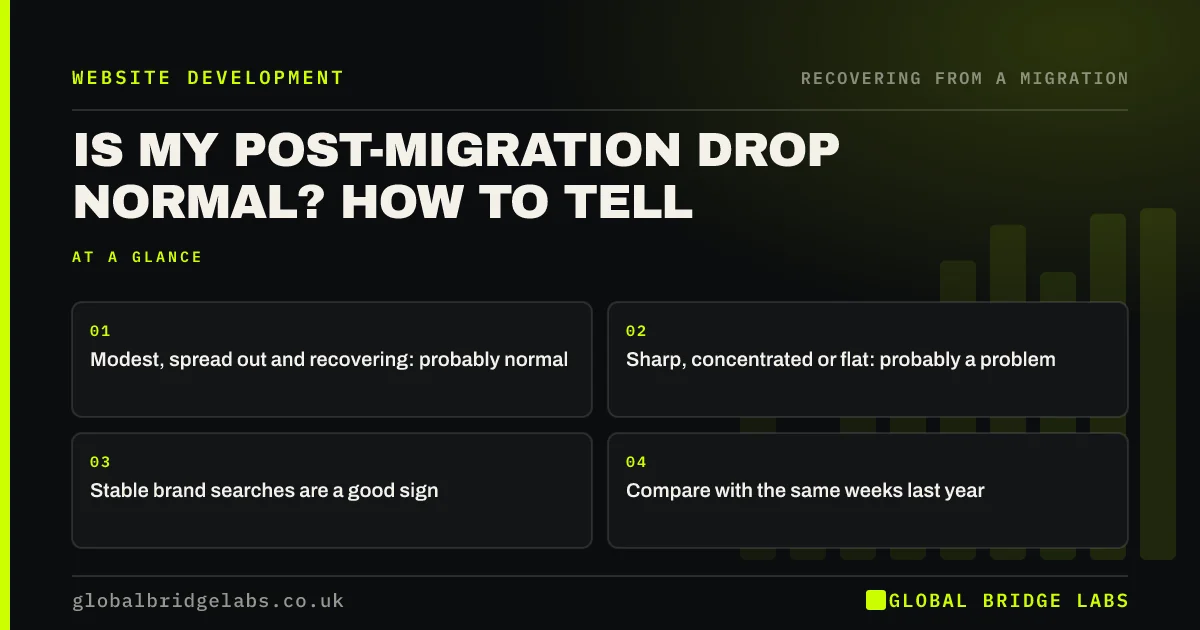
A small dip for a few weeks after a migration is common while Google processes redirects. A drop is probably normal if it is modest, spread across many pages, brand searches are stable and it is recovering week by week. It is probably a problem if it is sharp, concentrated on certain pages, hits brand searches or is still flat after two or three months.
- Modest, spread out and recovering: probably normal.
- Sharp, concentrated or flat: probably a problem.
- Stable brand searches are a good sign.
- Compare with the same weeks last year.
Not sure if your drop is normal? Message us on WhatsApp.
Chat on WhatsApp →What does a normal dip look like?
In a well-planned migration, clicks may dip for a week or two, with individual pages swapping between old and new URLs in results. Old URLs move into page with redirect in Search Console while new ones become indexed. The dip is shallow, affects many pages a little rather than a few pages a lot, and the weekly trend points back towards the baseline.
What points to a real problem?
Look for patterns rather than single numbers.
- A sharp fall in the first few days.
- Brand searches dropping.
- A handful of top pages losing most of their clicks.
- Rising not found or soft 404 errors.
- No recovery after six to eight weeks.
How do you rule out seasonality?
Compare the post-launch weeks with the same weeks last year, not just the weeks before launch. Many businesses have predictable dips, such as summer or the period after Christmas. Check whether competitors and your other channels dipped too. If last year shows the same shape, the migration may not be the cause. If last year was flat and this year fell, look closer.
Want a second opinion on your post-launch data? Send it to us on WhatsApp.
Chat on WhatsApp →What does this look like in practice?
A pattern we see: an owner sees clicks fall in the month after launch and fears the worst. Year-on-year data shows the same dip every August, and the top pages are holding. One category page is genuinely down, and its redirect points to the wrong page. Fixing that one redirect is all the migration needs.
Normal or not checklist
- Check whether the dip is shallow and spread out.
- Check brand searches.
- Check top pages one by one.
- Compare with the same weeks last year.
- Act on problems; wait out a normal dip.
Next step
Put this week's clicks next to the same week last year and your pre-launch baseline. If both comparisons show a drop on specific pages, start with those pages.
Message us on WhatsApp about a traffic drop, or book a 30-minute consultation.
Chat on WhatsApp →Sources and further reading
- Performance report (Search results) · Search Console Help
- Site moves with URL changes · Google Search Central
- Page indexing report · Search Console Help
Frequently asked questions
How much traffic drop is normal after a migration?
There is no fixed figure. A well-planned migration often sees a modest dip for a week or two, then a recovery towards the baseline. Large, sharp or lasting drops, or drops concentrated on a few pages, are not normal and usually have a specific cause worth finding.
How long does a normal post-migration dip last?
For small sites with complete redirects, often a few weeks. Larger sites and domain changes can take a few months to settle fully. If traffic is still flat or falling after two or three months, treat it as a problem and investigate rather than waiting longer.
Why did my brand searches drop after the migration?
Brand search drops usually point to a technical problem, such as a noindex tag, a robots.txt block, the homepage redirecting wrongly or the site being slow or unavailable. Check the homepage with URL Inspection, review robots.txt and look at the Page indexing report straight away.
Written by

Global Bridge Labs (GBL) is a UK–Sri Lanka partner for social media, websites and BPO. Everything here comes from client delivery, not theory.