On this page
- 01Key takeaways
- 02Why are logistics websites different?
- 03Mistake 1: vague capability pages
- 04Mistake 2: no coverage information
- 05Mistake 3: stock lorry photos
- 06Mistake 4: long quote forms
- 07Mistake 5: accreditations out of sight
- 08Mistake 6: no route for existing customers
- 09What does this look like in practice?
- 10Logistics website checklist
- 11Next step
- 12Sources and further reading
- 13Frequently asked questions
Key takeaways
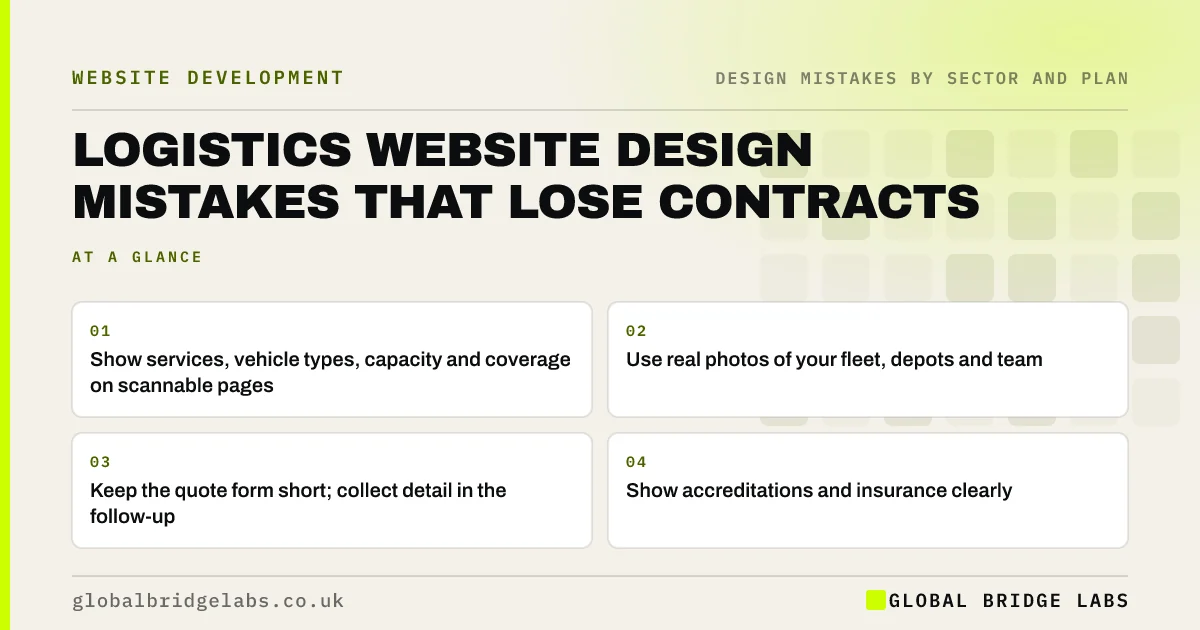
Logistics buyers, usually operations or procurement managers, want to know quickly whether you can handle their freight, routes and volumes. The design mistakes that lose contracts are vague capability pages, no coverage information, stock photos of other companies' lorries, long quote forms and missing accreditations. Make capability scannable and the quote request short.
- Show services, vehicle types, capacity and coverage on scannable pages.
- Use real photos of your fleet, depots and team.
- Keep the quote form short; collect detail in the follow-up.
- Show accreditations and insurance clearly.
Want your logistics site reviewed? Message us on WhatsApp.
Chat on WhatsApp →Why are logistics websites different?
Logistics buying is business-to-business, often involves several people and is based on capability, reliability and compliance. Buyers shortlist suppliers from their websites before calling. A site that makes capabilities hard to judge drops off the shortlist without anyone knowing.
Mistake 1: vague capability pages
Pages that say 'We deliver tailored logistics solutions' tell a buyer nothing. State what you move, how (vehicle types, temperature control, hazardous goods), where, at what volumes and on what timescales. Use lists and tables that buyers can scan and compare.
Mistake 2: no coverage information
Buyers need to know whether you cover their routes. Show coverage as a simple map with a text list of regions or countries beside it, so it works for search engines and screen readers as well as at a glance.
Mistake 3: stock lorry photos
Buyers in the sector recognise stock images, and sometimes other companies' liveries. Real photos of your fleet, warehouses and people show scale and that you are genuine.
Mistake 4: long quote forms
A quote form asking for every dimension, weight and date before any contact is abandoned by buyers who just want to start a conversation. Ask for the essentials to qualify the enquiry and route it, then gather detail by phone or email. Offer a direct line for urgent work.
Want a quote journey buyers complete? Message us on WhatsApp and we will discuss your requirements.
Chat on WhatsApp →Mistake 5: accreditations out of sight
Buyers check accreditations, operator licences, insurance and certifications such as ISO standards early. Show them on capability pages and near the quote button, and make sure they are current.
Mistake 6: no route for existing customers
Existing customers looking for tracking, invoices or support should not have to wade through sales pages. Add a clear customer login or support link in the header so the sales journey stays clean.
What does this look like in practice?
A pattern we see: a haulage site leads with a stock lorry image and a single services paragraph, with a twelve-field quote form. Replacing it with real fleet photos, a capability list and a short form makes the site easier for buyers to shortlist.
Logistics website checklist
- Scannable capability pages with specifics.
- Coverage map plus text list.
- Real fleet, depot and team photos.
- Short quote form plus direct line.
- Accreditations and insurance visible.
- Customer login or support link in the header.
Next step
Ask a buyer you work with what they check first on a supplier's website, then check how quickly yours answers it.
Message us on WhatsApp for a logistics website review, or book a 30-minute consultation.
Chat on WhatsApp →Sources and further reading
- Structuring forms · GOV.UK Service Manual
- Photos as web content · Nielsen Norman Group
- Understanding SC 1.1.1: Non-text Content · W3C
Frequently asked questions
What should a logistics company website include?
Clear capability pages covering what you move, how, where and at what volumes, a coverage map with a text list, real fleet photos, accreditations and insurance, case studies, a short quote form and a direct phone line.
How long should a logistics quote form be?
As short as possible while still qualifying and routing the enquiry: contact details, type of freight, origin and destination, and timing. Gather full specifications in the follow-up conversation.
Do logistics buyers use websites to choose suppliers?
Yes. Buyers typically research and shortlist suppliers online before contacting them. A site that makes capabilities, coverage and compliance easy to judge is more likely to make the shortlist.
Written by

Global Bridge Labs (GBL) is a UK–Sri Lanka partner for social media, websites and BPO. Everything here comes from client delivery, not theory.