On this page
- 01Key takeaways
- 02What does the logistics customer journey look like?
- 03What do shippers check on a logistics website?
- 04How should a logistics quote request work?
- 05How do you design for the buying group?
- 06Why are onboarding and tracking part of the journey?
- 07When is the website a small part of winning contracts?
- 08What does this look like in practice?
- 09Logistics journey checklist
- 10Next step
- 11Sources and further reading
- 12Frequently asked questions
Key takeaways
Businesses choosing a logistics or transport provider usually move from a trigger, such as a failed carrier or new contract, through research, quote requests and checks on reliability and coverage, to a trial and onboarding. Logistics websites should show services by shipment type, coverage, proof of reliability, how quoting works and what onboarding involves, with a quote request that captures the details needed to price.
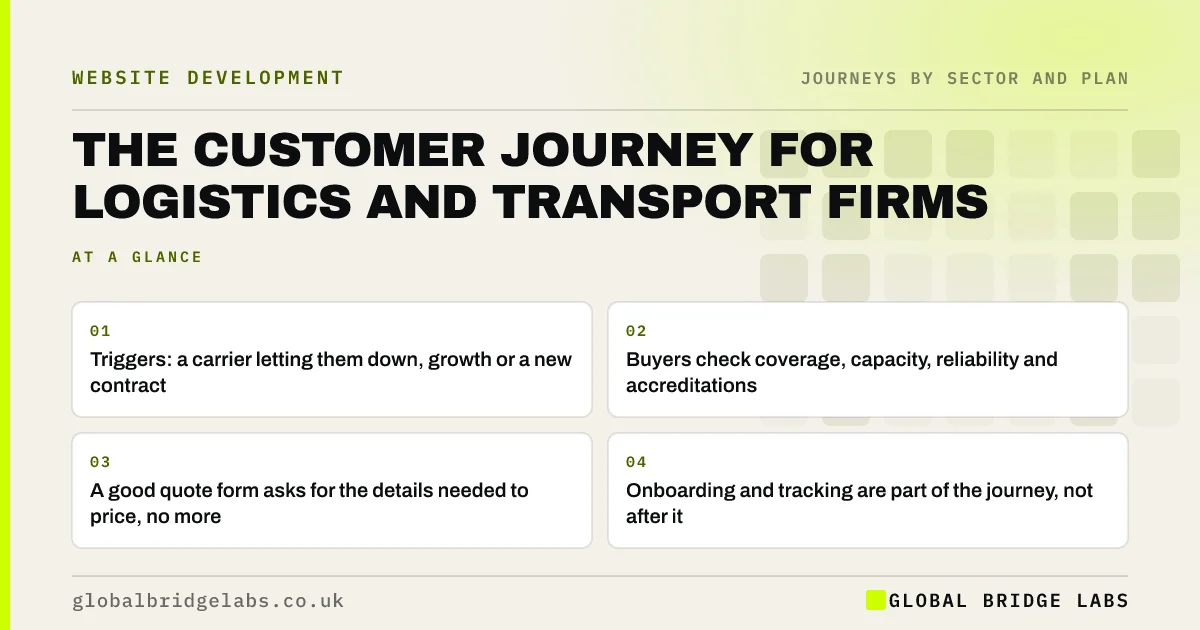
- Triggers: a carrier letting them down, growth or a new contract.
- Buyers check coverage, capacity, reliability and accreditations.
- A good quote form asks for the details needed to price, no more.
- Onboarding and tracking are part of the journey, not after it.
Want your logistics website checked against how shippers buy? Message us on WhatsApp.
Chat on WhatsApp →What does the logistics customer journey look like?
The logistics customer journey often begins when something breaks: a carrier misses deliveries, volumes grow beyond a current supplier, or a new contract needs different capacity. The buyer, often an operations or supply chain manager, searches by service and route, checks coverage and proof, requests quotes from several providers, involves finance or a director, and may run a trial before committing.
What do shippers check on a logistics website?
Shippers check whether you handle their shipment type, cover their routes, have capacity, and deliver reliably. They look for accreditations, insurance, fleet or network details, technology such as tracking and integrations, and examples from similar businesses. Missing coverage or capacity details is a common reason to move on.
- Services by shipment type: pallets, parcels, temperature-controlled, same-day.
- Coverage: routes, regions and international lanes.
- Capacity and fleet or network details.
- Reliability evidence and accreditations.
- Tracking, integrations and reporting.
- Case studies from similar shippers.
How should a logistics quote request work?
A logistics quote request should collect what you need to price accurately, such as collection and delivery postcodes, shipment type, weights or pallet counts, frequency and timescales, without becoming a barrier. Split it into short steps if it is long, explain why each detail matters, and offer a call for complex or regular contracts. Say when the quote will arrive.
- Multi-step vs single-step forms: which gets more enquiries?
- Instant quote calculators: do they win more enquiries?
Want your quote form trimmed to what you need to price? Message us on WhatsApp.
Chat on WhatsApp →How do you design for the buying group?
Logistics decisions often involve operations, finance and a director. The operations manager researches; others check cost, risk and contract terms. Give the champion material they can forward: a one-page service summary, accreditation details, insurance and a clear onboarding plan. Pages that answer risk questions plainly help the people who never visit.
Why are onboarding and tracking part of the journey?
Onboarding and tracking are part of the journey because they decide whether the new customer stays. Explain onboarding steps on the website: account setup, integration, first collections and who to contact. Make tracking easy to find from the homepage. Customers who can self-serve tracking and paperwork phone less and trust more.
When is the website a small part of winning contracts?
For large contracts won through tenders or long relationships, the website is a credibility check rather than the main sales tool. It still matters: buyers and procurement teams look for accreditations, policies and evidence. Make those easy to find, even if most of the selling happens in meetings.
What does this look like in practice?
A pattern we see on logistics sites: the homepage shows lorries and slogans, coverage is described as 'nationwide', and the quote form is a general contact form. Shippers cannot tell whether the firm handles their freight type or route, and quote requests arrive missing the details needed to price, adding days of back-and-forth.
Service pages by shipment type, a coverage map and a structured quote form shorten both the buyer's research and the quoting cycle. Across our client work we have seen a 2.4x enquiry rate from conversion changes of this kind. Global Bridge Labs (GBL) builds logistics journeys from the shipper's checklist.
Logistics journey checklist
- Service pages by shipment type.
- Coverage map and capacity details.
- Accreditations, insurance and reliability evidence.
- Structured quote request with a reply time.
- Forwardable summary for the buying group.
- Onboarding steps and easy tracking access.
Next step
Shippers judge a carrier's website on coverage, proof and how easy it is to get a price. We will check yours against their checklist and show the gaps.
Message us on WhatsApp for a logistics customer journey review, or book a 30-minute consultation.
Chat on WhatsApp →Sources and further reading
- Structuring forms · GOV.UK Service Manual
- Journey mapping 101 · Nielsen Norman Group
- The 95-5 rule: most B2B buyers are out of market · LinkedIn B2B Institute
Frequently asked questions
How do businesses choose a logistics provider?
Usually after a trigger such as a carrier letting them down or volumes growing. They search by service and route, check coverage, capacity, reliability and accreditations, request quotes from several providers, involve finance or a director, and sometimes run a trial before committing.
What should a logistics company website include?
Services by shipment type, coverage and capacity, accreditations and insurance, reliability evidence and case studies, tracking and integrations, a structured quote request with a stated reply time, and clear onboarding information.
What should a logistics quote form ask?
Only what you need to price: collection and delivery postcodes, shipment type, weights or pallet counts, frequency and timescales. Split long forms into short steps, explain why details are needed and offer a call for complex or regular contracts.
Written by

Global Bridge Labs (GBL) is a UK–Sri Lanka partner for social media, websites and BPO. Everything here comes from client delivery, not theory.