On this page
- 01Key takeaways
- 02How do you compare content writing costs?
- 03What does an in-house writer cost per article?
- 04What do outsourced articles cost?
- 05Who owns the expertise?
- 06When is an in-house writer better?
- 07When is outsourcing content better?
- 08How do you control quality?
- 09What should a content brief include?
- 10What does this look like in practice?
- 11Content writing checklist
- 12Next step
- 13Sources and further reading
- 14Frequently asked questions
Key takeaways
In-house vs outsourced content writing is best compared per article. A staff writer on £30,000 producing 10 articles a month costs about £310 per article with overheads. Outsourced articles cost an indicative £150–£600 each. For four articles a month, outsourcing costs about £7,000–£29,000 a year against about £37,000 for a hire.
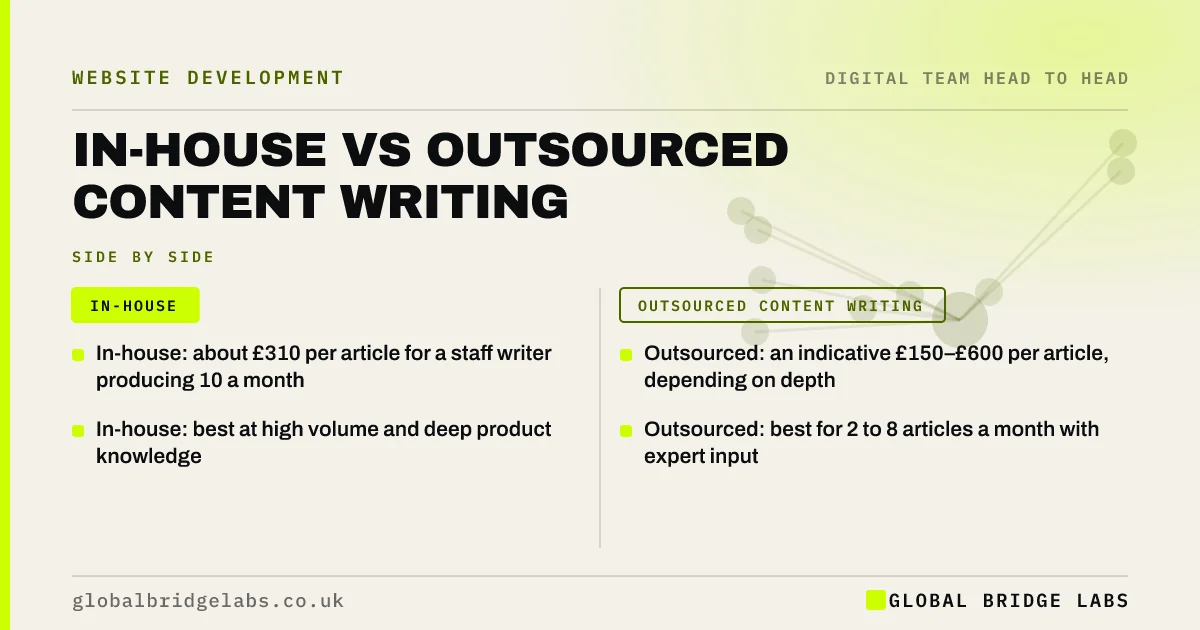
- In-house: about £310 per article for a staff writer producing 10 a month.
- Outsourced: an indicative £150–£600 per article, depending on depth.
- In-house: best at high volume and deep product knowledge.
- Outsourced: best for 2 to 8 articles a month with expert input.
Want content costed per article for your plan? Message us on WhatsApp.
Chat on WhatsApp →How do you compare content writing costs?
Compare cost per finished, published article, including briefing, editing and approval time. A salary divided by output gives the in-house figure; the outsourced figure is the fee plus your time to brief and review. Hourly rates alone mislead, because writers work at very different speeds.
What does an in-house writer cost per article?
A writer on £30,000 costs about £34,463 a year in employment costs, and about £37,000 with equipment and software. Producing 10 researched articles a month, about 120 a year, that is roughly £310 per article. At 5 a month, it doubles to about £620.
What do outsourced articles cost?
Outsourced articles commonly cost an indicative £150–£600 each, depending on length, research, subject expertise and whether SEO briefs and editing are included. Four articles a month at those rates costs about £7,200–£28,800 a year, plus your time briefing and approving.
Want a content plan priced at your volume? Send us your topics on WhatsApp.
Chat on WhatsApp →Who owns the expertise?
Good business content depends on your expertise, not the writer's. Whoever writes needs access to the people who know the answers. Plan 20 to 30 minutes of an expert's time per article for a short interview or voice note; this matters more than whether the writer is in-house.
When is an in-house writer better?
When you need high volume every month, when the subject is so technical that briefing outsiders takes longer than writing, or when content also covers emails, sales material and social posts that benefit from someone inside the business.
When is outsourcing content better?
When you need a steady few articles a month, when you want SEO structure and editing built in, or when output must continue through holidays. It avoids paying a full salary for part-time output.
How do you control quality?
Use a brief for every article: the question it answers, the reader, the facts and sources, and the next step. Check drafts for accuracy and for people-first usefulness, which Google's guidance on helpful content describes. Keep a style guide so every writer sounds like your business.
What should a content brief include?
A good brief makes any writer faster and more accurate. Keep it to one page per article.
- The question the article answers, in the buyer's words.
- Who the reader is and what they already know.
- Facts, figures and sources to use.
- The expert to interview and when.
- The next step you want the reader to take.
What does this look like in practice?
A pattern we see in UK B2B services firms: a director writes an article when time allows, perhaps three a year. Outsourcing production with a 20-minute monthly interview produces a steady flow of question-led articles, each reviewed by the director for accuracy.
Content writing checklist
Use these steps to decide.
- Decide how many articles a month you need.
- Calculate in-house cost per article at that volume.
- Get outsourced prices for the same brief.
- Book expert time for each article.
- Write a brief template and style guide.
Next step
Tell us your topics and monthly volume. We will cost in-house and outsourced content per article in a 30-minute call.
Message us on WhatsApp for a content cost comparison, or book a 30-minute consultation.
Chat on WhatsApp →Sources and further reading
- Creating helpful, reliable, people-first content · Google Search Central
- Rates and thresholds for employers 2026 to 2027 · HM Revenue & Customs
- Earnings and hours worked, occupation by four-digit SOC: ASHE Table 14 · Office for National Statistics
Frequently asked questions
Is it cheaper to outsource content writing?
At low to moderate volume, usually. A £30,000 staff writer producing 10 articles a month costs about £310 per article, but about £620 at 5 a month. Outsourced articles cost an indicative £150–£600 each and scale up or down with your content plan.
How much does a content writer cost in the UK?
A writer on £30,000 costs about £34,463 a year in employment costs using 2026/27 rates, and about £37,000 with equipment and software, before recruitment. Check local salaries against ONS occupation data, as pay varies with region, sector and experience. Recruitment comes on top.
How do I keep outsourced content accurate?
Give each writer a brief with the question, reader, facts and sources, give them 20 to 30 minutes with an expert in your business, and have that expert approve the draft before publishing. Keep a style guide so every writer sounds like your business.
Can AI tools replace a content writer?
They can speed up research and first drafts, but accurate, useful business content still needs your expertise, fact-checking and editing. Search engines reward helpful, people-first content. Use AI as a tool within a process that includes expert input and human review.
Written by

Global Bridge Labs (GBL) is a UK–Sri Lanka partner for social media, websites and BPO. Everything here comes from client delivery, not theory.