On this page
- 01Key takeaways
- 02Why are switching customers worth a section?
- 03What do switchers worry about?
- 04What should a switching section say?
- 05Should you criticise competitors?
- 06When should switchers get a separate page?
- 07What does this look like in practice?
- 08Switching section checklist
- 09Next step
- 10Sources and further reading
- 11Frequently asked questions
Key takeaways
Switching supplier website visitors are often your best prospects: they already buy the service and are unhappy with someone else. They fear disruption, cost and repeating the same mistake. Give them a short homepage section or link that names the switch, explains how you handle the handover and shows proof from others who moved.
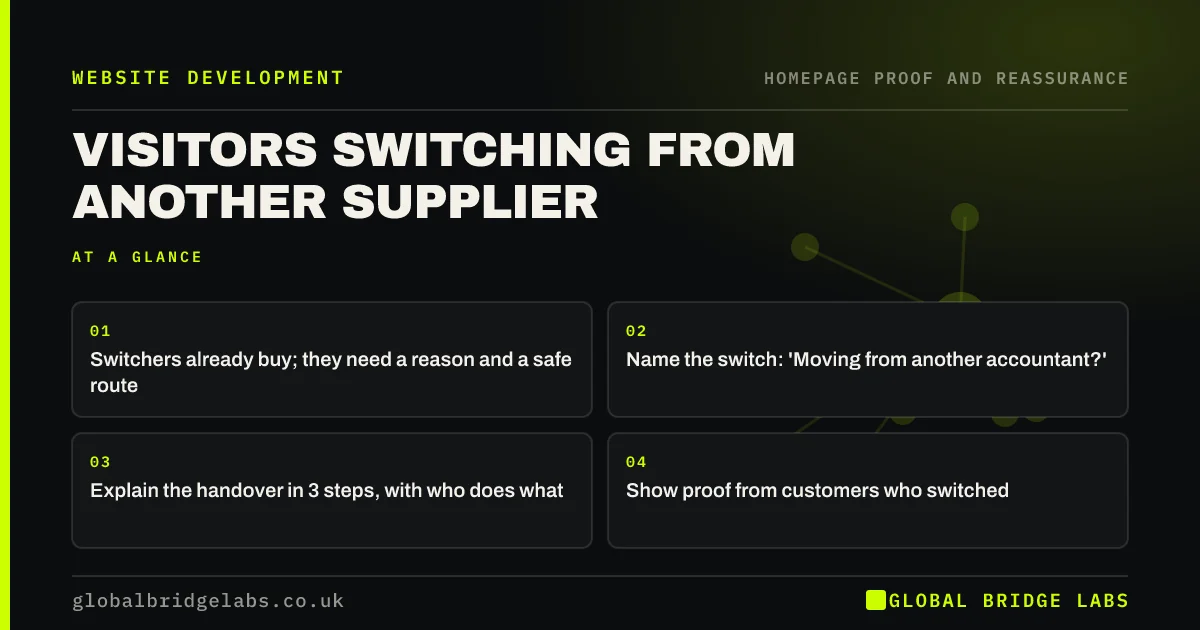
- Switchers already buy; they need a reason and a safe route.
- Name the switch: 'Moving from another accountant?'
- Explain the handover in 3 steps, with who does what.
- Show proof from customers who switched.
Want a switching section written for your homepage? Message us on WhatsApp.
Chat on WhatsApp →Why are switching customers worth a section?
Switching customers are worth it because they have already decided they need the service and often know what good looks like. In many sectors, such as accounting, IT support, cleaning contracts and property management, a large share of new business comes from people leaving another provider. They respond to different messages from first-time buyers.
What do switchers worry about?
Switchers worry about three things: disruption (lost records, a gap in service), cost and hassle (exit fees, paperwork, explaining everything again) and repeating the mistake (another provider who over-promises). Your copy should answer each in plain terms.
What should a switching section say?
Name the situation in a heading, such as 'Moving from another provider?'. Then explain the handover in three steps: 'We contact your old firm, we move the records, nothing changes for you until we are ready.' Add how long it takes and proof from a customer who switched.
Should you criticise competitors?
No. Describe the problems switchers commonly have ('slow replies', 'surprise bills') without naming anyone, and show how you handle those points differently. Disparaging named competitors carries legal and reputational risk, and buyers tend to trust calm confidence more than attacks.
When should switchers get a separate page?
Give them a separate page when switching is a large share of your new business or when the handover process is detailed. Keep a one-line link on the homepage, such as 'Switching from another provider? See how we handle it', so the main page stays focused.
What does this look like in practice?
A pattern we see in accountancy and IT support: most new clients are switching, but the homepage speaks only to new businesses. Adding one switching section with a three-step handover often brings in enquiries from people who had been putting off the move.
Switching section checklist
- Check how many new customers came from a competitor.
- Name the switch in a heading.
- Explain the handover in 3 steps.
- Say how long it takes and what it costs.
- Add proof from a customer who switched.
- Describe problems, never named competitors.
Next step
Ask your last five customers who switched what nearly stopped them. Their answers are the copy for your switching section.
Message us on WhatsApp to turn those answers into a section, or book a 30-minute consultation.
Chat on WhatsApp →Sources and further reading
Frequently asked questions
How do I win customers from competitors with my website?
Speak directly to people switching: name their situation, address their worries about disruption and cost, explain your handover in a few steps and show proof from customers who moved. Describe common problems without naming or criticising competitors.
Should my homepage mention switching providers?
Yes, if switchers are a meaningful share of your new business. A short section or a clear link from the homepage tells them you make moving easy, which removes one of the biggest reasons they stay with a provider they dislike.
Can I compare myself with competitors on my website?
You can make fair comparisons, but they must be accurate, verifiable and not misleading under the CAP Code. Naming competitors adds legal risk, so many small businesses describe common problems instead and show how they handle them.
Written by

Global Bridge Labs (GBL) is a UK–Sri Lanka partner for social media, websites and BPO. Everything here comes from client delivery, not theory.