On this page
- 01Key takeaways
- 02Why do the title and description affect conversion?
- 03What should a homepage title tag say?
- 04What should a homepage meta description say?
- 05Why does Google sometimes show something else?
- 06When should the title focus on the brand alone?
- 07What does this look like in practice?
- 08Homepage title and description checklist
- 09Next step
- 10Sources and further reading
- 11Frequently asked questions
Key takeaways
Your homepage meta description and title tag are the first version of your homepage most visitors see, in Google's results. Use the title for your name, main service and area, and the description for a specific promise and proof. Accurate expectations bring visitors who convert; vague or keyword-stuffed ones bring visitors who leave.
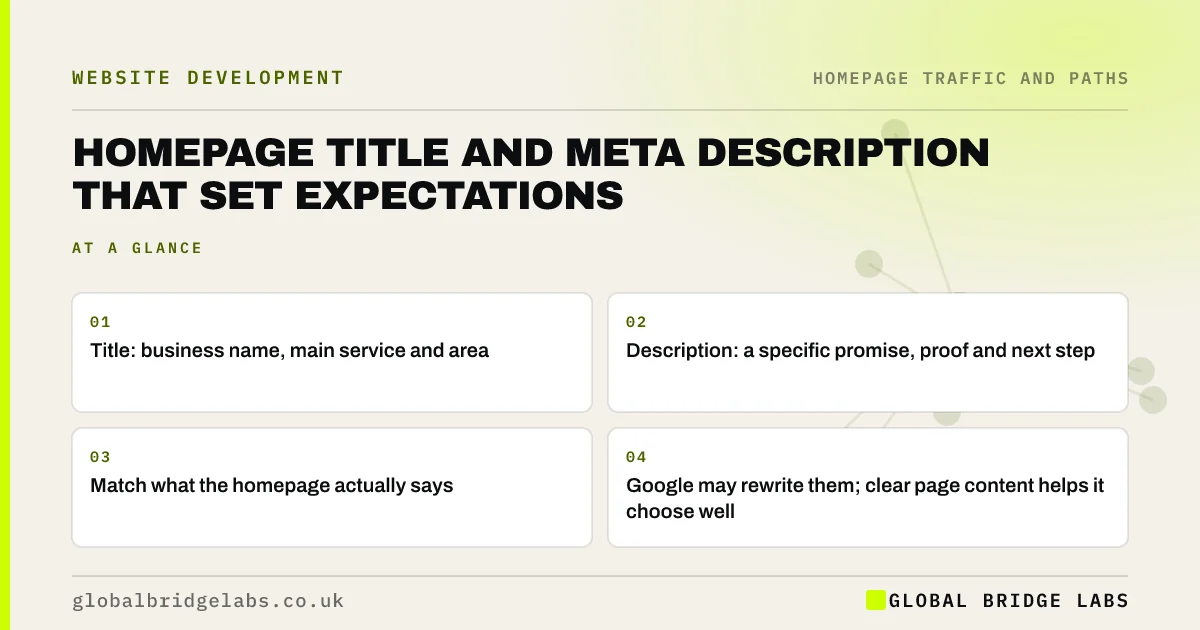
- Title: business name, main service and area.
- Description: a specific promise, proof and next step.
- Match what the homepage actually says.
- Google may rewrite them; clear page content helps it choose well.
Want your homepage title and description rewritten? Message us on WhatsApp.
Chat on WhatsApp →Why do the title and description affect conversion?
They set expectations before the click. A title that says 'Emergency plumber, Leeds' brings people needing an emergency plumber in Leeds; a homepage that then talks about bathroom design loses them. When the search result and the homepage say the same thing, visitors feel they have arrived in the right place.
What should a homepage title tag say?
Include your business name, your main service and your area, in a natural order: 'Leeds Boiler Repairs and Servicing | Smith Heating'. Keep it short enough to read in results. Do not list every service or town; that reads as spam and Google may rewrite it.
What should a homepage meta description say?
Write one or two sentences, roughly 150 characters, with a specific promise, a piece of proof and a hint of the next step: 'Gas Safe engineers across Leeds. Most repairs same or next day, fixed prices. Rated 4.9 from 212 reviews.' Google does not use the description for ranking, but it can affect who clicks.
Why does Google sometimes show something else?
Google may rewrite titles and choose page text instead of your meta description when it thinks something else better matches the search. Clear headings and a homepage that states what you do plainly give it better material to choose from.
When should the title focus on the brand alone?
If almost all homepage clicks come from branded searches and your name already says what you do, the title can lead with the brand. Still include the service and area, because they reassure branded searchers that they have found the right business.
What does this look like in practice?
A pattern we see: a homepage titled 'Home' with no meta description, so Google shows a fragment of cookie banner text. Writing a clear title and description is a ten-minute job that improves how the business looks to everyone who searches for it.
Homepage title and description checklist
- Title: name, main service and area.
- Description: promise, proof and next step.
- Keep both specific and natural, not stuffed.
- Check they match the homepage hero.
- Search your name to see how they appear.
Next step
Search your business name on Google and read your homepage result as a stranger would. If it does not say what you do and where, rewrite the title and description today.
Message us on WhatsApp for options, or book a 30-minute consultation.
Chat on WhatsApp →Sources and further reading
- Influencing your title links in search results · Google Search Central
- Control your snippets in search results · Google Search Central
- SEO Starter Guide · Google Search Central
Frequently asked questions
What should my homepage title tag be?
Your business name, main service and area in a natural phrase, such as 'Leeds Boiler Repairs and Servicing | Smith Heating'. Keep it readable and avoid listing every service or town, which can look spammy and lead Google to rewrite it.
What makes a good homepage meta description?
A sentence or two, roughly 150 characters, that makes a specific promise, offers proof such as a review score and hints at the next step. It should match what the homepage says so visitors who click feel they are in the right place.
Does the meta description affect rankings?
No, Google does not use it as a ranking factor. It can affect click-through rate because it often appears in results, and Google may replace it with page text if that better matches the search.
Written by

Global Bridge Labs (GBL) is a UK–Sri Lanka partner for social media, websites and BPO. Everything here comes from client delivery, not theory.