On this page
- 01Key takeaways
- 02Why does hiring cause design mistakes?
- 03Mistake 1: judging on portfolio looks alone
- 04Mistake 2: no brief
- 05Mistake 3: unclear ownership
- 06Mistake 4: leaving content out of the scope
- 07Mistake 5: no testing or accessibility standard
- 08Mistake 6: choosing on price alone
- 09Mistake 7: no plan for after launch
- 10What does this look like in practice?
- 11Hiring checklist
- 12Next step
- 13Sources and further reading
- 14Frequently asked questions
Key takeaways
The costliest mistakes when hiring a web designer are choosing on portfolio looks alone, starting without a brief, not agreeing who owns the site and domain, and leaving mobile, accessibility and content out of the scope. Ask how they test, who writes the words and what happens after launch before you sign.
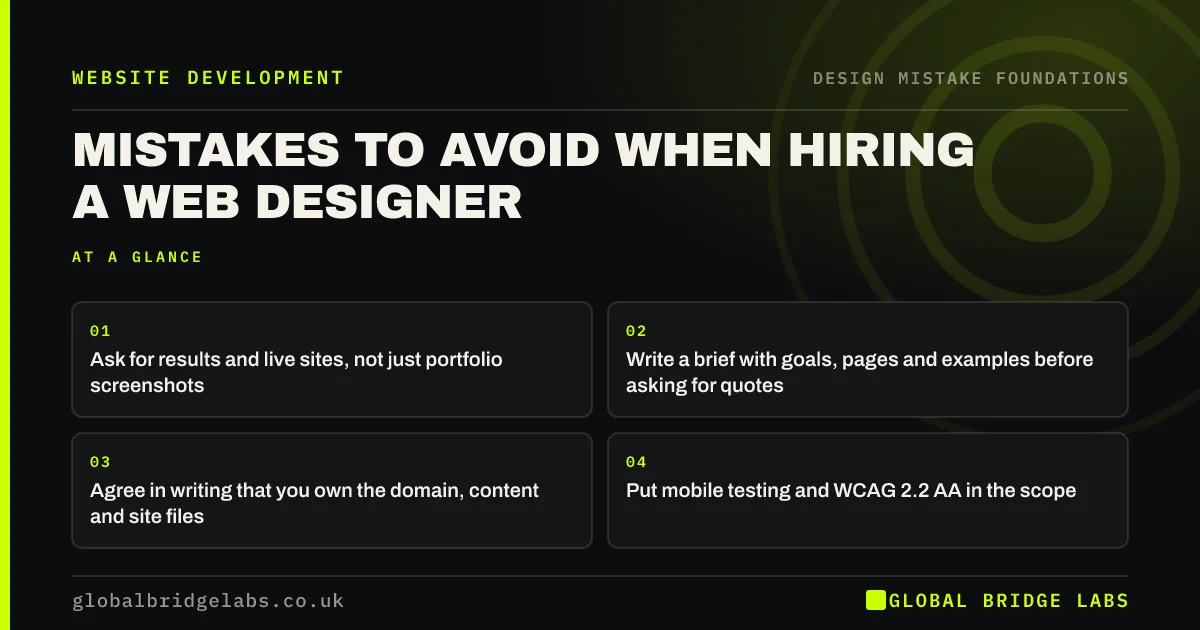
- Ask for results and live sites, not just portfolio screenshots.
- Write a brief with goals, pages and examples before asking for quotes.
- Agree in writing that you own the domain, content and site files.
- Put mobile testing and WCAG 2.2 AA in the scope.
Comparing web designers? Message us on WhatsApp.
Chat on WhatsApp →Why does hiring cause design mistakes?
Many design mistakes are baked in at the hiring stage. A designer chosen for visual flair may produce a striking site that is hard to use. A scope that leaves out content or testing produces pages with placeholder text and untested forms. Choosing well prevents problems that are expensive to fix later.
Mistake 1: judging on portfolio looks alone
Portfolio screenshots show how a site looked on a large screen on launch day. Open the live sites on your phone. Check whether the text is readable, the contact details easy to find and the forms working. Ask what happened to enquiries or sales after launch and whether you can speak to a client.
Mistake 2: no brief
Without a brief, quotes are not comparable and the designer fills gaps with assumptions. A one or two-page brief covering goals, audience, pages, must-have features, examples you like and why, and budget range makes quotes fairer and the design more focused.
Mistake 3: unclear ownership
Some businesses discover after a dispute that the designer registered the domain in their own name or the site runs on a proprietary platform they cannot leave. Agree in writing that you own the domain, the content, the design files and admin access, and that you can move the site.
Mistake 4: leaving content out of the scope
If nobody is responsible for the words, the design is built around placeholder text and the real content arrives late, too long or too short for the layout. Agree who writes and edits copy, who supplies photos and when, and design around real content wherever possible.
Need help scoping a website project? Message us on WhatsApp and we will discuss your requirements.
Chat on WhatsApp →Mistake 5: no testing or accessibility standard
Ask which devices and browsers they test on and whether they work to WCAG 2.2 AA. WebAIM's 2026 survey found detectable accessibility failures on 95.9% of top home pages, so do not assume it is included. Write the standard, the device list and form testing into the contract.
Mistake 6: choosing on price alone
The cheapest quote often leaves out content, testing, training or support. In the UK market a new small business website typically ranges from about £1,500–£5,000 for a simple site to £5,000–£20,000 or more for a custom build with integrations. Compare what each quote includes before comparing the totals.
Mistake 7: no plan for after launch
Sites need updates, security patches and small changes. Agree who handles them, how quickly and at what cost. Care plans in the UK market commonly run from about £50 to £500 a month depending on what is included.
What does this look like in practice?
A pattern we see: a business hires on a beautiful portfolio, the new site launches on time, and only then does someone notice the contact form was never tested on iPhone. Agreeing testing and acceptance criteria up front would have caught it before launch.
Hiring checklist
- Write a short brief before asking for quotes.
- Check live portfolio sites on your phone.
- Ask for a client you can speak to.
- Agree you own domain, content and files.
- Agree who writes content and supplies photos.
- Put WCAG 2.2 AA and a device list in the contract.
- Agree post-launch support and costs.
Next step
Write a one-page brief with your goals and must-have pages before speaking to any designer.
Message us on WhatsApp to talk through your brief, or book a 30-minute consultation.
Chat on WhatsApp →Sources and further reading
- The WebAIM Million: accessibility of the top 1,000,000 home pages · WebAIM
- WCAG 2 overview · W3C Web Accessibility Initiative
- Designing for different browsers and devices · GOV.UK Service Manual
Frequently asked questions
What should I look for when hiring a web designer?
Live sites that work well on a phone, evidence of results for clients, a clear process that includes content and testing, a stated accessibility standard, clear ownership terms and a plan for support after launch. A striking portfolio alone is not enough.
What are red flags when hiring a web designer?
Refusing to put ownership in writing, registering your domain in their name, no testing process, no mention of mobile or accessibility, a quote with no breakdown, and no references. Pressure to sign quickly is another warning sign.
How much does a web designer cost in the UK?
Market ranges vary widely: roughly £1,500–£5,000 for a simple small business site and £5,000–£20,000 or more for a custom build with integrations. Compare what each quote includes, such as content, testing and support, before comparing totals.
Written by

Global Bridge Labs (GBL) is a UK–Sri Lanka partner for social media, websites and BPO. Everything here comes from client delivery, not theory.