On this page
- 01Key takeaways
- 02What is the cost of staff turnover?
- 03How do you calculate turnover cost per leaver?
- 04What does a worked example look like?
- 05What is the annual cost of turnover?
- 06How does outsourcing change turnover cost?
- 07How can you reduce turnover cost in-house?
- 08How do you calculate your staff turnover rate?
- 09What does this look like in practice?
- 10Turnover cost checklist
- 11Next step
- 12Sources and further reading
- 13Frequently asked questions
Key takeaways
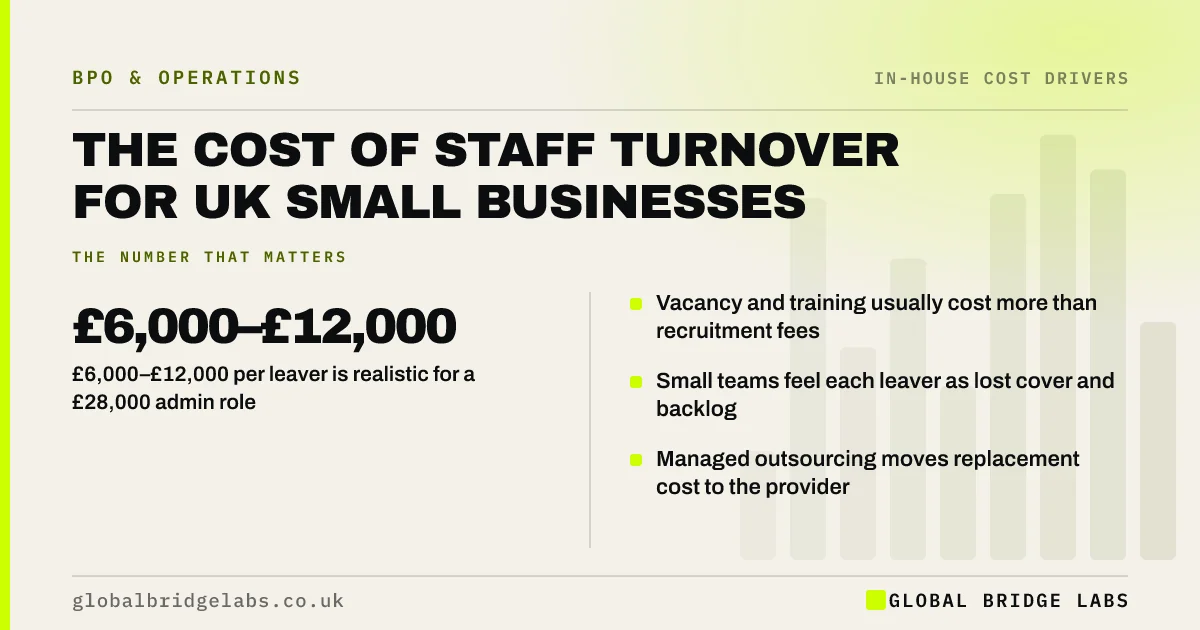
The cost of staff turnover is the total spent when someone leaves: lost output during notice and vacancy, recruitment, training and management time. For a £28,000 admin role, a realistic cost per leaver is about £6,000–£12,000. In a small team, one leaver a year can wipe out any saving from paying lower wages.
- £6,000–£12,000 per leaver is realistic for a £28,000 admin role.
- Vacancy and training usually cost more than recruitment fees.
- Small teams feel each leaver as lost cover and backlog.
- Managed outsourcing moves replacement cost to the provider.
Want your turnover cost worked out? Message us on WhatsApp with your leavers last year.
Chat on WhatsApp →What is the cost of staff turnover?
The cost of staff turnover is the sum of costs caused by an employee leaving and being replaced. It includes lower output during the notice period, the vacancy gap, recruitment, training the replacement and extra management time. Most of it does not appear as a line in the accounts, which is why it is underestimated.
How do you calculate turnover cost per leaver?
Add these five parts for each leaver.
- Notice period: lower output while the leaver works their notice.
- Vacancy: overtime, backlog or lost sales while the role is empty.
- Recruitment: adverts, agency fees and interview time.
- Training: lost output while the replacement learns, plus trainer time.
- Management: extra hours spent covering and supervising.
What does a worked example look like?
An administrator on £28,000 resigns. Four weeks of notice at reduced output loses about £700. A six-week vacancy covered partly by overtime costs about £3,000. Direct recruitment costs about £1,400, and training the replacement about £4,000. The total is about £9,100, roughly a third of the salary.
With an agency fee of £5,600 instead of direct hiring, the total rises to about £13,700.
Want this calculated for your team? Send the roles and leavers on WhatsApp.
Chat on WhatsApp →What is the annual cost of turnover?
Multiply the cost per leaver by the number of leavers a year. A team of ten with two leavers a year, at £9,000 each, loses about £18,000 a year to turnover. That is a real cost of the in-house model that rarely appears when comparing it with outsourcing.
How does outsourcing change turnover cost?
Outsourced providers have turnover too, but they carry its cost. A managed provider recruits and trains replacements within its rate and keeps cover running, so a departure does not create a vacancy on your side. Ask any provider how it measures and manages its own turnover.
How can you reduce turnover cost in-house?
Reduce the number of leavers and the cost of each. Fair pay, clear progression and manageable workloads cut leavers; written processes and cross-training cut the cost of each departure. Removing repetitive overflow work from a stretched team can also reduce burnout-driven resignations.
How do you calculate your staff turnover rate?
Divide the number of leavers in the last 12 months by the average number of employees over the same period, and multiply by 100. A team averaging ten people with two leavers has a turnover rate of 20%. Track it by role, because turnover is usually concentrated in a few positions.
What does this look like in practice?
A pattern we see in UK contact-heavy SMEs: the customer service role has turned over three times in two years. Each time, the owner covers the phones and rebuilds the training. Moving first-line support to a managed team, and keeping one in-house lead, ends the cycle.
Turnover cost checklist
Use these steps to measure it.
- Count leavers in the last 12 months by role.
- Cost notice, vacancy, recruitment, training and management per leaver.
- Multiply by leavers per year.
- Add the result to your in-house cost comparison.
- Identify the roles that turn over most often.
Next step
Tell us which roles turn over most. We will cost the turnover and compare it with a managed alternative in a 30-minute call.
Message us on WhatsApp for a turnover cost estimate, or book a 30-minute consultation.
Chat on WhatsApp →Sources and further reading
- Rates and thresholds for employers 2026 to 2027 · HM Revenue & Customs
- Workplace pensions: what you, your employer and the government pay · GOV.UK
- Vacancies and jobs in the UK (latest bulletin) · Office for National Statistics
Frequently asked questions
How much does it cost to replace an employee in the UK?
For an admin role on £28,000, notice, vacancy, recruitment and training typically total around £6,000–£12,000, depending on whether an agency is used and how long the role stays empty. Specialist and senior roles cost more to replace because recruitment and training take longer.
What is included in staff turnover cost?
Lower output during the notice period, the vacancy gap, recruitment fees and interview time, training the replacement, and extra management time. Most of these are time costs rather than invoices, so they are often left out of budgets and of in-house versus outsourcing comparisons.
Does outsourcing remove turnover risk?
It moves it. Providers have their own staff turnover, but a managed provider carries the cost of replacing and training people and keeps cover running while it does. Ask any provider how it measures turnover, how it transfers knowledge, and how service levels are protected during changes.
How can a small business reduce staff turnover?
Pay fairly for the local market, give clear progression, keep workloads manageable and hold regular one-to-ones. Removing repetitive overflow work from stretched teams also helps, because burnout is a common reason people leave small businesses. Exit conversations reveal patterns worth acting on.
Written by

Global Bridge Labs (GBL) is a UK–Sri Lanka partner for social media, websites and BPO. Everything here comes from client delivery, not theory.