On this page
- 01Key takeaways
- 02How does a cookie banner affect speed?
- 03Why are some consent tools so heavy?
- 04How do you keep a banner compliant and fast?
- 05What must you not do for the sake of speed?
- 06Does a full-screen consent wall hurt more?
- 07What does this look like in practice?
- 08Cookie banner speed checklist
- 09Next step
- 10Sources and further reading
- 11Frequently asked questions
Key takeaways
A cookie banner can be the slowest part of a page, because it is the first thing every new visitor sees and it usually loads from a third party. A badly set-up banner delays the first screen, pushes content down as it appears and holds back other scripts. The answer is not to remove it. It is to choose a light tool, load it early and show it as an overlay.
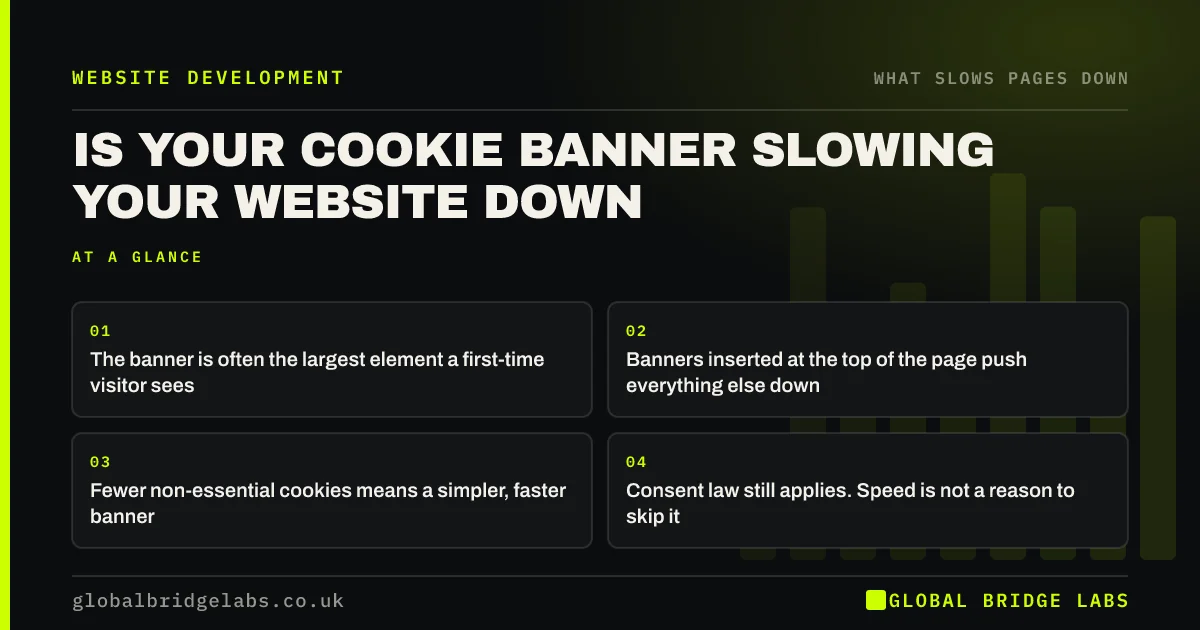
- The banner is often the largest element a first-time visitor sees.
- Banners inserted at the top of the page push everything else down.
- Fewer non-essential cookies means a simpler, faster banner.
- Consent law still applies. Speed is not a reason to skip it.
Want to know what your cookie banner costs in speed? Send us the URL on WhatsApp.
Chat on WhatsApp →How does a cookie banner affect speed?
A cookie banner affects speed in three ways. The consent tool's own script has to load, often from another company. The banner may be the largest thing on a new visitor's first screen, so its arrival time becomes the page's Largest Contentful Paint. And a banner that is inserted above the content shifts the page, which counts against Cumulative Layout Shift.
Google's web.dev guidance on cookie notices covers all three and recommends loading the notice script asynchronously and avoiding layouts that move the page.
Why are some consent tools so heavy?
Consent management platforms are built for large publishers with hundreds of advertising partners. They carry vendor lists, multiple languages and detailed preference screens. A small business with analytics and one advertising pixel is loading machinery it does not need.
The tool also sits in front of your other scripts, deciding which may run. If it is slow, everything waiting on it is slow.
How do you keep a banner compliant and fast?
Reduce what needs consent, then make the banner cheap to show.
- 1. Remove cookies and tags you do not use, so there is less to ask about.
- 2. Choose a lightweight consent tool suited to a small site.
- 3. Load the consent script early and asynchronously.
- 4. Display the banner as an overlay fixed to the bottom, not inserted at the top.
- 5. Keep the text short and the buttons large enough to tap.
- 6. Hold back non-essential scripts until a choice is made.
Unsure which cookies your site sets? Ask us on WhatsApp for a list.
Chat on WhatsApp →What must you not do for the sake of speed?
Do not remove the banner while still setting non-essential cookies, and do not load tracking before consent to save a step. Under the Privacy and Electronic Communications Regulations, as explained in the Information Commissioner's Office guidance, non-essential cookies generally need the user's consent before they are set.
The legitimate route to no banner is to set nothing that requires one. The rules and exemptions have been changing, so check the current guidance before relying on that.
Does a full-screen consent wall hurt more?
Yes, in experience if not in measured speed. A consent wall that covers the page forces a decision before the visitor has seen anything, and on a phone it can hide the content entirely. Google's guidance on intrusive interstitials makes an allowance for legally required notices, but visitors are less forgiving. A compact bottom banner asks the same question at lower cost.
What does this look like in practice?
A pattern we see on small business sites: an enterprise consent platform was installed to be safe, with a full vendor list, for a site that runs one analytics tool. On a phone, the banner arrives late, slides in from the top and moves the headline just as the visitor starts reading.
Switching to a light tool shown as a bottom overlay, and removing tags that were never used, makes the page steadier and quicker with no loss of compliance. Global Bridge Labs (GBL) reviews cookies and speed together for this reason.
Cookie banner speed checklist
- Open the site in a private window on a phone.
- Note when the banner appears and whether the page moves.
- List the cookies and tags that need consent.
- Remove the ones you do not use.
- Show the banner as a bottom overlay.
- Confirm nothing non-essential loads before consent.
Next step
Every new visitor meets your cookie banner before your offer. We will check what it costs in speed and movement, and how to slim it down without breaking the rules.
Message us on WhatsApp for a cookie banner and speed review.
Chat on WhatsApp →Sources and further reading
- Best practices for cookie notices · web.dev (Google)
- Cookies and similar technologies under PECR · Information Commissioner's Office
- Optimise Cumulative Layout Shift · web.dev (Google)
Frequently asked questions
Does a cookie banner slow down a website?
It can. The consent tool loads its own script, the banner is often the largest element a new visitor sees, and a banner inserted at the top pushes the page down. A lightweight tool loaded early and shown as a bottom overlay avoids most of the impact.
Can a cookie banner cause layout shift?
Yes. A banner that is inserted into the page above the content moves everything beneath it when it appears. Showing it as an overlay fixed to the bottom of the screen prevents the shift.
Can I remove my cookie banner to speed up my site?
Only if the site sets no cookies that need consent. Removing the banner while still using non-essential cookies breaks UK rules. Reduce the cookies you use first, then check the current Information Commissioner's Office guidance on what requires consent.
Which is faster, a cookie banner or a consent wall?
A compact banner. A full-screen wall blocks the content until the visitor decides, which feels slower and can hide the page on a phone. A small bottom banner asks the same question without getting in the way.
Written by

Global Bridge Labs (GBL) is a UK–Sri Lanka partner for social media, websites and BPO. Everything here comes from client delivery, not theory.