On this page
- 01Key takeaways
- 02What is the difference between a contractor and outsourcing?
- 03How do the off-payroll working rules apply?
- 04Which costs more?
- 05When is a contractor the right choice?
- 06When is outsourcing the better choice?
- 07What are the other risks with contractors?
- 08How do you reduce IR35 risk with contractors?
- 09What does this look like in practice?
- 10Contractor or outsourcing checklist
- 11Next step
- 12Sources and further reading
- 13Frequently asked questions
Key takeaways
Contractors vs outsourcing is a choice between buying a person's time and buying a managed service. Contractors bring specialist skills quickly but cost more per hour and can raise off-payroll working (IR35) questions. Medium and large clients must decide a contractor's status; small clients leave it to the contractor's company. Outsourcing a defined service avoids most of that.
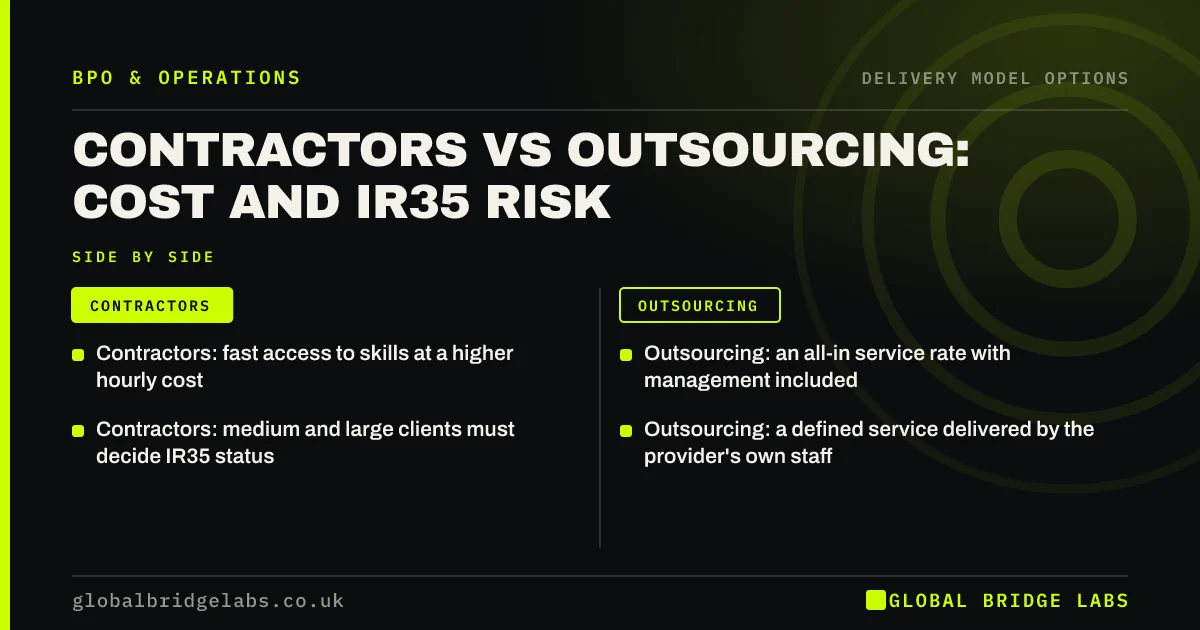
- Contractors: fast access to skills at a higher hourly cost.
- Outsourcing: an all-in service rate with management included.
- Contractors: medium and large clients must decide IR35 status.
- Outsourcing: a defined service delivered by the provider's own staff.
Weighing a contractor against a managed service? Message us on WhatsApp.
Chat on WhatsApp →What is the difference between a contractor and outsourcing?
A contractor is an individual, often working through their own limited company, who provides their personal services to your business. Outsourcing means a provider delivers a defined service using its own employees, supervision and processes. With a contractor you buy a person's time; with outsourcing you buy an outcome.
How do the off-payroll working rules apply?
Under the off-payroll working rules (IR35), if a worker would be an employee were it not for their intermediary company, tax and National Insurance must be paid as if they were employed. For medium and large private sector clients, the client must decide the worker's status and issue a status determination statement. For small clients, the worker's own company decides.
Whether your business counts as small depends on company size tests. HMRC's check employment status for tax tool helps assess individual engagements.
Which costs more?
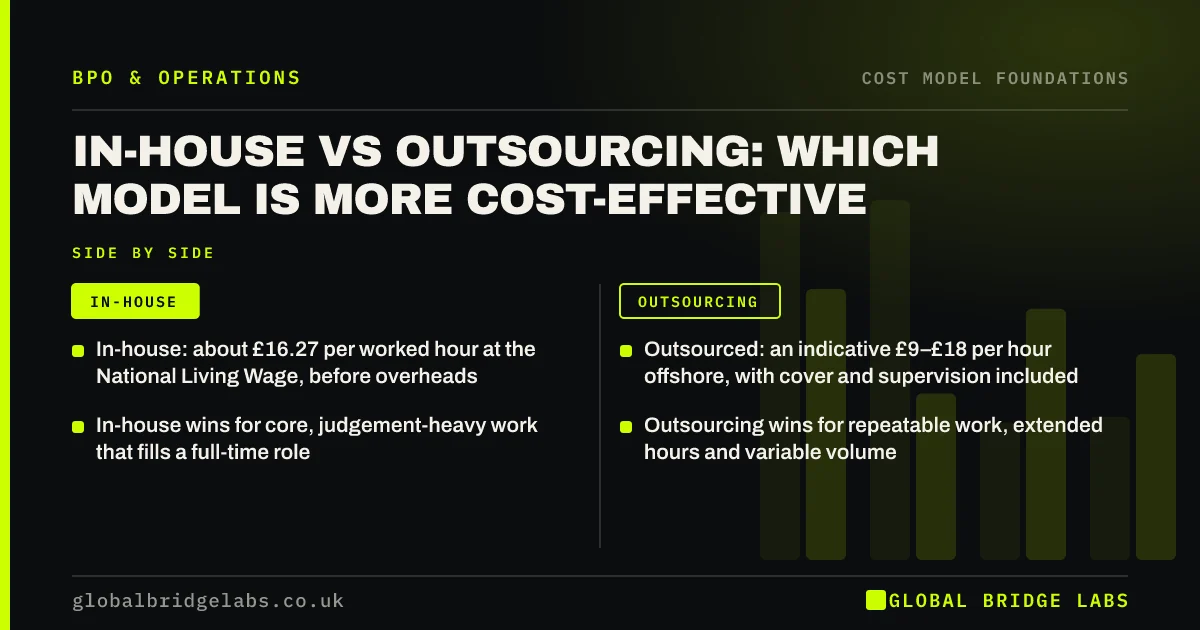
Contractor day rates reflect specialist skills, short notice and no employment costs for you, so they are usually well above the loaded cost of an employee per hour. A managed offshore service for support and admin costs an indicative £9–£18 per hour. For repeatable work, outsourcing is usually far cheaper; for scarce specialist skills needed briefly, a contractor may be the only option.
Want a contractor and a managed service priced side by side? Send us the role on WhatsApp.
Chat on WhatsApp →When is a contractor the right choice?
For short, specialist pieces of work with a clear end, such as a system migration, an interim finance role or a technical audit, where you need a particular expertise quickly and do not need ongoing cover. Check status for each engagement if you are a medium or large client.
When is outsourcing the better choice?
For ongoing, repeatable work that needs cover and supervision: support, admin, data, bookkeeping. The provider employs and manages its own staff, and you buy a defined service against service levels. This is a different arrangement from engaging an individual contractor through their company, though you should take advice if a contract blurs the line.
What are the other risks with contractors?
Knowledge leaves when the contract ends, cover is rarely available during holidays, and long engagements under your direction increase status risk. Keep documentation current, and plan a handover before the end date.
How do you reduce IR35 risk with contractors?
If you are a medium or large client, assess each engagement, issue a status determination statement, and review it when the work changes. Whatever your size, define the work as a deliverable with an end date where possible, avoid treating contractors like employees, and use HMRC's check employment status for tax tool on borderline cases.
What does this look like in practice?
A pattern we see in UK SMEs: a contractor has run the back-office admin for two years, full time and under the owner's direction. Replacing the arrangement with a managed service for the admin, and a short contractor engagement only for a system migration, reduces cost and status risk.
Contractor or outsourcing checklist
Answer these first.
- Is the work short and specialist, or ongoing and repeatable?
- Is your business small, medium or large for these rules?
- Who directs the work day to day?
- Who covers holidays and handover?
- Have you costed the day rate against a managed service?
Next step
Tell us the work you are using contractors for. We will say where a managed service would fit and cost it in a 30-minute call.
Message us on WhatsApp to compare contractors and outsourcing, or book a 30-minute consultation.
Chat on WhatsApp →Sources and further reading
- Understanding off-payroll working (IR35) · HM Revenue & Customs
- Check employment status for tax · HM Revenue & Customs
- Employment status · GOV.UK
Frequently asked questions
Does IR35 apply to outsourcing?
The off-payroll working rules target individuals providing personal services through intermediaries. Buying a defined service from a provider that employs and manages its own staff is a different arrangement, but take advice if a contract effectively supplies one named person working under your direction.
Who decides IR35 status for a contractor?
For medium and large private sector clients, the client decides and issues a status determination statement to the worker. For small clients, the contractor's own company decides. HMRC's check employment status for tax tool can help either party assess an engagement.
Are contractors more expensive than outsourcing?
Usually, per hour. Contractor rates reflect specialist skills, short notice and the absence of employment benefits. For repeatable support and admin work, a managed offshore service at an indicative £9–£18 per hour is typically far cheaper, and it includes supervision and cover.
When is a contractor better than a managed service?
For short, specialist projects with a clear end, such as a system migration, a technical audit or interim cover for a senior finance role, where you need specific expertise quickly and do not need ongoing cover. For ongoing repeatable work, a managed service usually fits better.
Written by

Global Bridge Labs (GBL) is a UK–Sri Lanka partner for social media, websites and BPO. Everything here comes from client delivery, not theory.