On this page
- 01Key takeaways
- 02What is storytelling in a business context?
- 03What structure should a story follow?
- 04Where do you find stories every week?
- 05How do stories attract the right customers?
- 06Should the owner's own story feature?
- 07What must you get right legally and ethically?
- 08What does this look like in practice?
- 09Storytelling checklist
- 10Next step
- 11Sources and further reading
- 12Frequently asked questions
Key takeaways
Storytelling on social media for business means showing a real customer's situation, what was done and what changed. It works because a buyer can see themselves in the customer. The owner's life story matters far less than a short, accurate account of a problem solved.
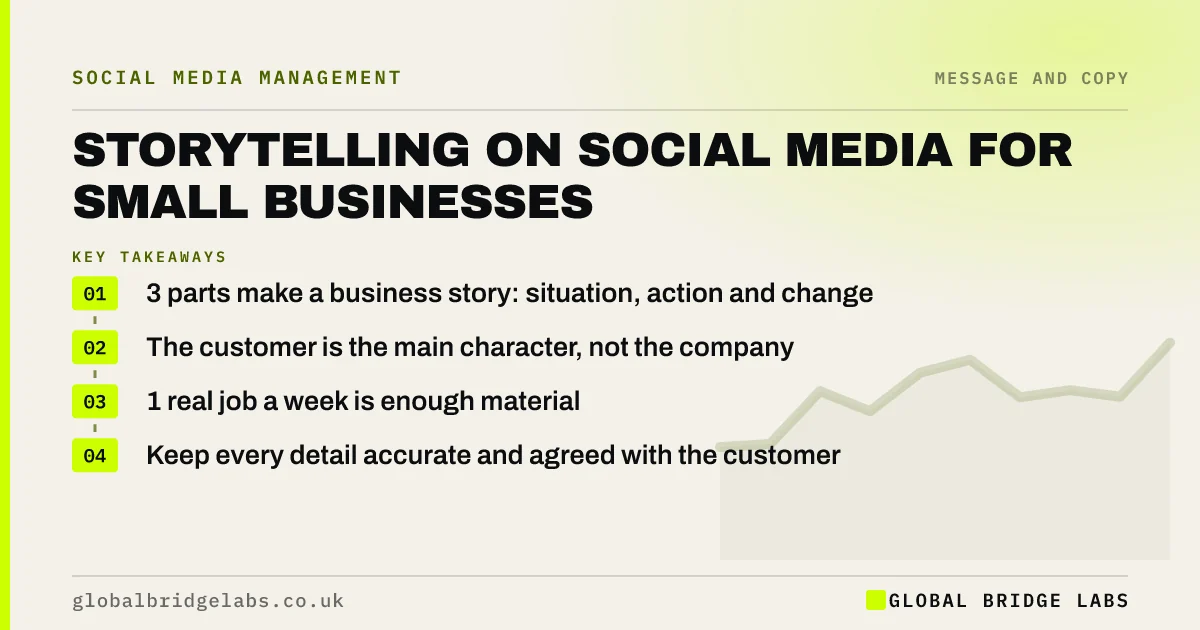
- 3 parts make a business story: situation, action and change.
- The customer is the main character, not the company.
- 1 real job a week is enough material.
- Keep every detail accurate and agreed with the customer.
Want a customer story drafted from one of your jobs? Message us on WhatsApp.
Chat on WhatsApp →What is storytelling in a business context?
Business storytelling is describing a real sequence of events so that a reader understands a problem and its solution through one example. It is not fiction and it is not a founder's memoir. It is the difference between 'we fit boilers' and 'the heating failed on Christmas Eve, and here is what happened next'.
What structure should a story follow?
Use three parts. The situation: who the customer was and what was wrong. The action: what you did, including one decision that mattered. The change: what is different now, ideally with a number or the customer's own words. Five or six sentences is enough.
- Situation: 'A nursery with a three-week waiting list for tours.'
- Action: 'We moved booking to messages and set fixed slots.'
- Change: 'Tours are booked the same day they are requested.'
Where do you find stories every week?
Find them in ordinary work. Each week ask the team three questions: which job was hardest, which customer was most relieved, and what went differently from plan. Any answer with a problem and a change is a story. Keep a running list so there is always one ready.
- The hardest job of the week.
- The most relieved customer.
- A mistake caught before it mattered.
- A question that changed how you work.
Send us this week's hardest job on WhatsApp and we will discuss your requirements.
Chat on WhatsApp →How do stories attract the right customers?
Stories attract the right customers because you choose which ones to tell. Tell stories about the kind of customer and job you want more of, and state the details that identify them: the type of property, the size of the firm, the scale of the work. Readers in the same position recognise it.
Should the owner's own story feature?
Occasionally. Why you started and what you stand for can build trust, especially for a founder-led firm. Keep it to perhaps one post in ten, and connect it to what the customer gains. A feed made mostly of the owner's journey attracts supporters more than buyers.
What must you get right legally and ethically?
Get permission before sharing a customer's story, and never embellish. Details that identify a person are personal data. Results you describe must be genuine and typical enough not to mislead. If the customer prefers anonymity, describe the type of customer and remove identifying details.
What does this look like in practice?
A pattern we see with UK small businesses: the best stories are told in the office and never posted, because nobody thinks routine work is interesting. A weekly five-minute conversation to capture one job is usually enough to keep a proof post going out every week.
Storytelling checklist
Check each story before it goes out.
- The customer is the main character.
- Situation, action and change are all present.
- The type of customer and job is clear.
- Details are accurate.
- The customer has agreed, or is anonymised.
- It ends with one next step.
Next step
Ask your team today which job last week was the hardest. Write it up in six sentences using situation, action and change.
Message us on WhatsApp for the three-part story template, or book a 30-minute consultation.
Chat on WhatsApp →Sources and further reading
- What is valid consent? · Information Commissioner's Office
- Recognising ads: social media and influencer marketing · ASA / CAP
- The Long and the Short of It: balancing short and long-term marketing strategies · IPA
Frequently asked questions
What is storytelling in social media marketing?
It is using a real sequence of events, usually a customer's problem and how it was solved, to explain what a business does. A short story is easier to remember and believe than a list of services. Keep it true and specific.
How do I tell my brand story on social media?
Tell it through customers. Share one real job each week using situation, action and change. Add an occasional post about why you started and what you care about, linked to what the customer gains. Choose jobs of the kind you want more of.
How long should a story post be?
Five or six sentences, or a video of under a minute, is enough for most stories. Longer formats such as carousels suit jobs with several stages. Keep only the details a similar buyer would need. Cut anything that does not move the story on.
Do I need permission to share a customer's story?
Yes, if the customer could be identified. Ask in writing and say where the story will appear. If they decline, describe the type of customer and remove names, addresses and images that would identify them. Keep their reply on file.
Written by

Global Bridge Labs (GBL) is a UK–Sri Lanka partner for social media, websites and BPO. Everything here comes from client delivery, not theory.