On this page
- 01Key takeaways
- 02What is a buying trigger?
- 03How do you find your triggers?
- 04What kinds of trigger are there?
- 05How do you time content to dated triggers?
- 06How do you handle undated triggers?
- 07What are the risks of trigger-based content?
- 08What does this look like in practice?
- 09Trigger content checklist
- 10Next step
- 11Sources and further reading
- 12Frequently asked questions
Key takeaways
Buying triggers are the events that turn a vague need into an active search. Content timed to triggers reaches people as they start looking. Find your triggers from past customers, sort them into dated and undated, and publish relevant content two to six weeks before the dated ones.
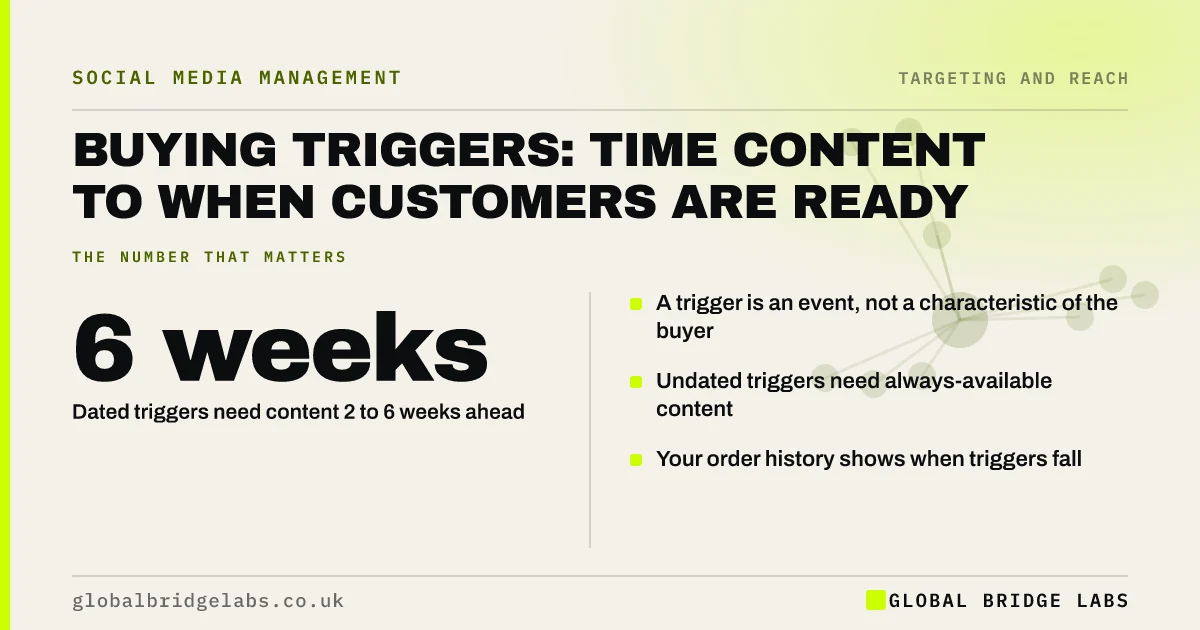
- A trigger is an event, not a characteristic of the buyer.
- Dated triggers need content 2 to 6 weeks ahead.
- Undated triggers need always-available content.
- Your order history shows when triggers fall.
Want a trigger calendar built from your sales history? Message us on WhatsApp.
Chat on WhatsApp →What is a buying trigger?
A buying trigger is a specific event that causes someone to start looking for a supplier: a boiler failing, a lease ending, a new baby, a tax deadline, a contract win. Knowing who your customer is tells you where to aim. Knowing the trigger tells you when.
How do you find your triggers?
Ask recent customers one question: what happened that made you get in touch when you did? Record the answers for 20 customers. Then check enquiry and order dates over two years for peaks. Most businesses find four to eight triggers, a few of which account for most sales.
- Ask: 'What made you contact us when you did?'
- Chart enquiries by month for two years.
- List regulatory and seasonal dates in your sector.
- Note life and business events customers mention.
What kinds of trigger are there?
There are two kinds. Dated triggers fall at a known time: seasons, deadlines, the school year, the tax year. Undated triggers happen to individuals unpredictably: a breakdown, a move, a resignation. Each needs a different content approach.
- Dated: winter, year end, exam season, renewal dates.
- Undated: breakdowns, moving house, staff leaving.
- Dated triggers suit scheduled campaigns.
- Undated triggers suit pinned and searchable posts.
Send us your busiest and quietest months on WhatsApp and we will discuss your requirements.
Chat on WhatsApp →How do you time content to dated triggers?
Publish before the trigger, not during it. Buyers research ahead, and your calendar fills ahead. Start awareness content about six weeks before, proof and pricing content about four weeks before, and booking content about two weeks before. Adjust to your own lead times.
How do you handle undated triggers?
Handle undated triggers with content that is always findable. Pin a post for the most common emergency or event, keep the wording searchable, and repeat it every few weeks. When the trigger happens to someone, your answer should already be there.
What are the risks of trigger-based content?
The risks are tastelessness and false urgency. Some triggers are distressing, such as bereavement or debt, and need restraint. Never invent a deadline. And do not go silent between triggers: most buyers are not in the market at any one time, and steady visibility is what makes the timed posts land.
What does this look like in practice?
A pattern we see with UK seasonal businesses: content about the busy season starts when the season does, by which time the diary is full and the posts bring enquiries that cannot be served. Moving the same content six weeks earlier fills the diary on better terms.
Trigger content checklist
Build this once a year.
- Twenty customers have been asked what triggered them.
- Enquiries are charted by month.
- Triggers are sorted into dated and undated.
- Dated content is scheduled two to six weeks ahead.
- A pinned post covers the main undated trigger.
- No deadline is invented.
Next step
Ask your next five customers what made them get in touch when they did. Write the answers on one page and look for the pattern.
Message us on WhatsApp for the trigger calendar template, or book a 30-minute consultation.
Chat on WhatsApp →Sources and further reading
- The 95-5 rule: most B2B buyers are out of market · LinkedIn B2B Institute
- The Long and the Short of It: balancing short and long-term marketing strategies · IPA
- Unfair commercial practices guidance (CMA207) · Competition and Markets Authority
Frequently asked questions
What is a buying trigger?
It is an event that causes someone to start looking for a product or service, such as a breakdown, a deadline, a move or a change in circumstances. It explains when a customer buys, not only who they are. Ask customers what theirs was.
What are examples of buying triggers?
Examples include a boiler failing, a lease ending, a new baby, the tax year end, winning a large contract, a member of staff leaving, moving house and a regulatory change. Each business has a handful that matter most. List yours from real enquiries.
How far ahead should I post seasonal content?
Start about six weeks before the season with awareness posts, move to proof and pricing around four weeks before, and booking posts about two weeks before. Adjust to how far ahead your customers plan. Look at when enquiries arrived last year.
How do I market to unpredictable needs like emergencies?
Keep an always-available post pinned to your profile, word it as people would search, and repeat it regularly. Make the contact route obvious. When the emergency happens, the answer is already in place. Review the wording every few months.
Written by

Global Bridge Labs (GBL) is a UK–Sri Lanka partner for social media, websites and BPO. Everything here comes from client delivery, not theory.