On this page
- 01Key takeaways
- 02Why does the goal have to come first?
- 03Which platforms suit which goals?
- 04What happens if you chase two goals on one channel?
- 05How do you judge an awareness channel fairly?
- 06When does goal-led selection break down?
- 07What does this look like in practice?
- 08What if the goal changes mid-year?
- 09Next step
- 10Sources and further reading
- 11Frequently asked questions
Key takeaways
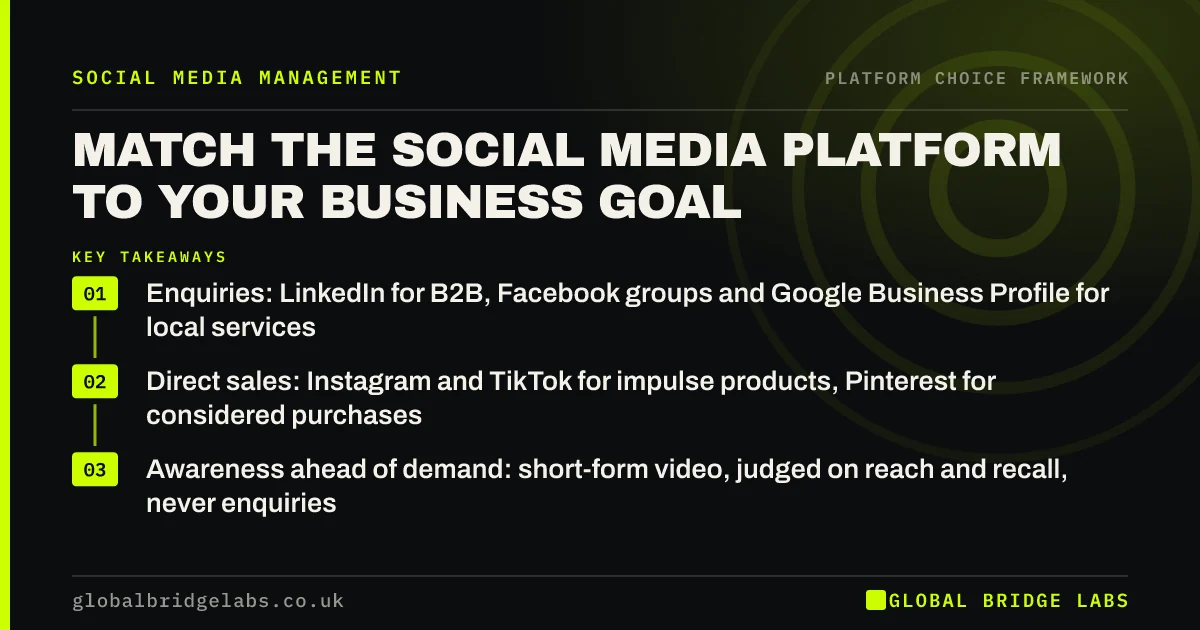
Pick the goal first and the platform second. A channel that is wrong for enquiries can be right for recruitment, and judging it on the wrong metric is how good channels get closed and bad ones get kept.
- Enquiries: LinkedIn for B2B, Facebook groups and Google Business Profile for local services.
- Direct sales: Instagram and TikTok for impulse products, Pinterest for considered purchases.
- Awareness ahead of demand: short-form video, judged on reach and recall, never enquiries.
- Recruitment: LinkedIn for experienced hires, short-form video for early-career.
- Retention and repeat business: messaging apps and email, not feed posts.
Tell us your single most important goal this year and we will name the channel for it on WhatsApp.
Chat on WhatsApp →Why does the goal have to come first?
Because the same platform performs completely differently depending on what you are asking it to do, and the metric you judge it by changes with the goal. A channel producing strong reach and no enquiries is a failure against a lead goal and a success against an awareness goal.
Most UK small businesses we meet have not written the goal down, which means every channel is implicitly being judged on enquiries. That is the harshest possible test and it eliminates channels that were doing useful work.
Which platforms suit which goals?
The mapping below holds for most UK small and medium businesses. Treat it as a starting hypothesis to test rather than a rule.
- B2B enquiries: LinkedIn primary. Judge on qualified conversations started, not impressions.
- Local consumer enquiries: Facebook groups plus Google Business Profile. Judge on calls.
- E-commerce sales: Instagram and TikTok for discovery, Pinterest for higher consideration.
- Brand awareness: short-form video. Judge on reach and branded search volume.
- Recruitment: LinkedIn for experienced roles, short-form video for apprentices.
- Customer retention: WhatsApp or a messaging channel. Judge on repeat purchase rate.
What happens if you chase two goals on one channel?
The content becomes incoherent and both goals underperform. Recruitment content and sales content speak to different people with different questions, and a feed that alternates between them teaches the algorithm and the audience that the account is about nothing in particular.
If you genuinely have two goals, the cleaner answer is one channel each, or one channel with a clearly separated surface, such as a careers page on a company profile. Do not try to serve a buyer and a candidate in the same post.
Two goals and one team? We will split them properly. Message us on WhatsApp.
Chat on WhatsApp →How do you judge an awareness channel fairly?
On leading indicators, over a longer window, and never on last-click attribution. An awareness channel's job is to make your name familiar before a need exists, and by definition that effect shows up somewhere else weeks later.
Three fair measures: branded search volume in Search Console, the proportion of enquiries that arrive already knowing what you do, and direct traffic to your site. If all three are rising while the awareness channel runs, the channel is working even though its own dashboard shows no conversions.
When does goal-led selection break down?
When the goal changes faster than the channel can mature. Social channels take roughly two to three quarters to show a reliable signal, so a business that changes its primary goal every quarter will never learn anything from any channel.
It also breaks down when the real goal is unstated. If the actual objective is that a director wants the business to look modern, no amount of metric design will make the channel assessment honest. Better to name that goal openly, budget it as brand spend, and judge it accordingly.
What does this look like in practice?
A UK recruitment-led logistics firm was running one channel for two audiences: clients who needed drivers, and drivers who needed work. Engagement was reasonable and neither audience converted well.
Splitting the goals put client content on a professional network and driver content on short-form video, with different people owning each. Total output stayed roughly the same. Applications rose sharply because candidates finally saw a feed that was about them, and client conversations improved because the professional feed stopped being half a job board.
What if the goal changes mid-year?
Keep the channel and change the metric rather than changing the channel. A platform that was serving an awareness goal can usually serve a lead goal with different content and a different call to action, and you keep the audience you spent two quarters building.
Changing channels every time the goal changes is the most expensive pattern in small business marketing, because each switch resets you to a cold start. The exception is a genuine change in who you sell to. A new buyer is a new channel question; a new goal for the same buyer usually is not.
Next step
Write one goal on a page, name the single metric that proves it, and only then choose the channel. If you cannot name the metric, the goal is not specific enough to choose a platform against, and any channel you pick will be judged unfairly.
Message us on WhatsApp with your goal and we will map it to a channel and a metric.
Chat on WhatsApp →Sources and further reading
- LinkedIn Pages best practices · LinkedIn
- Google Search Console · Google
Frequently asked questions
Which social media platform is best for generating enquiries?
LinkedIn for B2B services and Facebook groups plus Google Business Profile for local consumer services. Enquiry-led goals favour platforms where people arrive with a supplier problem to solve, rather than platforms optimised for entertainment, where reach is high and buying intent is close to zero.
Can one platform serve more than one business goal?
Rarely well. Recruitment and sales content speak to different people with different questions, and mixing them teaches both the audience and the algorithm that the account is about nothing specific. Split the goals across channels or across clearly separated surfaces.
How do you measure a brand awareness channel?
By branded search volume in Search Console, direct traffic, and the share of enquiries that already know what you do. Last-click attribution will always make an awareness channel look like a failure, because its effect appears elsewhere weeks later.
How long before a channel proves whether it suits a goal?
Two to three quarters for a reliable signal, because the first quarter mostly measures the cold-start problem every new account faces. Businesses that change their primary goal every quarter never learn anything from any channel, because none gets long enough to produce evidence either way.
Written by
Global Bridge Labs (GBL) is a UK–Sri Lanka partner for social media, websites and BPO. Everything here comes from client delivery, not theory.