On this page
- 01Key takeaways
- 02Where are UK students on social media?
- 03How does the academic calendar drive demand?
- 04What works for selling to students?
- 05What works for graduate recruitment?
- 06What should you avoid with student audiences?
- 07What does this look like in practice?
- 08How do you reach students without a big budget?
- 09Next step
- 10Sources and further reading
- 11Frequently asked questions
Key takeaways
UK students live in short-form video and closed messaging groups, and their year runs on a calendar nothing else follows. Freshers week, exam periods and term ends dictate demand far more than any campaign you plan.
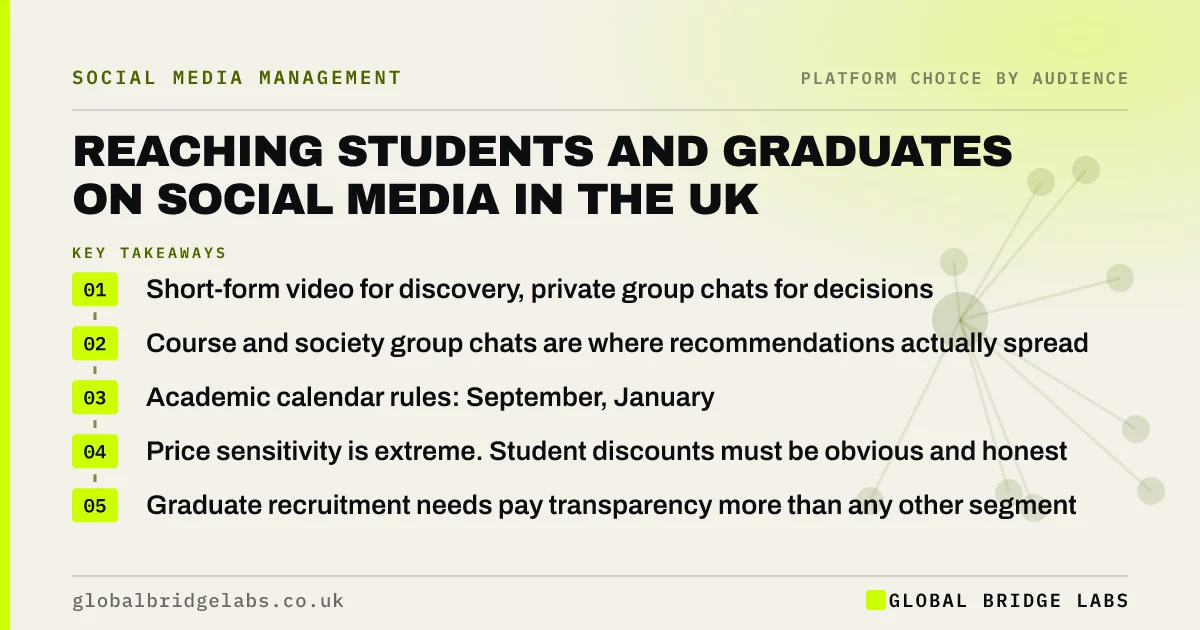
- Short-form video for discovery, private group chats for decisions.
- Course and society group chats are where recommendations actually spread.
- Academic calendar rules: September, January and exam periods drive everything.
- Price sensitivity is extreme. Student discounts must be obvious and honest.
- Graduate recruitment needs pay transparency more than any other segment.
Targeting UK students? We will plan around the academic year on WhatsApp.
Chat on WhatsApp →Where are UK students on social media?
In short-form video for discovery and in closed group chats for decisions, which means the part of the journey you can influence is the first half only.
The recommendation happens somewhere you cannot see: a course WhatsApp group, a society chat, a house group. That is not a problem to solve but a constraint to design around, by making your content easy to screenshot and forward with no context.
How does the academic calendar drive demand?
Almost completely, and a business that plans on a normal marketing calendar will miss every window. Five periods that matter more than anything else.
- Late August to September: arrival, freshers, and every recurring spending decision.
- October: societies, part-time work, and settling into routines.
- January: new term, new intentions, and second-semester decisions.
- Exam periods: demand collapses for almost everything except food and study spaces.
- March to May: graduate job decisions and summer planning.
What works for selling to students?
Honest value and obvious logistics. Student budgets are genuinely tight, so price must be visible and the discount must be real rather than a marked-up price with a percentage taken off.
Location and opening hours matter more than for almost any other audience, because students travel on foot and decide at short notice. Putting the walking distance from campus in your posts is a small detail that changes behaviour.
We will build a student-term content plan for your business. Ask on WhatsApp.
Chat on WhatsApp →What works for graduate recruitment?
Pay transparency, specificity about the actual job, and content from people who joined recently rather than from the leadership team. A graduate wants to know what a Tuesday looks like and what the starting salary is.
The most effective graduate content we see is a recent joiner describing their first three months honestly, including the parts that were hard. It is more persuasive than any employer branding campaign because it is obviously not written by marketing.
What should you avoid with student audiences?
Attempting to sound young, which fails visibly and permanently. Slang used incorrectly by a business account is screenshotted and shared as a joke, and that is not the kind of reach you want.
Also avoid vague discounts, gated offers requiring several steps, and anything requiring a desktop computer. This audience acts on a phone within about thirty seconds or not at all, and every additional step loses a large share of them.
What does this look like in practice?
A UK café near a university ran consistent content all year and could not understand why revenue swung so wildly. The content was not the variable; the campus was empty for roughly four months of the year.
Rebuilding the plan around the academic calendar, with heavy activity in September and January, minimal spend during exam periods and a shift to local residents over summer, smoothed the year considerably. The same effort produced better results by being spent when there was anyone to reach.
How do you reach students without a big budget?
Through societies, course representatives and student-run accounts, which reach further into the relevant groups than any advertising you could buy and cost almost nothing.
Sponsoring a society for a modest sum usually buys mentions in the exact group chats you cannot access, which is far better value than paid reach. So does offering something genuinely useful to a society rather than a discount code.
The other free lever is being physically present at the right moment. A stall during arrivals week produces more lasting awareness among first years than a term of posting, because it happens when every habit for the year is being set.
Student-run accounts are the third route and the cheapest. Course, society and halls accounts reach exactly the people you want and will often work with a local business for very little, particularly where there is something genuinely useful in it for their members rather than a straight advertisement.
Whatever you do, plan it around arrivals week rather than around your own marketing calendar, because that fortnight sets the habits for the whole academic year.
Next step
Put the UK academic calendar into your content plan before anything else, and mark the four weeks that matter most for your business. Then check whether your current spending is concentrated there or spread evenly across a year that is not evenly distributed.
Message us on WhatsApp and we will build your plan around the academic year.
Chat on WhatsApp →Sources and further reading
Frequently asked questions
Which platforms reach UK students?
Short-form video for discovery and closed group chats for the actual decision. You can influence the first half of that journey only, so make every post easy to screenshot and forward with no surrounding context attached.
When should you market to students in the UK?
Late August to October for arrival and the recurring spending decisions that follow it, January for the new term, and March to May for graduate roles. Demand collapses during exam periods for almost everything except food and study spaces, so plan around the academic calendar rather than a marketing one.
What works for graduate recruitment on social media?
Pay transparency, specificity about what the job actually involves, and content from people who joined recently rather than from the leadership team. An honest account of a first three months, including the difficult parts, outperforms any employer branding campaign.
What should businesses avoid when targeting students?
Trying to sound young, which gets screenshotted and shared as a joke. Also avoid vague discounts, multi-step offers and anything needing a desktop. This audience acts on a phone within thirty seconds or not at all.
Written by

Global Bridge Labs (GBL) is a UK–Sri Lanka partner for social media, websites and BPO. Everything here comes from client delivery, not theory.