On this page
- 01Key takeaways
- 02When should you add a second channel?
- 03What are the three conditions?
- 04Which second channel should you choose?
- 05How do you protect the first channel?
- 06What should the second channel be for?
- 07What does this look like in practice?
- 08How do you resource a second channel?
- 09Next step
- 10Sources and further reading
- 11Frequently asked questions
Key takeaways
Add a second channel only when the first is producing enquiries, you are replying within four working hours, and you have found at least three spare hours a week. Missing any of those three makes a second channel a way of making the first one worse.
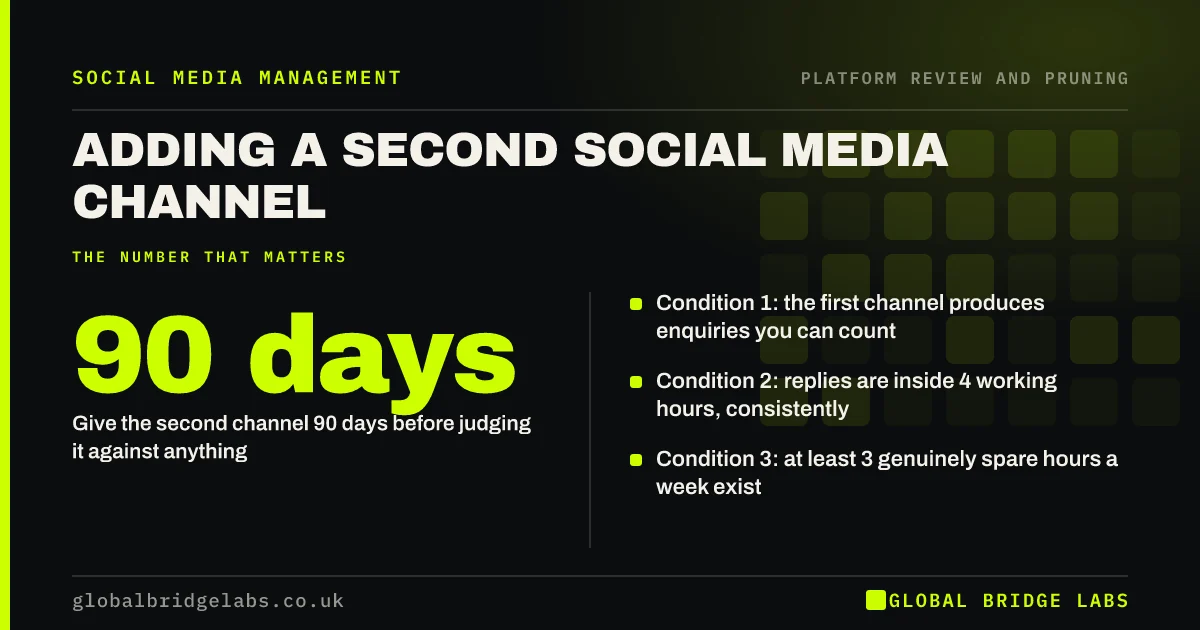
- Condition 1: the first channel produces enquiries you can count.
- Condition 2: replies are inside 4 working hours, consistently.
- Condition 3: at least 3 genuinely spare hours a week exist.
- Choose a channel that shares production with the first, not a new format.
- Give the second channel 90 days before judging it against anything.
Ready for a second channel? We will check the three conditions on WhatsApp.
Chat on WhatsApp →When should you add a second channel?
When your first channel is working and you have capacity, which is a much higher bar than most businesses apply. The usual sequence is the opposite: a second channel gets added because the first is not working, which reliably produces two channels that do not work.
If the first channel is not producing, adding a second treats the wrong problem. The issue is content, offer, audience or reply speed, and none of those are fixed by a new platform.
What are the three conditions?
All three must be true, and the third is the one people fudge.
- The first channel produces countable enquiries, not just engagement.
- Replies are consistently inside 4 working hours, including in busy weeks.
- At least 3 spare hours a week exist, tracked honestly rather than assumed.
- Nobody has spare hours by default. They come from cutting something else.
- If you cannot name where the 3 hours come from, you do not have them.
Which second channel should you choose?
The one that shares production with your first, because that is what makes the marginal cost bearable. A photo-led first channel pairs cheaply with another photo-led surface. A video-led first channel pairs cheaply with another video surface.
What is expensive is a second channel demanding a format you do not currently produce. Adding video to a text-first operation is not adding a channel, it is adding a production capability, and it should be planned and costed as such.
- Repurpose content across social media channels
- WhatsApp vs Messenger for business: which should you use?
We will pick a second channel that reuses what you already make. Ask on WhatsApp.
Chat on WhatsApp →How do you protect the first channel?
By deciding in advance that it wins every conflict. Write down that when time is short, the second channel loses the week and replies on the first are never deferred.
Also keep the first channel's cadence unchanged for the first 90 days of the second. If the first channel's output drops when the second starts, you have not added a channel, you have split one.
What should the second channel be for?
A different job from the first, or there is little point. Reaching a different audience segment, serving a different goal such as recruitment, or acting as the verification surface for people who found you elsewhere.
A second channel doing the same job as the first, for the same audience, with the same content, is duplication rather than expansion. It adds hours and adds nothing, and it is the most common form of second channel we encounter.
What does this look like in practice?
A UK joinery business had one channel producing steady enquiries and replies inside a day. It added a second channel using clips from the same workshop footage, with the explicit job of reaching trade buyers rather than homeowners.
The marginal cost was about two and a half hours a week, because the footage already existed. Within two quarters the second channel was producing trade enquiries at roughly four times the average job value. It worked because all three conditions were met and the channel had a distinct job.
How do you resource a second channel?
From a decision, not from goodwill. The hours have to come from somewhere nameable: an existing channel, a cut elsewhere, an outsourced arrangement, or a genuine change in someone's job.
Hoping someone absorbs it is the most common failure mode, and it fails quietly. What happens is that the second channel gets the enthusiasm for six weeks, the first channel gets the neglect, and by month four both are worse than the single channel was.
If you cannot name where the hours come from, the honest position is that you are not adding a channel. You are proposing that somebody works longer, which is a different conversation and deserves to be had openly.
Revisit the answer at week six, when the initial enthusiasm has worn off and the real cost is visible.
Next step
Check the three conditions honestly before you do anything else. If your first channel is not producing enquiries or your replies take more than a day, fix that instead. A second channel will not rescue a first channel that is not working.
Message us on WhatsApp and we will check whether you are ready for a second channel.
Chat on WhatsApp →Sources and further reading
- Meta Business Help Centre · Meta
- LinkedIn Pages best practices · LinkedIn
Frequently asked questions
When should a business add a second social media channel?
Only when the first produces countable enquiries, replies are consistently inside four working hours, and at least three genuinely spare hours a week exist. Adding a second because the first is failing produces two failing channels.
Which second social channel should you choose?
One that shares production with your first, so the marginal cost is bearable. A second channel demanding a format you do not currently produce is adding a production capability, not a channel, and should be costed that way.
How do you stop a second channel damaging the first?
Decide in advance that the first wins every conflict, never defer its replies, and keep its cadence unchanged for the second channel's first 90 days. If the first channel's output drops, you split one channel rather than adding one.
What should a second social media channel be for?
A different job from the first: a different audience segment, a different goal such as recruitment, or a verification surface for people who found you somewhere else. Duplicating the first channel's job for the same audience adds hours and adds nothing.
Written by
Global Bridge Labs (GBL) is a UK–Sri Lanka partner for social media, websites and BPO. Everything here comes from client delivery, not theory.