On this page
- 01Key takeaways
- 02Why do advertising myths spread?
- 03Which myths are about social media?
- 04Which myths are about traditional advertising?
- 05Which myths apply to both?
- 06What does the evidence say?
- 07What do these myths cost?
- 08How do you avoid being caught by a myth?
- 09Is there any truth in the myths?
- 10What does this look like in practice?
- 11Next step
- 12Sources and further reading
- 13Frequently asked questions
Key takeaways
Most advertising myths share one fault: they replace your own evidence with a general rule. Social media is not free, print is not dead, and a bigger audience is not a better one. The firms that spend well test small, track honestly and ignore slogans.
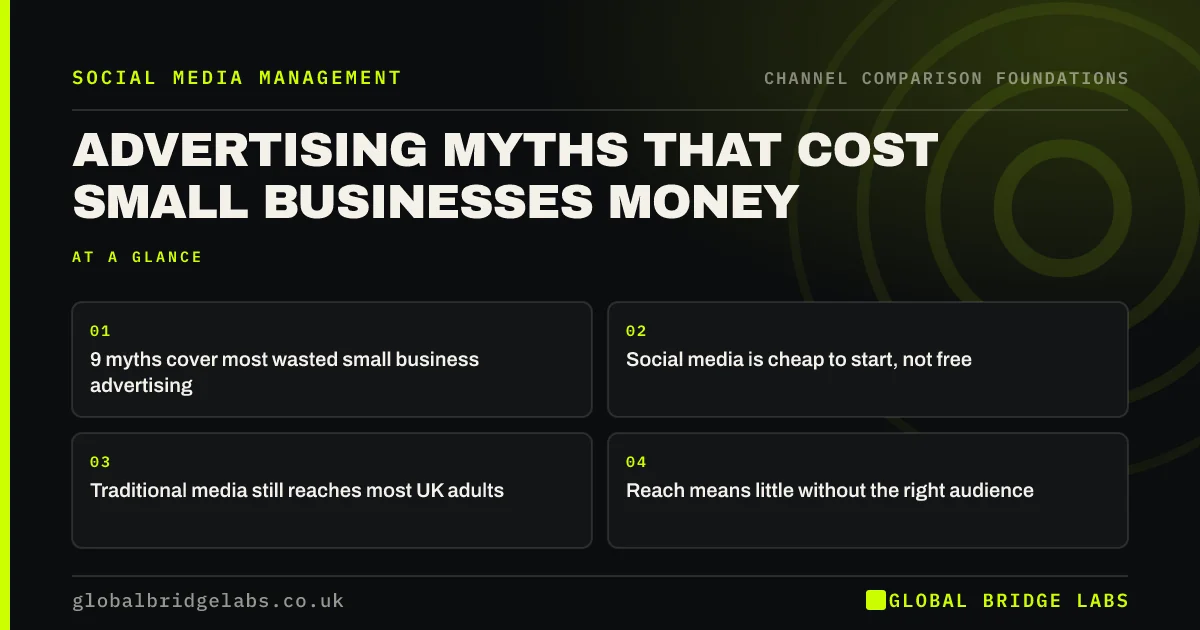
- 9 myths cover most wasted small business advertising.
- Social media is cheap to start, not free.
- Traditional media still reaches most UK adults.
- Reach means little without the right audience.
Heard a claim from a sales rep you are unsure about? Message us on WhatsApp and we will check it.
Chat on WhatsApp →Why do advertising myths spread?
Advertising myths spread because most are convenient for somebody. Media sellers favour their own medium, platforms favour their own tools, and business owners favour whatever they bought last year. A myth is any rule that lets you skip checking what happened to your own money.
Which myths are about social media?
Three myths lead small firms to expect too much from social media for too little.
- 'It is free.' Time is the cost, at about £16.27 an hour or more.
- 'More followers means more sales.' Fit matters more than size.
- 'You must be on every platform.' One done well beats five ignored.
Which myths are about traditional advertising?
Three myths push firms to dismiss or overbuy traditional media.
- 'Nobody reads print or listens to radio.' UK audiences remain large.
- 'It cannot be measured.' A code or number measures it well enough.
- 'The rate card is the price.' Most rates can be negotiated.
Which myths apply to both?
Three myths cause trouble in any medium.
- 'One advert will show whether it works.' Most media need repetition.
- 'Bigger reach is better.' Reach outside your market is waste.
- 'Good products sell themselves.' Not to people who have never heard of you.
What does the evidence say?
Ofcom's 2026 research shows both sides of the picture: 89% of adult internet users use social media, and just under nine in ten adults still hear live radio each week. The Advertising Association and WARC report that more than four-fifths of UK ad spend is now online. Large audiences exist everywhere. Your buyers are in only some of them.
What do these myths cost?
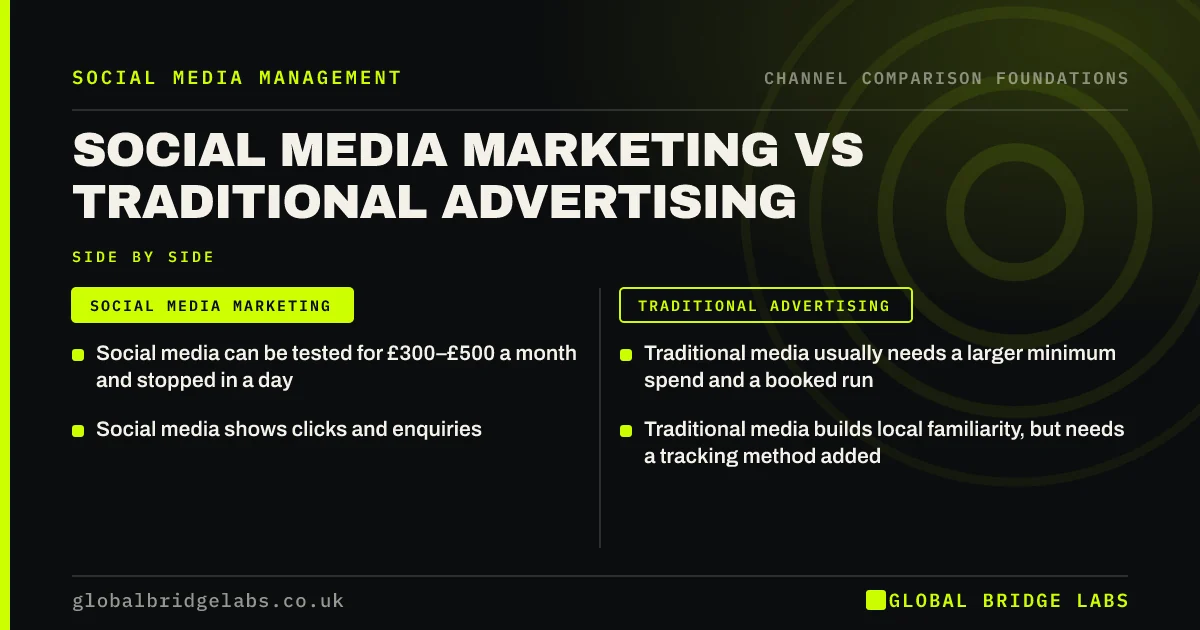
The cost is usually a renewal nobody questioned or a channel abandoned too early. A £600 annual advert kept for five years on a myth is £3,000. A social account dropped after one quiet month wastes the hours already put in. Testing is cheaper: paid social can be trialled from £300–£500 a month.
- Advertising mistakes small businesses make, and the fixes
- How to test an advertising channel in six weeks
Want your current spend checked against the evidence? Message us on WhatsApp and we will discuss your requirements.
Chat on WhatsApp →How do you avoid being caught by a myth?
Ask three questions of any advertising claim. Who benefits if I believe it? What would my own customers say? How would I know within eight weeks? If a claim cannot survive those, it should not decide your budget.
- 1. Ask who gains from the claim.
- 2. Ask 20 customers what they notice.
- 3. Run a small tracked test.
- 4. Decide on your figures.
Is there any truth in the myths?
Usually a little, which is why they last. Social media can be done with no media spend. Some printed titles have lost most of their readers. A single advert does occasionally work. The mistake is treating a sometimes as an always.
What does this look like in practice?
A pattern we see in first conversations with owners: one firm belief, held for years, is steering the whole budget. It might be that customers are too old for social media, or that leaflets go straight in the bin. A ten-minute check against recent customers often overturns it.
Next step
Write down the one thing you are sure of about your advertising. Then ask your next ten customers whether it is true.
Message us on WhatsApp with what you find and we will help you act on it, or book a 30-minute consultation.
Chat on WhatsApp →Sources and further reading
Frequently asked questions
Is social media marketing really free?
No. Opening an account is free, but creating posts, replying to messages and reviewing results takes hours each week, and most businesses need some paid promotion to reach new people. Count staff time at its real hourly cost before calling any channel free.
Is it true that nobody reads leaflets?
No. JICMAIL panel data for early 2026 found the average door drop is kept in the home for 5.6 days and looked at about three times. Many are discarded, but enough are read for a well-aimed leaflet to pay, provided the offer is clear and the area is right.
Do more followers mean more customers?
Not reliably. A few hundred followers who live in your area and need your service are worth more than thousands who do not. Judge social media on enquiries from the right people, not on the follower count. Ask new enquirers whether they follow you, and you will see how loosely the two are linked.
Can you really measure traditional advertising?
Yes, well enough to decide. A unique phone number, an offer code, a short web address or simply asking every enquirer how they heard of you will show whether a printed or broadcast advert is producing a response.
Written by

Global Bridge Labs (GBL) is a UK–Sri Lanka partner for social media, websites and BPO. Everything here comes from client delivery, not theory.