On this page
- 01Key takeaways
- 02How do you decide which channels to keep?
- 03What evidence should you use?
- 04How long is long enough before cutting?
- 05What about channels that protect your brand?
- 06What is the cost of keeping too many?
- 07What does this look like in practice?
- 08Who should make the decision?
- 09Next step
- 10Sources and further reading
- 11Frequently asked questions
Key takeaways
Keep a channel only if it produces enquiries, protects your name in search, or is where your buyers verify you. Everything else is habit. Most UK small businesses can close one or two channels today and lose nothing.
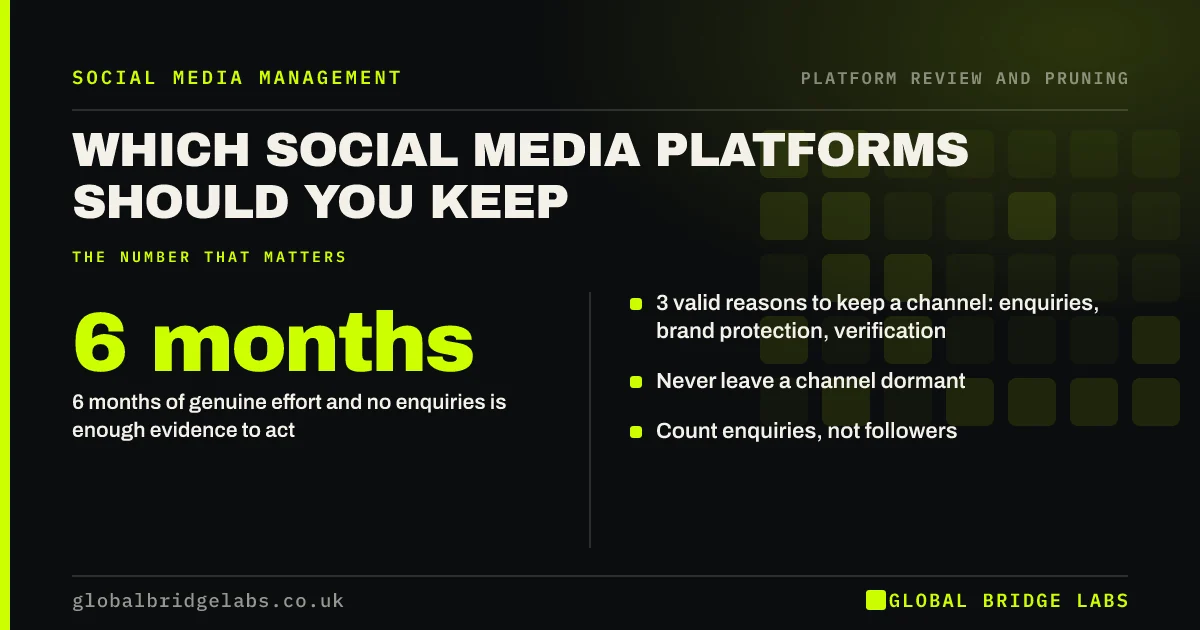
- 3 valid reasons to keep a channel: enquiries, brand protection, verification.
- 6 months of genuine effort and no enquiries is enough evidence to act on.
- Never leave a channel dormant. Close it properly or maintain it minimally.
- Count enquiries, not followers. The two frequently point in opposite directions.
- The review takes an hour. Most businesses have been avoiding it for years.
Want a straight answer on which channels to cut? Message us on WhatsApp.
Chat on WhatsApp →How do you decide which channels to keep?
Score each one against three questions and keep it only if the answer to at least one is a clear yes. Does it produce enquiries? Does it protect your name when someone searches for you? Is it where your buyers verify you before they buy?
A channel that fails all three is costing you hours and producing nothing. Keeping it usually has nothing to do with evidence and everything to do with the discomfort of admitting a year was spent on the wrong thing.
What evidence should you use?
Data you already have, which is why this review takes an hour rather than a quarter. Five sources, all free.
- Your last 30 enquiries and where each one came from. Ask if you did not record it.
- Website referral traffic by social source, and whether those visits convert.
- Direct message volume per channel over the last 90 days.
- Time spent per channel, tracked honestly for two weeks.
- What appears when you search your own business name.
How long is long enough before cutting?
Six months of genuine, consistent effort. Less than that and you are judging inconsistency rather than the channel. More than that and you are paying for the decision you have already made.
Genuine effort means the cadence the platform requires, replies within a working day, and content adapted for the format. A channel that received three posts a month and no replies has not been tested, and closing it teaches you nothing.
Not sure whether you gave a channel a fair run? We will tell you on WhatsApp.
Chat on WhatsApp →What about channels that protect your brand?
Keep them, at near-zero effort. A profile that ranks for your business name and confirms you are a real, trading business is doing a job even though it produces no enquiries.
The maintenance standard is low: a complete bio, a current description, a pinned post directing people to where you are active, and a photograph from this year. That is perhaps 20 minutes a quarter, which is a fair price for controlling what appears when someone searches your name.
What is the cost of keeping too many?
Slower replies on the channels that matter, cross-posted content that performs worse everywhere, and the gradual erosion of the two channels you should be protecting. The fourth channel rarely fails on its own; it takes the first two down with it.
There is also a morale cost that rarely gets named. A person responsible for five channels they cannot maintain will quietly disengage from all of them, and that is harder to recover from than any algorithm change.
What does this look like in practice?
A UK independent travel agency maintained five channels with one part-time person. The review took 45 minutes and showed that 28 of the last 30 enquiries came from two sources: a Google Business Profile and one social channel.
Two channels were closed with pinned redirects, one was kept at maintenance level for brand protection, and the freed hours went into replying faster on the channel that was actually producing. Content volume halved and enquiries rose in the following quarter.
Who should make the decision?
The person who will live with it, with the person who hears where enquiries come from in the room. In most UK small businesses that is the owner and whoever answers the phone, which is a more useful pairing than it sounds.
Avoid making it a marketing decision alone. The person who built a channel is the worst placed to judge whether it should close, not because they are dishonest but because three years of effort is genuinely hard to set aside.
Write the decision down, including the reasoning, so that in six months nobody relitigates it from memory. Channel decisions that get quietly reversed are how businesses end up back at five accounts.
Diary the next review at the same time so it stays a rhythm rather than a crisis.
Next step
Block one hour, pull your last 30 enquiries, and write down where each came from. The decision will usually make itself, and the only difficult part is acting on an answer you probably already suspected.
Message us on WhatsApp and we will run the channel review with you in an hour.
Chat on WhatsApp →Sources and further reading
- Google Search Console · Google
- Google Business Profile Help · Google
Frequently asked questions
How do you decide which social media channels to keep?
Keep a channel only if it produces enquiries, protects your name in search, or is where buyers verify you before purchase. A channel failing all three is costing hours and producing nothing, whatever its follower count says.
How long should you try a channel before closing it?
Six months of genuine effort, meaning the cadence the platform actually requires, replies within a working day, and content adapted to the format rather than cross-posted. Anything less tests your own inconsistency rather than testing the channel.
Should you keep social accounts you do not use?
Keep them at maintenance level if they rank for your business name: a complete bio, a current description, a pinned redirect and a photograph from this year, about 20 minutes a quarter. Never leave one visibly dormant, because that is worse than not having it.
What does keeping too many channels actually cost?
Slower replies on the channels that matter, cross-posted content that performs worse everywhere, and erosion of your best two. There is also a morale cost: someone responsible for five unmaintainable channels disengages from all of them.
Written by
Global Bridge Labs (GBL) is a UK–Sri Lanka partner for social media, websites and BPO. Everything here comes from client delivery, not theory.